

Coating thickness meter Lonroy
With the continuous advancement of technology and the increasing diversity of materials and manufacturing processes, coating thickness measurement has become a crucial factor in ensuring the quality and performance of products. In the past, this measurement process was often carried out manually, requiring significant effort and time. However, thanks to technological progress, coating thickness gauges have emerged as essential tools for quickly and accurately measuring coating thickness on various surfaces.
In this article, EMIN will introduce the importance and necessity of coating thickness gauges in modern industry.

What is a Coating Thickness Gauge?
One indispensable tool in the coating industry is the ultrasonic coating thickness gauge, which allows users to measure paint film thickness without causing damage to the material. Measuring dry film thickness is one of the most critical factors in the coating field, as it directly affects the coating process, product quality, and overall cost.
Dry film thickness measurement not only helps estimate the expected service life of a coating, but also plays an important role in evaluating the appearance and performance of the finished product. By using a coating thickness gauge, industries can ensure compliance with international standards, guaranteeing both the quality and durability of protective coatings.
How Does a Coating Thickness Gauge Work?
In industrial applications, the dry film thickness of coatings can be measured on magnetic steel surfaces or on non-magnetic metal substrates such as stainless steel or aluminum using a digital coating thickness gauge. Two main principles are commonly applied in this measurement process:
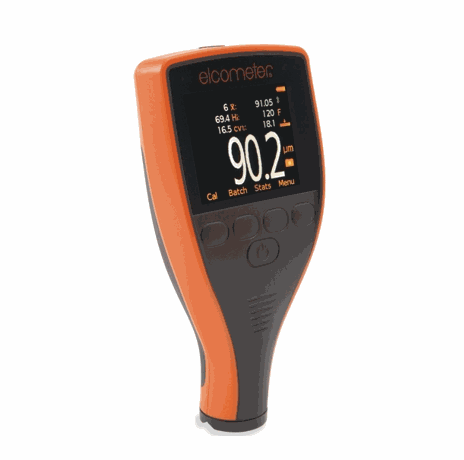
The electromagnetic induction method is used for non-magnetic coatings applied on magnetic substrates such as steel. During measurement, the gauge generates an alternating current through an induction coil. When the coil passes over the coating layer, the alternating current produces a magnetic field that interacts with the conductive properties of the coating. Based on changes in the magnetic field, the gauge calculates and displays the coating thickness.
The eddy current method is used for non-conductive coatings applied on non-ferrous metals such as aluminum. During measurement, the gauge generates eddy currents within the probe coil placed on the metal surface. These currents create a magnetic field inside the substrate, and the interaction between this field and the coating’s conductivity allows the instrument to determine the coating thickness.
By applying digital coating thickness gauges based on electromagnetic induction or eddy current principles, industries can accurately measure coating thickness on various metal surfaces. This ensures product quality and durability, while also supporting process control, production monitoring, and maintenance activities.
The Importance of Coating Thickness Gauges
First, coating thickness measurement helps ensure the quality of the final product. Coating thickness is a key parameter for evaluating uniformity and meeting technical requirements. If the coating is too thin, it may not provide sufficient protection against external factors such as corrosion, chemicals, or impact. On the other hand, if the coating is too thick, it may cause problems such as cracking, surface defects, or failure to meet requirements related to weight, insulation, or electrical resistance.
Second, coating thickness measurement provides essential information for production process control. It helps monitor coating performance and ensures that the coating is applied according to the correct procedures and standards. By tracking coating thickness, manufacturers can adjust application time, pressure, and coating methods to achieve the desired results.
Conclusion
Coating thickness gauges have become indispensable tools in modern industry. Measuring coating thickness ensures product quality and performance, thereby improving durability, reliability, and overall value. By selecting the appropriate coating thickness gauge and adhering to industry standards, manufacturers can achieve greater accuracy and efficiency in both production and maintenance processes.
-
-
-
-
-
-
-
-
-
-
-
-
-
-
-
-
-
-
-
-
-
-
-
-