The answer is that there are two common types of power supplies: linear power supplies and switching power supplies.
So is it a linear source? Switching power
Linear power and switching power are both electrical devices used to power and charge DC electronic devices. They have two main functions: voltage lowering and AC to DC conversion. Although both perform power lowering and rectification, the way they do it is different. This results in each type of source being more suitable for specific applications.
Linear sources are used for low noise and high accuracy. With the use of heavy transformers and analog filters, a linear source produces clean voltage at low cost, however, its size and weight are greater. This type of source is best suited for recording equipment, electric musical instruments, medical equipment, and high-precision laboratory measuring instruments.
Switching power supplies (SMPS) are used for applications requiring high performance and large current. Unlike linear sources, SMPSs regulate voltage with semiconductor components, using power transistors for high-frequency switching. This makes SMPS energy efficient, light and compact, although they can be noisy. SMPS are commonly used in computers, phone chargers, manufacturing equipment, and many electronic devices that require low voltage.
How does a linear source work?
Based on popular analog components from the 50s, using large transformers and capacitors to step down and rectify the voltage. Although transistors were widely used, high AC voltages caused too much heat for transistors to handle. Therefore, linear sources rely on high-power components to ensure performance and reliability in providing clean voltage.
Diagram of 1 linear source:
Step 1: Use a transformer to step down the high AC voltage to a lower level.
Step 2: The lowered voltage then passes through the rectifier to convert the AC voltage into a DC voltage pulse.
Step 3: The DC voltage pulse passes through a filter consisting of inductors and capacitors to eliminate fluctuations, creating a stable DC voltage suitable for sophisticated electronic devices.
Product reference: Linear DC power source GW INSTEK GPR-30H10D (300V, 1A, 300W)
How switching power works
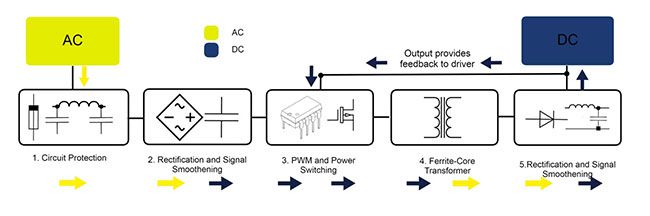
Switching power supplies (SMPS) are complex devices that use semiconductor components to perform high-frequency power switching through a compact ferrite core transformer. These types of sources have the ability to raise and lower the voltage by using a DC feedback loop to control the output voltage.
Step 1: High-voltage AC current enters the power supply through a circuit protection module that includes a fuse and an EMC filter. The fuse protects the circuit from overvoltage, while the EMC filter suppresses interference waves from unfiltered AC power.
Step 2: Once the circuit is protected, the high AC voltage is passed through a second module consisting of a bridge rectifier and smoothing inductor. The bridge rectifier converts AC to DC, then this DC signal is processed through a capacitor for smoothing.
Step 3: The next high-voltage DC is sent through the PWM driver, which receives feedback and controls the power MOSFET to regulate the voltage through high-frequency conversion, generating a DC square wave.
Step 4: The DC square wave is passed through the ferrite core transformer to convert the signal into an AC square wave.
Step 5: The AC square waves pass through a bridge rectifier to convert into DC pulses, then through a filter for smoothing. The final output is sent back to the PWM driver creating a feedback loop to regulate a stable output voltage.
Refer to the product at: GW INSTEK SPS-606 Switching DC Power Supply (60V, 6A, 1CH)
Difference between linear source and switching source
There are many different reasons for choosing a specific power source for applications. These factors typically include performance, noise, reliability, maintainability, size, weight and cost. Now you have an overview of how these types of sources work. Here's how they handle power, affecting performance and usability in certain applications.
Effective
The rectification and voltage regulation process always suffers from some degree of inefficiency because the current must pass through a series of electrical and electronic components. But what is the specific effect?
Depending on their rating, switching power supplies can reach 80 – 92% efficiency. This means your device can generate 80 – 92% of its power from the input power. This efficiency is achieved through the use of small but effective components to regulate voltage through high-frequency low-voltage switching.
In contrast, linear sources can only convert 50 – 60% of the energy, due to the use of larger and less efficient components.
Interference signal
Although the efficiency is not high, the linear source compensates for this weakness by providing a stable, clean, low-noise signal output. Using linear power for analog components allows for smooth and switching-free power handling, resulting in output with little noise.
In contrast, switching power supplies rely on high-frequency switching of low voltages to reduce heat and increase efficiency, but generate more noise. The level of signal noise depends on the design and quality of the switching power supply.
Size and Weight
The size and weight of a power source can greatly influence its applicability in small electronic devices. Linear power supplies, with their heavy and bulky components, cannot fit into electronic devices with limited space, unless used as an external charger.
Meanwhile, switching power supplies use small and lightweight components, allowing for designs compact enough to be integrated into already small devices. The light weight and small size of switching power supplies, coupled with their high power efficiency, make them suitable for most portable electronic devices.
Repair ability
Linear sources have fewer parts that are likely to fail during operation, providing stable and reliable output. The simple design and use of common electronic components make it easy to find parts and make repairs.
In contrast, switching sources have more delicate components, making them more likely to fail than linear sources. However, good design and use of quality components can make switching sources very reliable, even comparable to linear sources. The main problem with switching power supplies is that they are more difficult to repair due to their complex design.
Conclude
Above is all the information about linear sources and switching sources. To ensure electronic devices are always in good use, use the original charger that came with the device. If you don't have one, you can purchase a suitable external charger.
Before buying, remember that linear power supplies are suitable for devices that require high precision such as electric musical instruments, radios, and medical instruments. Meanwhile, switching power is used for applications that require high efficiency such as computer power supplies, chargers, and lighting systems.