Thanks to the rapid advancement of sensor technology, these devices are increasingly optimized in terms of accuracy, durability and integration capabilities, thereby expanding the scope of applications in industrial production, materials research, medicine and many other areas of life.
What are tension and compression force sensors used for?
The load cell is a specialized device used to determine the force acting on an object in the form of tensile or compressive force. Thanks to its accurate and stable response, this sensor is widely used in both industry and in-depth research. The purpose of use includes:
- The device helps to record and display tensile and compressive forces accurately in real time, thereby supporting applications that require high stability such as presses, material testing machines, tightening force testing systems, etc.
- Force sensors allow to evaluate the load-bearing capacity of components, structures or finished products, ensuring that the product meets mechanical standards before being put into use.
- In modern production lines, sensors are integrated with controllers or PLCs to automatically monitor the impact force, adjust according to programming and detect deviations immediately.
- Thanks to the ability to warn when the force exceeds the threshold, the sensor helps to minimize the risk of equipment damage, limit incidents and prolong the life of mechanical systems.
- In the laboratory, force sensors are indispensable devices for collecting data in mechanical experiments, material analysis, deformation simulation or load characterization.
Practical applications of tension and compression force sensors in industry and life
The load cell is an important device in modern measurement systems, used to accurately record the force applied in both directions: tension and compression. Thanks to its fast response, high accuracy and stable durability, the load cell is present in many different fields, from industrial production, construction to medicine, transportation and daily life. Here are some common applications:
1. In industrial production
Industrial electronic weighing system: Force sensors are installed in conveyor scales, floor scales or hopper scales to determine the mass of raw materials during the packaging and transportation process, helping to manage goods more accurately and effectively.
Product quality measurement: Applied in tensile/compression testing machines, pressure testing equipment to evaluate the bearing capacity of materials such as metal, plastic, rubber, etc.
Integrated in automation: Used to monitor the impact force of robot arms during assembly, gluing, welding, and screw tightening operations, ensuring the correct force and not damaging components.
2. In the construction and structural industry
Structural load capacity monitoring: Attach sensors to columns, beams or concrete slabs to monitor actual compressive force/load to assess the life and stability of the structure.
Bridge and road load monitoring: Integrate sensors into vehicle weighing stations to control traffic and detect overload risks, contributing to protecting traffic infrastructure.
3. In the medical field
Rehabilitation exercise machine: Sensors help control and adjust the force applied to muscles and joints during physical therapy exercises, supporting recovery after injury.
Specialized medical scales: Integrated in a weighing chair or weighing bed to measure the weight of patients who cannot stand, serving treatment and health monitoring.
4. In transportation and logistics
Vehicle load scale: Used in dynamic weighing station systems/axle weighing stations to accurately determine vehicle weight, ensuring that it does not exceed the allowable load.
Cable tension monitoring: Used in cranes, hoists or traction systems to ensure appropriate tension, prevent breakage and unsafe operation.
Some common errors when using tension and compression force sensors
To ensure the stable and durable operation of the device, users need to recognize and avoid the following common technical errors:
- Wrong direction or wrong position
The sensor is not installed on the correct force axis or is mounted off the working plane, which can cause serious errors. The device must be properly fixed and in the correct direction of the designed force to ensure accurate measurement results.
- Overload beyond the allowable limit
If the sensor is subjected to a force exceeding the rated measuring range, the sensor element may be permanently deformed or completely damaged. The user must select the correct type of sensor with the appropriate load and have an overload protection mechanism when necessary.
- Electrical signal interference
Electromagnetic interference from nearby devices such as inverters, motors or power systems can distort the measurement signal. Solutions include using shielded cables, installing filters or shielding the signal appropriately.
- Wear and tear over time
Sensors may experience mechanical fatigue, reduced sensitivity or increased error after long periods of continuous load. Periodic calibration and periodic inspection help detect potential damage in a timely manner.
- Effects from the working environment
Environments with high temperatures, high humidity, dust or corrosive chemicals can reduce the durability and accuracy of the sensor. Choosing a sensor with a high protection level (IP67, IP68...) or adding a protective cover is necessary in harsh conditions.
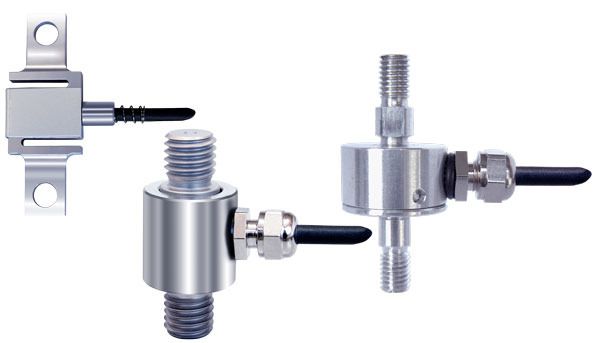
You can refer to some of the following tension and compression force sensor products: