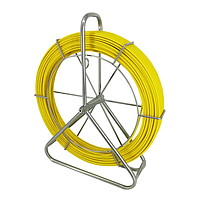
Fiberglass Cable Duct Rodder
When cable installation has to pass through long conduit runs, bends, underground ducts, or partially occupied pathways, a rigid and traceable guide tool becomes essential. Fiberglass Cable Duct Rodder products are widely used to help technicians route pulling lines through duct systems before the actual cable is installed, improving control during utility, telecom, and electrical work.
In practical field applications, the right rodder helps reduce downtime during cable laying, especially where access is limited or the route includes multiple turns. This category focuses on rodder solutions designed for duct guidance, pull-line feeding, and related cable installation tasks in demanding jobsite conditions.

Where fiberglass duct rodders are typically used
A fiberglass duct rodder is commonly selected when installers need to feed a line through conduit, underground duct banks, pipe networks, or cable pathways that cannot be reached directly by hand. The rod provides a balance between flexibility and push strength, allowing it to travel through curved sections while still maintaining forward movement over distance.
These tools are relevant across power distribution, communications infrastructure, industrial facilities, and site maintenance work. In many projects, the rodder is used as a first-step installation aid before traction tools, clamps, or cable pulling accessories are brought into the process. For teams working in a broader cable-handling workflow, it can also be useful to explore related hot stick equipment where electrical safety and line access are part of the job context.
Why fiberglass is a practical material for duct rodding
The main advantage of fiberglass rod construction is its combination of light weight, tensile capability, and controlled flexibility. Compared with improvised methods, a purpose-built rodder is easier to manage over longer distances and better suited for repeated deployment in field environments.
Fiberglass also supports stable handling in conduit applications where the rod must push forward without collapsing too easily at bends. Depending on the model, users may prioritize diameter, bend radius, reel size, and tensile performance to match the duct size and expected route complexity. This is especially important when selecting between lighter rodders for smaller ducts and heavier rods for longer or more resistant pathways.
How to choose the right model for your application
Selection usually starts with the duct route itself. Smaller diameters can be easier to handle in tighter bends and lighter-duty conduit runs, while larger diameters may offer more push strength for demanding paths. Length should be matched to the actual installation route, with enough margin for handling and retrieval rather than choosing only by maximum reach.
For example, the BILO 10mm*350m Fiberglass Cable Duct Rodder may suit long-distance routing where extended reach is a priority, while the BILO 14mm*200m and BILO 14mm*300m versions are more aligned with users who want a heavier rod profile for stronger pushing behavior. If the installation route involves larger ducts or tougher feeding conditions, a model such as the BILO 16mm*250m Fiberglass Cable Duct Rodder may be more appropriate within the available range.
Representative options in this category
This category includes multiple BILO rodder configurations covering different diameter and length combinations. Examples include 11mm*300m, 12mm*300m, 13mm*250m, 14mm*200m, 14mm*300m, and 16mm*250m variants, giving buyers a practical range for matching route distance and handling preference.
Across these models, key differences relate to rod diameter, reel format, weight, bend radius, and tensile characteristics. Rather than focusing only on one specification, buyers should consider the full installation scenario: duct diameter, number of bends, route length, access points, and whether the rod will mainly be pushed, pulled, or used to carry a leader line for the next installation stage.
Role in the overall cable installation workflow
A duct rodder is not usually the final pulling device; it is part of a broader installation sequence. In typical use, the rod is first passed through the duct, then used to introduce a pull line or guide line, after which cable pulling tools can be applied. This makes the rodder a foundational tool for improving efficiency and reducing trial-and-error during cable routing.
Where stronger traction is needed after the guide line has been established, teams may pair the process with dedicated pulling hardware. For that reason, some buyers reviewing this category may also compare it with products such as the BILO JXRS-05, JXRS-10, JXRS-15, JXRS-20, or JXRS-30 ratchet cable pullers, which are intended for fixation, traction, and lifting tasks in related workflows rather than for duct probing itself.
Operational and safety considerations
Even a well-matched rodder should be used with attention to route condition and field safety. Installers typically assess the duct for obstruction, moisture, sharp edges, and bend severity before feeding the rod. Controlled deployment helps reduce unnecessary stress on the rod while improving line accuracy through the conduit.
Because many cable installation jobs are performed around energized environments or utility infrastructure, jobsite protection remains important alongside tool selection. Depending on the maintenance environment, suitable PPE and protective accessories such as insulating gloves and insulating boots may also be relevant when electrical exposure risks are part of the work area.
What buyers often compare before ordering
For procurement teams and maintenance planners, the most useful comparison points are usually rod diameter, total length, reel portability, and expected duct compatibility. A longer rod is not always the better choice if the reel becomes harder to transport or if the route mainly consists of short service runs. Likewise, a thicker rod may offer stronger push performance but can be less suitable for tighter bends or smaller conduits.
It is also worth considering how often the tool will be used and whether it needs to support occasional maintenance work or frequent installation activity. For organizations standardizing cable-routing tools across multiple field teams, choosing a small number of well-targeted rodder sizes often provides better operational consistency than buying many overlapping variants.
Choosing with application fit in mind
The best results usually come from matching the rodder to the route, not just to a headline specification. A compact-diameter model can be practical for tighter conduits and long feeding distances, while larger-diameter versions are often preferred where more pushing rigidity is needed. Reviewing length, bend behavior, handling weight, and worksite conditions together will lead to a more reliable choice.
This Fiberglass Cable Duct Rodder category is intended for buyers who need dependable duct-routing tools for cable installation and line feeding work. If you are comparing options for conduit access, underground cable preparation, or pull-line setup, the available BILO models provide a useful starting point for selecting the right balance of reach, flexibility, and field handling.
Get exclusive volume discounts, bulk pricing updates, and new product alerts delivered directly to your inbox.
By subscribing, you agree to our Terms of Service and Privacy Policy.
Direct access to our certified experts