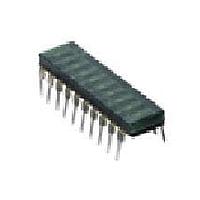
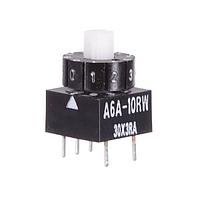
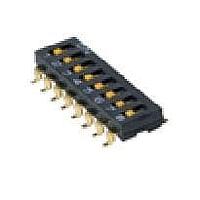
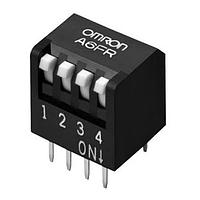
DIP / SIP Switches
Small configuration choices often need to stay reliable for years, even when a device has no display, no keyboard, and limited space on the PCB. In those cases, board-mounted switches remain a practical way to set addresses, select modes, enable features, or store basic hardware options directly in the product design. DIP / SIP Switches are widely used for exactly that role in industrial electronics, communications equipment, embedded control boards, and serviceable field devices.
Why DIP and SIP switches are still relevant
Although many settings can now be programmed in software, physical configuration components still matter in applications where technicians need a simple, visible, and repeatable way to define operating parameters. A DIP or SIP switch can provide a direct hardware setting without requiring firmware access, additional interfaces, or special tools.
This makes them especially useful during commissioning, servicing, or product customization. In many designs, they are chosen for tasks such as address selection, operating mode setup, feature enable/disable control, or maintenance-level configuration where a compact manual switching interface is more practical than a more complex input method.
Typical forms and mounting options
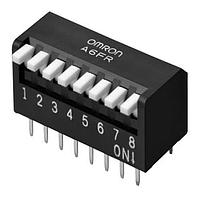
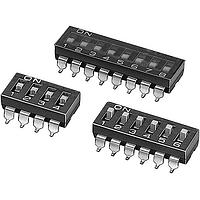
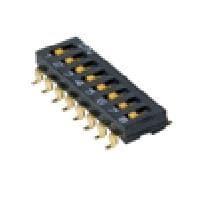
Within this category, you will commonly see compact switch arrays with multiple positions arranged for PCB integration. Depending on the design requirement, engineers may choose different actuator styles such as raised slide or flush slide formats, as well as layouts intended for either through-hole or surface-mount assembly.
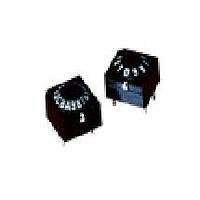
Examples in this range illustrate that variety well. Parts such as the Littelfuse SD08H1SK and Littelfuse SD08H0SK reflect different slide profiles for SMD assembly, while the Littelfuse SD06H1KD and Littelfuse SDA04H1BD show common through-hole options for board-level designs. Where application needs call for different pole arrangements or selector behavior, models such as the ITT Cannon RTE1001V14 and ITT Cannon RTE1002N14 help show how these switches can support more specific configuration logic.
How these switches are used in electronic equipment
DIP and SIP switches are often selected when configuration needs to remain accessible but infrequently changed. Common use cases include setting communication node IDs, defining startup behavior, selecting test modes, enabling optional functions, or choosing operating ranges in compact electronic assemblies.
They are also valuable in products that need straightforward field service. A technician can inspect switch positions visually and confirm whether the hardware setup matches the expected configuration. In systems where environmental or personnel protection is the primary concern, a separate category such as safety switches may be more appropriate, since board-level DIP/SIP devices serve a very different purpose from enclosure or machine isolation components.
Selection criteria for engineers and buyers
Choosing the right switch starts with the configuration logic of the equipment. The number of positions, switching style, actuator height, mounting method, and electrical rating all affect whether a part fits the board and the intended service process. For example, some projects prioritize low-profile packaging for dense layouts, while others prefer raised actuators for easier manual operation during production or maintenance.
Mechanical access is another important factor. If the switch will be adjusted after assembly, designers should consider enclosure openings, labeling, and tool access. If the configuration is set only once during manufacturing, a flush style may be sufficient. Buyers also often compare expected switching life, packaging style, and soldering compatibility to align with assembly flow and long-term product support.
For applications where the switching function must be electronic rather than manually actuated, it may be worth reviewing solid state switch options. That comparison helps clarify whether the design calls for physical configuration hardware or a semiconductor-based switching approach.
Representative manufacturers in this category
This category includes products associated with established component manufacturers used across industrial and electronic design environments. Littelfuse appears prominently in the available examples, covering multiple position counts, actuator styles, and mounting formats suited to different PCB requirements.
Other relevant names in the current assortment include ITT Cannon, JAE Electronics, and Eaton. For example, Eaton S1031A and JAE Electronics 43J41GB highlight that DIP/SIP switching solutions are not limited to a single product family or sourcing path. Depending on the application, buyers may also evaluate broader switch portfolios from brands such as Alcoswitch - TE Connectivity, Alps Alpine, Bourns, C&K, and Molex when aligning component strategy with preferred suppliers.
Integration considerations in the wider switch ecosystem
Board-mounted configuration switches are only one part of a broader switching landscape. They differ significantly from power isolation devices, environmental sensing switches, and external operator controls. Understanding that distinction helps avoid mismatched sourcing decisions, especially in B2B purchasing where products may share the word “switch” but serve entirely different electrical and mechanical functions.
For instance, accessories for mounting, protection, or installation support may belong in other switch accessories, while heavy-duty line isolation products belong elsewhere. DIP/SIP components are specifically intended for low-power PCB configuration tasks, not for load breaking or equipment isolation.
What to look for when comparing listed parts
When reviewing individual product pages, it is helpful to compare the switch arrangement, number of positions, mounting style, and actuator format against the actual PCB and enclosure design. A part such as Littelfuse BD02 may fit a compact two-position requirement, while products like BPA04SB, SDA06H0SBR, or eight-position versions may better suit applications with more configuration combinations.
It is also worth checking whether the switch is intended for repeated field adjustment or mainly for factory setup. That practical difference can influence the preferred actuator style and service accessibility much more than the nominal electrical rating alone. In many purchasing workflows, the best choice is the one that reduces assembly issues and makes the final hardware configuration easier to verify.
Choosing the right DIP / SIP switch for your application
The right part depends on how the setting will be used in the finished product: how many positions are needed, how often the switch will be changed, how much PCB space is available, and whether the installer must access it easily after assembly. A well-matched switch simplifies hardware configuration and helps keep product behavior consistent across production, commissioning, and service stages.
By comparing mounting style, actuator format, and position count within this category, engineers and procurement teams can narrow down parts that fit both the electrical design and the real-world maintenance process. For compact, dependable hardware configuration on the board, DIP and SIP switches remain a practical and proven choice.
Get exclusive volume discounts, bulk pricing updates, and new product alerts delivered directly to your inbox.
By subscribing, you agree to our Terms of Service and Privacy Policy.
Direct access to our certified experts