Air Particle Counter
Air cleanliness is a critical variable in many environments, from HVAC maintenance and cleanroom verification to facility inspections and indoor air investigations. An Air Particle Counter helps teams quantify airborne particles by size and concentration, making it easier to detect contamination sources, assess filtration performance, and document environmental conditions with measurable data.
Compared with general particulate indicators, this category is typically used when users need size-channel counting rather than only a mass concentration trend. That makes these instruments relevant for maintenance engineers, quality teams, validation specialists, and EHS professionals who need more detailed visibility into suspended particles in the air.

Why airborne particle counting matters
In controlled environments, particle size and count directly affect product quality, process stability, and compliance work. Cleanrooms, pharmaceutical areas, electronics production, and critical HVAC systems often require evidence that airborne contamination stays within acceptable limits, especially when evaluating filtration and room recovery performance.
Outside clean manufacturing, particle counting is also useful in building diagnostics and indoor environment studies. It can help identify dust ingress, filter leakage, abnormal particle spikes near process equipment, or changes caused by occupancy, maintenance activity, or ventilation imbalance. For broader air investigations, users often compare particle data with tools such as an indoor air quality meter to build a more complete picture of environmental conditions.
How an air particle counter works
Most instruments in this category use laser light scattering to detect particles carried through a defined airflow path. As sampled air passes through the optical chamber, particles scatter light; the instrument interprets the signal to estimate particle size and count events in separate channels.
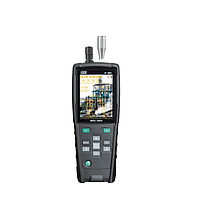
Many handheld models in this range measure six particle size channels down to 0.3 µm, which is a common threshold for facility and clean environment checks. Depending on the model, the user may view results in cumulative, differential, or concentration modes, making the data easier to interpret for trend monitoring, spot checks, or reporting.
Typical applications across industry
Air particle counters are widely used in preventive maintenance, commissioning, and environmental verification. In HVAC systems, they support filter testing, duct cleanliness checks, and air handling unit performance assessment. In healthcare and laboratory spaces, they can support routine area qualification and contamination control practices.
Manufacturing and process industries also rely on particle counting during troubleshooting. If a production space shows yield loss, static-related contamination, or unexplained dust accumulation, particle data can help narrow down whether the source is the room environment, filtration, personnel movement, or nearby operations. Where mass-based particulate trends are also important, users may review a dedicated dust monitor alongside channel-based counters.
What to look for when choosing a model
The right selection usually starts with minimum detectable particle size, number of channels, and flow rate. For portable inspection work, six-channel handheld models covering 0.3 µm to 10 µm are often a practical choice because they provide a useful balance between portability and detail. Higher flow instruments may be better suited to more demanding verification tasks where faster sample collection is important.
Data handling is another key factor. Some users need only local display and onboard memory, while others require USB, Ethernet, or serial communication for traceability and integration into maintenance or quality workflows. Environmental readings such as temperature and humidity can also be helpful because they add context when particle levels change under different operating conditions.
Battery runtime, accessory ecosystem, and calibration support should not be overlooked. Handheld users may benefit from spare batteries, cradles, zero filters, and protective cases, especially when instruments move frequently between sites or are used for scheduled route inspections.
Representative products in this category
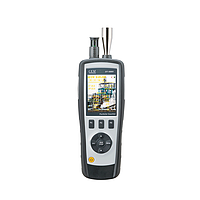
Several models in this category illustrate the range of available use cases. The EXTECH VPC300 is a portable six-channel instrument that combines particle counting with temperature and humidity measurements, and it also includes built-in image and video capture. That makes it useful when technicians need not only readings, but also visual documentation tied to inspection activity.
The FLUKE 985 Particle Counter is another well-known handheld option for six-channel airborne particle measurement, with onboard storage and communication features that support routine facility monitoring and reporting. For users who want a compact Extech alternative, the EXTECH VPC260 provides six-channel counting in a lighter portable format suited to spot checks and field inspections.
There are also products in this category that serve the broader measurement ecosystem rather than acting as the main counter itself. Examples include the EXTECH VPC-BATT replacement battery, the KANOMAX 3888-70 cradle for handheld particle counters, and the KANOMAX 3887-03 Zero Filter used in verification and maintenance workflows. For higher-flow or more advanced reporting environments, Lighthouse SOLAIR airborne particle counters expand the category toward larger-format instruments designed for more formal monitoring tasks.
Handheld versus higher-flow systems
Handheld particle counters are often the first choice for mobile inspections, service calls, and room-to-room surveys. They are easier to carry, faster to deploy, and well suited to troubleshooting tasks where the user needs immediate feedback at multiple locations during the same shift.
Larger or higher-flow systems are more appropriate when sample throughput, structured reporting, or fixed-location use matters more than portability. These instruments can be a better fit for formal cleanroom documentation, longer sampling routines, or workflows that require stronger connectivity and more robust audit records. If your requirement is broader than airborne counting alone, you may also want to review the wider particle counter category.
Related measurement considerations
Not every particulate task calls for the same instrument type. Airborne particle counters focus on counting suspended particles by size channel, while other devices may emphasize PM2.5 or PM10 mass concentration, gas parameters, or general indoor comfort indicators. Understanding that distinction helps avoid selecting a tool that does not match the reporting requirement.
For example, OMEGA HHTP21 is aimed more toward handheld particulate pollution monitoring with environmental parameters, while station-based products such as Casella Guardian2 serve continuous particulate observation in a different application context. These examples are useful because they show how particle counting sits within a broader environmental measurement workflow rather than standing alone.
Choosing with confidence
The best fit depends on where and how the instrument will be used: quick field checks, clean environment verification, HVAC diagnostics, or longer-term contamination tracking. Reviewing channel sizes, flow rate, memory, connectivity, and available accessories will usually narrow the options quickly.
This category brings together portable and advanced solutions for airborne particle measurement, along with selected accessories that support daily operation. If you need to compare handheld inspection tools with more specialized particulate methods, this page is a good starting point for identifying the right air particle counter for your monitoring workflow.
Get exclusive volume discounts, bulk pricing updates, and new product alerts delivered directly to your inbox.
By subscribing, you agree to our Terms of Service and Privacy Policy.
Direct access to our certified experts