Optical Switches
Reliable object detection often depends on sensing without physical contact, especially where speed, repeatability, and low mechanical wear matter. In conveyor systems, compact automation assemblies, office equipment, and embedded control designs, optical switches are widely used to detect presence, position, passage, or interruption with fast response and stable performance.
This category covers sensor devices that use light to detect an object or a change in a sensing path. Depending on the installation and application, that can include slotted transmissive parts for precise edge or tab detection, through-beam styles for longer sensing distances, and reflective designs for space-constrained layouts. For teams comparing sensing methods within broader switch architectures, related options such as control switches or emergency stop switches serve very different machine functions.
How optical switches fit into industrial and electronic designs
An optical switch typically combines a light emitter and a receiver to determine whether a target is present, absent, aligned, or moving through a defined sensing zone. Because detection is based on light rather than mechanical contact, these devices are often chosen where designers want to reduce wear, improve cycle life, or detect small movements with good repeatability.
Within this category, common sensing methods include transmissive and reflective operation. Transmissive versions detect when an object interrupts the light path, while reflective versions detect returned light from a nearby target. The right choice depends on available mounting space, target material, required sensing distance, and output interface.
Common optical switch types in this category
Slotted and through-beam devices are especially common for part counting, paper path detection, actuator position confirmation, and motion indexing. A slotted photointerrupter places emitter and detector across a slot, allowing a flag or moving component to interrupt the beam with high positional consistency. This makes it useful in compact mechanisms and PCB-based assemblies.
Reflective optical switches are often selected when the target can only be approached from one side. Instead of requiring the object to pass through a slot, the sensor responds to reflected light from the surface. That can simplify mounting in compact equipment, though target reflectivity and working distance become more important selection factors.
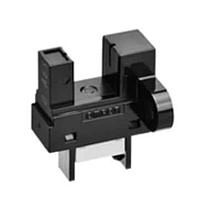
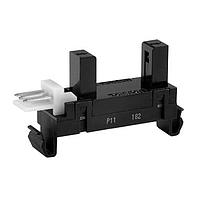
Examples in this range illustrate those differences clearly. The Omron Electronics EE-SX1041 and EE-SX1088 represent slotted transmissive photo microsensor styles, while the Omron Electronics EE-SY410 and ams OSRAM SFH 9206-6/7 show reflective approaches for non-contact detection in tighter mechanical layouts.
What to consider when selecting an optical switch
Selection usually starts with the sensing principle and mechanical format. Slot width, aperture size, mounting style, and sensing distance all affect whether the sensor will fit the machine geometry and reliably detect the intended target. For example, a compact part such as the ROHM Semiconductor RPI-124 can be relevant where very small package size and fine detection are important, while panel-mount or screw-mount constructions may suit larger assemblies.
Electrical output is the next major factor. This category includes devices with phototransistor output as well as Photo IC output, and each option influences interface design, signal conditioning, and controller compatibility. Designers should also review switching speed, operating temperature range, and output configuration when matching a sensor to production environments or embedded electronics.
Mounting style can also narrow the field quickly. Through-hole devices may be preferred in robust PCB assemblies, while SMD/SMT options support more compact automated assembly processes. Panel-mount and screw-mount optical switches are often easier to integrate into machine frames, brackets, or protective housings where mechanical stability matters.
Representative manufacturers and product range
This category includes products from recognized sensor and optoelectronic suppliers such as Omron Automation and Safety, Omron Electronics, ROHM Semiconductor, and ams OSRAM. The available range spans miniature PCB-mount interrupters, slim through-beam sensors, reflective sensors, and industrial-style slot sensors for different integration needs.
Representative products in this category include the Omron Automation and Safety EE-SPW321-A for transmissive through-beam sensing, the EE-SX772R and EE-SX871 for slot-type industrial detection, the EE-SX670A for transmissive sensing in panel-mount form, and the Omron Electronics EE-SX3340 for surface-mount applications with Photo IC output. These examples help show the breadth of form factors rather than suggesting a single “best” choice for every design.
Typical applications for optical switches
Optical switches are commonly used in machines and assemblies where a control system needs fast, repeatable feedback without contact. Typical tasks include edge detection, media handling, presence sensing, home position detection, object counting, and gap or tab recognition. They are often found in automation modules, packaging mechanisms, feeders, printers, and compact electromechanical subsystems.
In industrial systems, they may complement other switching and safety components rather than replace them. For example, machine builders may use optical sensing for product detection while relying on devices such as disconnect switches for isolation functions. Understanding that distinction helps buyers select components based on sensing duty versus operator control or safety isolation.
Practical buying guidance for B2B sourcing
For procurement teams and design engineers, comparing optical switches is easier when requirements are defined in a structured way. Start with the target size, movement path, and required distance, then confirm the preferred sensing method and mounting style. After that, review output type, temperature range, and any packaging or assembly constraints that could affect production readiness.
It is also helpful to consider whether the part will be used in a prototype, a recurring machine platform, or a volume electronic assembly. A compact SMT reflective sensor may fit dense board-level designs, while a larger panel-mount or screw-mount unit may better serve maintenance-friendly industrial equipment. Looking at a few representative parts side by side can quickly narrow the shortlist before checking detailed electrical integration requirements.
Choosing the right optical switch for your application
The most suitable device depends less on headline specifications and more on how the sensor will interact with the actual target and installation geometry. A slotted transmissive sensor can be ideal for precise interruption detection, a through-beam type may support longer reach, and a reflective design can simplify installation where access is limited to one side.
Across this category, buyers can compare compact and industrial-grade formats from established manufacturers and review options for phototransistor or Photo IC output, PCB or panel mounting, and short-range or extended sensing setups. If your project requires dependable non-contact detection, this optical switch range provides a practical starting point for matching sensor format, output behavior, and mounting approach to the application.
Get exclusive volume discounts, bulk pricing updates, and new product alerts delivered directly to your inbox.
By subscribing, you agree to our Terms of Service and Privacy Policy.
Direct access to our certified experts