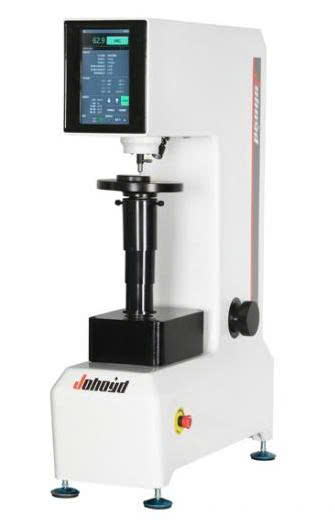
- Technical Parameters:
Initial test force (N): 10kgf (98.07N), allowable error ±2.0%
Total test force (N): 60kgf(588N), 100kgf(980N), 150kgf(1471N)
Rockwell scale: HRA、HRB、HRC、HRD、HRE、HRF、HRG、HRH、HRK HRL、HRM、HRP、HRR、HRS、HRV
Test standard:
+ GB/T230.1, GB/T230.2 national standards, JJG112 verification procedures
+ GB/T2848, GB/T3773 original standards, EN10109, ASTM E18, ISO 6508
Accuracy: 0.1HR
Dwelling time (s): 1-60
Hardness indication reading method: 7-inch touch LCD display
Z axis: Momentary lifting, automatic lifting, one-button testing
Lighting brightness: 0-100%
Maximum allowable height of test piece (mm): 230
Distance from center of indenter to body (mm): 160
Dimensions of hardness tester (mm): 550×220×730
Power supply: 220V/50HZ
Instrument weight (kg): 85
Hardness test range: HRA:20-88, HRB:20-100, HRC:20-70, HRD:40-77, HRE:70-94, HRF:60-100, HRG:30-94, HRH:80-100, HRK:40-100, HRL:100-120, HRM:85-110, HRR:114-125, HRS
Main functions and features of the instrument
1. The 7-inch LCD touch screen can intuitively display the hardness value, converted hardness, test method, test force, brightness, initial test force holding time, total test force holding time, elastic recovery time, number of measurements, statistical data, test time and other test processes. The test process is intuitive and clear;
2. The system has a built-in calibration function, which can automatically adjust the error range of 80-120%, or calibrate the instrument separately with low and high values
3. When testing the curved surface, it is automatically corrected according to the standard curved surface radius;
4. It can store 100 sets of test data, and the test data can be viewed at any time, and the current data can be deleted or all test data can be cleared; the average value and number of times can be displayed on the main interface. The product name can also be set.
5. Test force units can be converted to each other, the conversion units are: (Kgf, N)
6. Can simultaneously display: maximum value, minimum value, average value, number of tests, product name;
7. The main interface can simultaneously display 4 conversion scales, and can switch: national standard (GB), American standard (ASTM) and international (ISO) standard, a total of 20 measurement scales can be converted: HRA, HRB, HRC, HRD, HRE, HRF, HRG, HRK, HR15N, HR30N, HR45N, HR15T, HR30T, HR45T, HK, HBW, HS, HBS, HV, Rm (tensile strength),
8. The screen sleep time can be set, and it will automatically enter the sleep state after long-term inactivity, which is environmentally friendly;
9. The upper and lower limits of the measurement range can be set, which will be displayed on the main measurement interface, and the unqualified value will automatically prompt an alarm;
10. The operating system has 14 languages, which can be switched at will: Chinese, Traditional Chinese, English, Russian, German, French, Spanish, Portuguese, Turkish, Czech, Japanese, Korean, Thai, and Vietnamese;
11. Equipped with a built-in printer, the test data can also be exported to a USB flash drive via USB for storage and analysis;
12. The one-time molding structure of the casting shell is stable and does not deform. The pure white car paint is of high grade and has strong scratch resistance. It is still bright as new after years of use;
13. Our company has the ability to independently develop, design and produce, and our machines provide lifetime parts replacement and maintenance upgrade services;
The main uses and scope of the instrument:
1. Determine the Rockwell hardness of ferrous metals, non-ferrous metals and hard alloys:
2. Rockwell hardness of castings, annealed steel, normalized steel, non-ferrous metals and soft alloys;
3. Rockwell hardness of heat-treated materials such as quenching and tempering;