- Technical Parameters:
Brinell Ruler: HB1/30、HB2.5/31.25、HB2.5/62.5、HB2.5/187.5、HB5/62.5、HB10/100
Rockwell Ruler: HRA、HRB、HRC、HRD、HRE、HRF、HRG、HRH、HRK、HRL、HRM、HEP、HRR、HRS、HRV
Vickers Ruler: HV30、HV100
Test force:
+ Rockwell test force: 60、100、150Kgf(588、980、1471N)
+ Brinell test force:30、31.25、62.5、100、187.5Kgf(294.2、306.5、612.9、980.7、1839N)
+ Vickers test force:30、100Kgf(294.2、980.7N)
gain: Brandt:37.5×,Victorinox:75×
Maximum height of specimen: Rockwell 170mm, Vickers, Brinell 145mm
Indenter-outer wall distance: 165mm
Hardness test range: Rockwell:20-88HRA、20-100HRB、20-70HRC; Brinell:5-650HBW; Vickers:10-3000HV
Hardness reading: Automatic calculation
power supply: AC220+5%,50~60Hz
Dimensions (mm): 550×200×720mm
Host weight: 85kg
Main features of the instrument
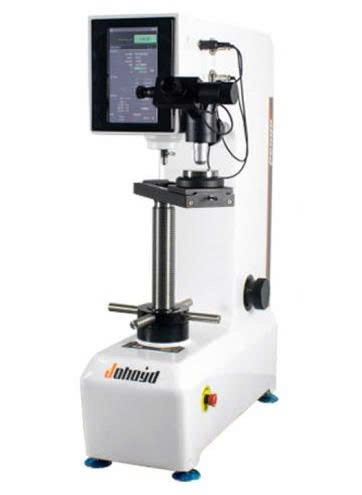
1. The optical system designed by senior optical engineers not only has clear images, but also can be used as a simple microscope, with adjustable brightness, comfortable vision, and not easy to fatigue after long-term operation;
2. The hardness value, conversion hardness, test method, test force, brightness, holding time, number of measurements, statistical data, and test time can be displayed intuitively on the 7-inch LCD touch screen. The test process is intuitive and clear;
3. The system comes with a calibration function, which can manually adjust the input error calibration instrument;
4. When testing the curved surface, it is automatically corrected according to the standard curved surface radius;
5. The adjustable range of optical system brightness: 0-100;
6. 100 sets of test data can be stored, and the test data can be viewed at any time, and the current data can also be deleted or all the test data can be cleared;
7. The test force unit can be manually selected for mutual conversion, the conversion unit is: (Kgf, N)
8. Simultaneous display: maximum value, minimum value, average value, test times, test block name (test block number can be input);
9. The main interface can display 4 conversion scales at the same time, and can be switched: National Standard (GB), American Standard (ASTM) and International (ISO) Standards. A total of 21 measurement scales can be converted: HRA, HRB, HRC, HRD, HRE, HRF, HRG, HRK, HR15N, HR30N, HR45N, HR15T, HR30T, HR45T, HK, HBW, HS, HBS, HV, Rm (tensile strength), MPa (pressure);
10. With diagonal length memory function, the diagonal length will be automatically memorized after shutting down, and it will be measured directly after turning on, without the need for secondary reset.
11. The upper and lower limit measurement range can be set, displayed on the main measurement interface, and the unqualified value will automatically prompt an alarm;
12. The operating system has 13 languages, which can be switched at will: Chinese, English, Russian, German, French, Spanish, Portuguese, Turkish, Czech, Japanese, Korean, Thai, Vietnamese;
13. It has three test methods of Brinell, Rockwell and Vickers, with eight levels of test force, which can meet various hardness test requirements;
14. Equipped with a built-in printer, the test data can also be output to U disk via USB for storage and analysis;
15. The casting shell has a stable and non-deformed structure in one-time molding, and the pure white car paint has a high grade, strong anti-scratch ability, and it is still bright as new after many years of use;
16. Our company has the ability of self-developed design, production and processing, and our machines provide parts replacement and maintenance upgrade services for life;
The main purpose and scope of use of the instrument:
1. Determine the Brinell, Vickers and Rockwell hardness of ferrous metals, non-ferrous metals and cemented carbides:
2. Brinell hardness of castings, annealed steel, normalized steel, non-ferrous metals and soft alloys;
3. Rockwell hardness of heat-treated materials such as quenching and quenching and tempering;
4. Vickers hardness of nitriding layer, ceramics, thin plates, metal flakes, electroplating layers, and small parts;