Vernier Calipers
In many workshops, inspection benches, and maintenance environments, a reliable measuring tool still needs to work without batteries, tolerate dirt, and deliver repeatable readings. That is why Vernier Calipers remain a practical choice for machining, fabrication, automotive service, and general dimensional checks. They are straightforward, durable, and well suited to users who prefer direct mechanical reading.
This category focuses on vernier-type calipers used for outside, inside, step, and depth measurement across common ranges such as 0-150 mm, 0-200 mm, and 0-300 mm. Whether the requirement is routine shop-floor inspection or more precise manual measurement, the selection includes trusted formats from manufacturers such as Mahr, MOORE & WRIGHT, and SATA.
Why vernier calipers are still widely used
A mechanical caliper is often chosen when users need a tool that is simple to maintain and ready to use at any time. In dusty workshops, field service conditions, or production areas where electronic tools may be less convenient, a vernier scale offers dependable performance without relying on power or displays.
Another advantage is operator control. Many technicians prefer the tactile feel of a sliding beam and jaws when checking shafts, holes, grooves, or part thickness. For routine inspection, this makes vernier calipers a practical option alongside other formats such as digital calipers, especially when ruggedness and simplicity matter more than fast numerical readout.
Typical measurement tasks for this category
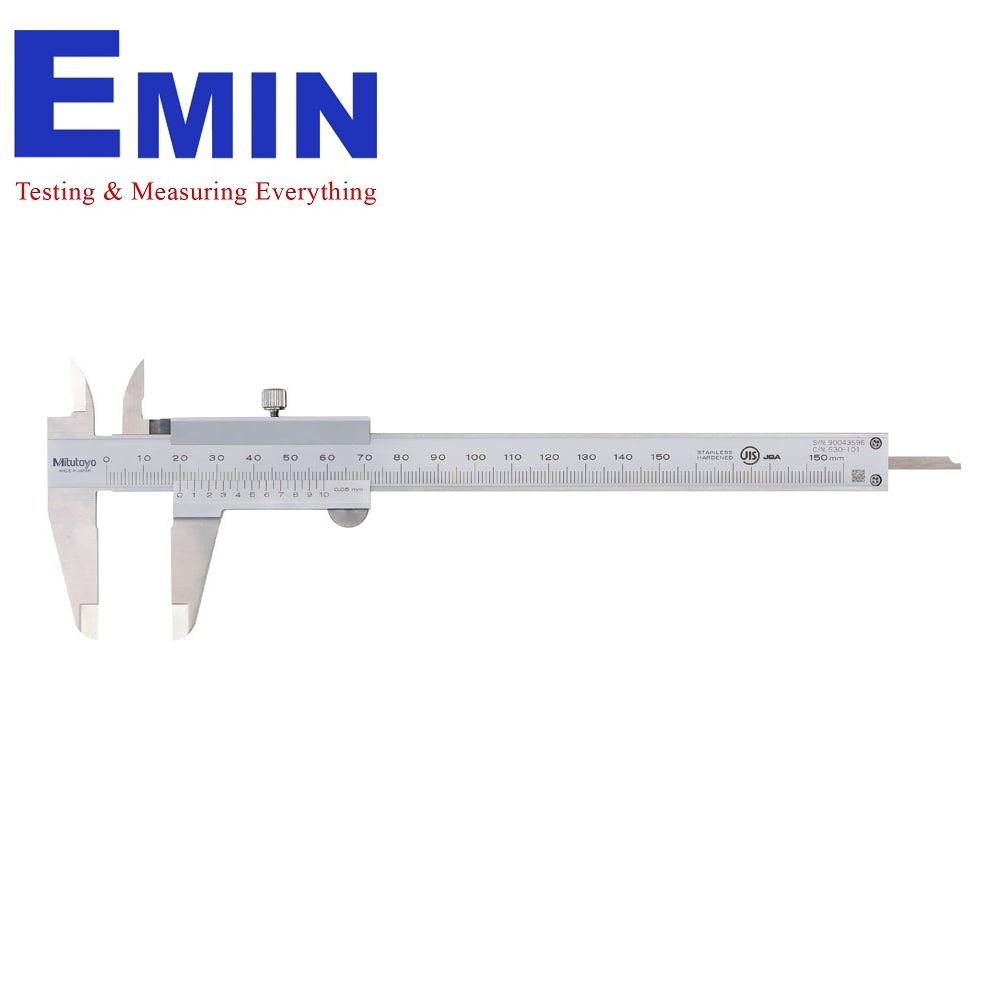
Vernier calipers are used for several common dimensional checks in metalworking and maintenance. The outside jaws measure external dimensions such as rod diameter, plate thickness, or turned parts. The inside jaws help verify bore or slot dimensions, while the depth rod can be used for groove depth, recesses, or drilled-hole depth.
These tools are also useful for step measurement when a part includes shoulders or offset surfaces. In practice, that makes them suitable for incoming inspection, machine setup, toolroom work, and repair operations where one handheld instrument needs to cover multiple measurement tasks.
- Outside diameter and thickness measurement
- Inside diameter and opening checks
- Depth measurement for grooves and holes
- Step measurement on machined components
Common ranges and reading values
Most buyers select a caliper range based on the largest part they expect to measure. The 0-150 mm size is a common everyday option for bench work and general workshop tasks. Larger 0-200 mm and 0-300 mm versions provide more reach for bigger components, though they may be less compact for constant carry.
Reading value and permissible error also matter. In this category, you can find examples with 0.05 mm vernier reading as well as finer 0.02 mm versions. A model such as the MOORE & WRIGHT MW100-15B is a practical 0-150 mm workshop caliper with 0.05 mm resolution, while the MOORE & WRIGHT MW160-32 extends to 0-300 mm with a 0.02 mm reading value for users who need more range and finer manual scale graduation.
Mahr options in the 16GN and 16FN series also illustrate typical range choices from 150 mm to 300 mm. Some variants include metric-only reading, while others provide combined metric and inch scales, which can be useful in mixed-standard environments.
Examples from the available range
For general workshop use, the MOORE & WRIGHT MW100 series covers familiar measuring ranges such as 0-150 mm, 0-200 mm, and 0-300 mm. These models are suitable when the priority is a conventional manual caliper for everyday dimensional checks. Their format fits common inspection tasks in fabrication, maintenance, and machine shops.
If finer graduation or a more metrology-focused format is required, Mahr analog-display calipers such as the 16GN and 16FN models are relevant examples in this category. The 16GN versions offer a 0.02 mm vernier value in ranges up to 300 mm, while 16FN models include metric/inch capability in selected sizes. For straightforward 0-150 mm manual measurement, the SATA 91501 is another useful reference with stainless steel construction and 0.02 mm resolution.
These examples show that the category is not limited to one usage profile. Some models are optimized for routine workshop handling, while others are better aligned with users who want a finer reading scale or dual-unit capability.
How to choose the right vernier caliper
The first consideration is measuring range. Buying more range than necessary can make the tool larger and less convenient, while buying too short a range limits usability. For many general tasks, 150 mm is enough. If your work involves larger housings, shafts, or fixtures, 200 mm or 300 mm may be more suitable.
The second factor is scale readability. A 0.05 mm vernier is often sufficient for standard workshop inspection, while 0.02 mm can be preferable when users are comfortable reading a finer scale and need closer manual discrimination. If your workflow involves both imperial and metric drawings, a dual-scale model such as selected Mahr 16FN versions can simplify daily use.
Also consider the mechanical details that affect handling, such as jaw length and the presence of a rectangular depth rod. For some applications, users may also compare this category with a dial caliper if they want easier visual reading while retaining a mechanical design.
Mechanical vernier vs other caliper types
The key strength of a vernier caliper is durability and independence from batteries. It is often the preferred format in harsh or mobile working conditions where electronic displays can be less convenient. For technicians already familiar with manual scale reading, it offers a dependable and economical approach to measurement.
Compared with digital models, vernier calipers are typically slower to read but simpler in construction. Compared with dial types, they avoid the dial mechanism and remain purely scale-based. If the application is focused on a specific geometry rather than general-purpose measurement, users may also review a diameter measurement caliper for more specialized tasks.
Applications across workshop and inspection environments
Manual calipers are commonly used in machining, mold work, automotive repair, maintenance departments, and educational training labs. They support quick dimensional verification during setup, in-process inspection, or final checks before assembly. Because one tool can handle several measurement modes, they are especially useful where flexibility matters.
They also remain relevant in B2B procurement because many teams need robust tools for daily use rather than highly specialized metrology equipment. A well-chosen vernier caliper can serve operators, maintenance engineers, quality personnel, and service technicians who need a practical instrument for routine dimensional control.
Finding a suitable option in this category
This range brings together mechanical calipers in the most common sizes and reading values used across industrial and workshop settings. Whether the priority is a compact 150 mm model, a larger 300 mm format, metric/inch reading, or finer 0.02 mm graduation, the category provides a solid starting point for comparing manual measurement tools from established manufacturers.
When selecting, focus on the actual parts you measure, the environment where the tool will be used, and the level of reading precision your operators are comfortable with. That approach will help you choose a vernier caliper that fits real working conditions rather than simply selecting by size alone.
Get exclusive volume discounts, bulk pricing updates, and new product alerts delivered directly to your inbox.
By subscribing, you agree to our Terms of Service and Privacy Policy.
Direct access to our certified experts