Feeler gauge
Precise mechanical assembly depends on controlling small gaps that are easy to overlook but critical in operation. When clearance is too tight, parts may bind, overheat, or wear prematurely. When it is too loose, vibration, leakage, poor alignment, or reduced efficiency can appear quickly. That is why a feeler gauge remains one of the most practical tools for checking and setting narrow clearances in maintenance, machining, and quality control.
On this page, buyers can explore feeler gauge sets, single feeler strips, and related gap-checking tools used across industrial workshops and production environments. Whether the task involves equipment setup, periodic inspection, or component fitting, the right gauge helps technicians make repeatable decisions with simple and direct measurement.
Where feeler gauges are used in industry
Feeler gauges are widely used wherever a thin, known thickness must be inserted between two surfaces to verify clearance. Common examples include valve adjustment, spark plug gap setting, machine setup, fixture alignment, bearing inspection, and general mechanical service work. In many of these tasks, larger measuring tools cannot access the gap directly or do not provide the same practical pass-or-no-pass feel.
They are also useful in production and repair settings where operators need a quick way to compare actual spacing against the required tolerance. In broader inspection workflows, a feeler gauge often complements other reference tools such as pin gauges for hole checking or pitch gages for thread identification.
Common feeler gauge formats in this category
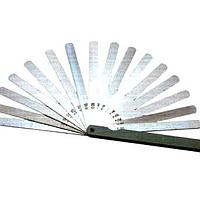
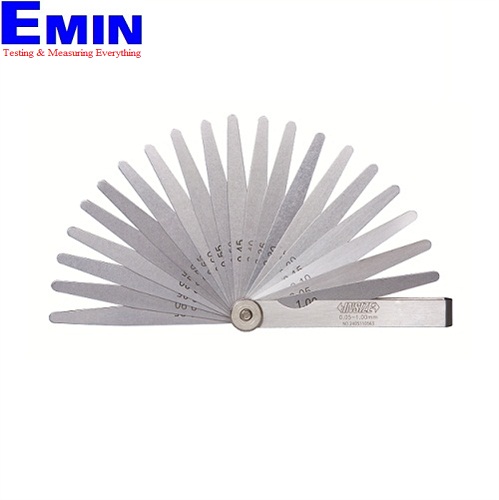
The most familiar format is the folding leaf set, where multiple blades of different thicknesses are fastened together for quick selection. This design is convenient for field work and general shop use because several sizes are available in one compact tool. Technicians can use one blade or combine multiple blades to achieve a target thickness when needed.
This category also includes feeler strips, which are useful when a specific thickness is used repeatedly or when a longer strip is more practical than a compact set. For example, the Niigata Seiki FG-03-1 and FG-07-1 are representative strip-style options, while the MOORE & WRIGHT FS20M illustrates the typical multi-piece feeler strip set format. Some related tools in the same measurement context, such as the Niigata Seiki TPG-700T taper gauge, are suited to checking wider or variable openings where a tapered profile is more appropriate than a flat blade.
How to choose the right feeler gauge
The first selection point is the thickness range required by the job. Fine mechanical adjustment may call for very thin blades, while heavier maintenance work may need a broader range. Buyers should also check whether the application is specified in metric or inch units to avoid conversion errors during setup or inspection.
Blade length and width also matter in real working conditions. Longer strips can reach deeper gaps or awkward locations, while shorter leaves are easier to handle in compact assemblies. For instance, the Niigata Seiki FG-03-1 and FG-07-1 are listed as 1 m long and 12.7 mm wide, which makes them relevant for applications where extended reach or custom handling is beneficial. By contrast, MOORE & WRIGHT single strips such as 1260020 to 1260025 are typical examples of inch-based feeler strip formats for straightforward thickness reference.
Another practical factor is how the gauge will be used day to day. A folding set is efficient for technicians who need many sizes at hand, while individual strips make sense for repetitive inspection at one known gap. If the task involves checking highly localized openings, it may also be worth reviewing the broader manufacturer offering from Niigata Seiki or MOORE & WRIGHT to match the tool style to the job.
What affects measurement reliability
A feeler gauge is simple, but reliable use still depends on good technique. The selected blade should slide into the gap with a light, consistent drag rather than being forced. Too much force can distort the feel of the measurement, while checking a dirty, oily, or burred surface can lead to false readings.
Stacking blades is common when intermediate thicknesses are needed, but users should do so carefully and keep the leaves clean and flat. In maintenance environments, blade condition matters as much as nominal size. Worn edges, corrosion, bending, or contamination reduce confidence in the result, especially when checking tight tolerances over time.
Examples from the featured product range
Several products in this category show the range of use cases covered by feeler gauges. The Niigata Seiki FG-03-1 is an example of a thin metric feeler strip, while the FG-07-1 offers a thicker alternative in the same long-strip format. These types of gauges are suitable when the user needs a defined thickness in a continuous strip rather than a folding pack.
The MOORE & WRIGHT FS20M represents a more traditional strip set arrangement, with multiple pieces covering a practical metric range. For inch-based work, individual strips such as MOORE & WRIGHT 1260020 through 1260025 illustrate how buyers can select a single thickness for repeated inspection steps. The Niigata Seiki 100MR Thickness gauge is also relevant for users comparing options within the broader thin-gap and thickness checking workflow.
Typical applications across maintenance and production
In automotive work, feeler gauges are commonly used for valve clearance and spark plug gap checks. In machine maintenance, they help verify the spacing between contacting or near-contacting parts during setup, overhaul, or troubleshooting. In fabrication and assembly, they can support fixture setup and consistency checks where controlled spacing affects fit and function.
These tools are also valuable in quality control because they provide a quick physical confirmation of whether a gap is within the intended range. While they are not a replacement for every dimensional measuring method, they are often the most practical option for narrow access points and direct clearance verification. For related dimensional reference tasks involving angular setups, users may also review angle gage blocks in the same standards and gage blocks ecosystem.
Why feeler gauges remain a practical workshop standard
Despite the availability of advanced measuring systems, feeler gauges continue to be widely used because they are fast, portable, and effective for real mechanical clearances. They require minimal setup, are easy to carry to the inspection point, and help technicians make immediate adjustments without complicated instrumentation. For many assembly and service tasks, that speed and simplicity are exactly what makes them indispensable.
Choosing the right feeler gauge set or strip comes down to thickness range, unit system, blade format, and access conditions. This category brings together practical options from established brands and gives industrial buyers a straightforward starting point for selecting tools that fit their measurement routine.
Get exclusive volume discounts, bulk pricing updates, and new product alerts delivered directly to your inbox.
By subscribing, you agree to our Terms of Service and Privacy Policy.
Direct access to our certified experts