Blood pressure monitor
Reliable blood pressure measurement is a routine requirement in home care, clinics, pharmacies, and general health monitoring. Choosing the right device depends on how and where it will be used, whether users need simple daily checks or more convenient data tracking, and how important cuff style, memory, and portability are for the application.
This blood pressure monitor category brings together digital devices designed for practical, repeatable measurement of blood pressure and pulse rate. The range includes both upper-arm and wrist models, with options from OMRON and Beurer to support different user preferences and monitoring needs.
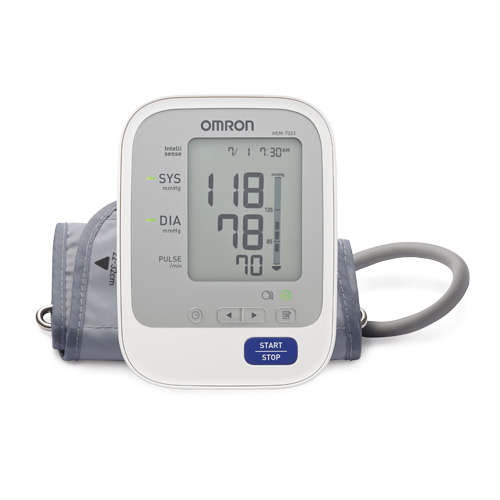
Upper-arm and wrist monitors for different usage needs
In day-to-day use, the main distinction is usually between upper-arm monitors and wrist monitors. Upper-arm units are widely selected for general home monitoring and clinical-style routine measurement, while wrist models are often preferred where compact size, lighter weight, and easier carrying are important.
Examples in this category show that both formats are available across different feature levels. Upper-arm models such as OMRON HEM-7121, HEM-7320, HEM-7280T, HEM-7361T, JPN600, and HEM 7143T1 are suited to regular arm-cuff measurement, while wrist units such as OMRON HEM-6161, HEM-6181, and HEM-6232T support users looking for a smaller device footprint.
Typical functions found in digital blood pressure monitors
Most devices in this selection use the oscillometric method, which is common in digital blood pressure measurement. They also combine pressure and pulse monitoring in one unit, typically with an LCD display and automatic inflation or deflation to simplify operation for non-specialist users.
Several OMRON models also include Intellisense technology and memory functions for storing previous readings. Depending on the model, memory capacity can vary from last-reading storage to dozens of measurements, and in some cases up to 100 readings per user with date and time. This can be useful for routine trend observation rather than one-time spot checks.
Feature differences that matter when selecting a model
For many buyers, the best choice is not the most feature-rich device but the one that fits the monitoring workflow. If the priority is straightforward operation, models such as OMRON HEM-8712 or HEM-7121 may be more suitable for basic home use. If reading history is more important, options like OMRON JPN600 or HEM-7320 provide broader memory functions.
For users who want easier record handling or mobile-friendly data transfer, Bluetooth-enabled models such as OMRON HEM-7280T, HEM-7361T, and HEM-6232T may be relevant. In cases where portability is critical, wrist models can reduce size and weight significantly compared with upper-arm versions, while still covering standard blood pressure and pulse measurement ranges.
Representative products in this category
The category includes several established digital monitors for different usage scenarios. OMRON HEM-7280T is an upper-arm model with Bluetooth connectivity, dual-user memory support, and a wide cuff circumference range, making it suitable where multiple users may share one unit. OMRON HEM-7361T is another connected upper-arm option designed for routine monitoring with extended reading storage.
For compact daily carry, OMRON HEM-6232T offers wrist measurement with Bluetooth low energy support and per-user memory, while OMRON HEM-6181 and HEM-6161 provide simpler wrist-monitor formats. On the upper-arm side, OMRON HEM-7320, HEM-7121, HEM-8712, and OMRON 7120 + adaptor address more conventional home monitoring needs. The category also includes the Beurer BM85 Blood Pressure Monitor for buyers comparing alternatives from another well-known manufacturer.
How to evaluate suitability for home, pharmacy, or care-point use
Selection criteria often start with the user profile. For individual home use, buyers usually focus on ease of operation, readable display, cuff comfort, and enough memory to compare recent readings. For family use, dual-user storage or larger memory can be more helpful than compact size alone.
For pharmacy counters, health kiosks, or general care environments, practical considerations may include battery life, repeatable operation, cuff size compatibility, and whether an AC adapter option is available. Some OMRON upper-arm models in this category support battery power with optional adapter operation, which may be beneficial where fixed placement is preferred.
Related health monitoring categories
Blood pressure monitoring is often part of a broader personal or clinical measurement setup. Depending on the application, users may also compare devices for temperature screening, glucose checking, or weight management to build a more complete routine around basic health data.
If you are planning a wider measurement setup, you may also want to explore medical thermometers, blood glucose meters, and weight management and body fat scales. For buyers reviewing products by maker, the Beurer brand page can also help with brand-specific comparison.
Choosing with confidence
A suitable blood pressure monitor should match the real monitoring context: upper-arm or wrist design, simple or connected operation, single-user or multi-user memory, and home portability or fixed-location use. Looking beyond headline specs and focusing on measurement routine, cuff style, power preference, and data handling will usually lead to a more practical selection.
Within this category, upper-arm and wrist models from OMRON and Beurer cover a useful range of everyday monitoring needs. Reviewing the intended user, required memory capacity, and whether Bluetooth connectivity is necessary is a good way to narrow down the most appropriate device for long-term use.
Get exclusive volume discounts, bulk pricing updates, and new product alerts delivered directly to your inbox.
By subscribing, you agree to our Terms of Service and Privacy Policy.
Direct access to our certified experts