
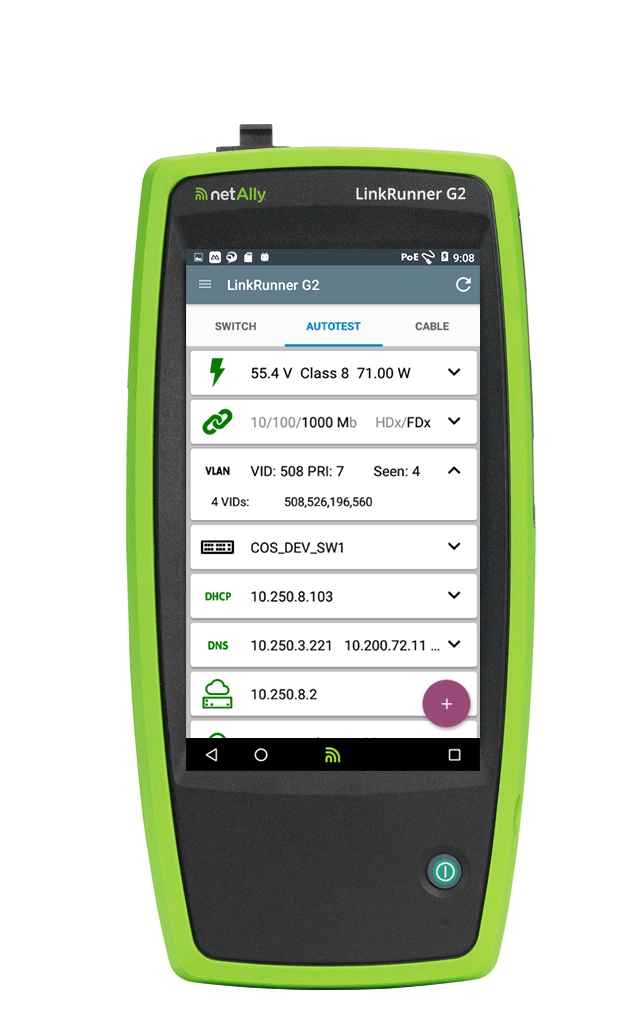
Netally LR-G2 Smart Wired Network Tester
General
Dimensions: 3.8 in x 7.7 in x 1.6 in (9.7 cm x 19.6 cm x 4.1 cm)
Weight: 18 oz (0.51 kg)
Battery: Rechargeable lithium-ion battery pack (3.6 V, 6 Ah, 21 Wh)
Battery Life: Typical operating life is 4 hours. Typical charge time is 7 hours.
Display: 5.0 in color LCD with capacitive touch screen (480 x 800 pixels)
Keypad: 1-key elastometric (power only)
Host Interface: Micro USB On-the-Go port
USB Port: USB 2.0 Type A port
SD Card Slot: Supports Micro SD
Cable Test: Pair length, crossed, reversed and distance to open, short, split
Tone Generator: Digital tone: [455 KHz]; Analog tones: [400 Hz, 1KHz]
Ports: RJ-45 copper port 10/100/1000BASE-T. 100/1000BASE-X. Fiber adapter port. Fiber port supports standard SFP
External AC Adapter/Charger: AC input 90-264 Vac 48-62 Hz input power DC output 15 Vdc at 2 amps or RJ-45 via PoE
Environmental
Operating Temperature: 32°F to 113°F (0°C to +45°C) NOTE: The battery will not charge if the internal temperature of the tester is above 122°F (50°C)
Operating Relative Humidity (% RH without condensation): 90% (50°F to 95°F; 10°C to 35°C); 75% (95°F to 113°F; 35°C to 45°C)
Shock and Vibrations: 1 m drop test, Random, 3.8 grms, 5 Hz-500 Hz (Class 2)
Safety: IEC 61010-1:2010: Pollution degree 2
Altitude: 4,000 m; Storage: 12,000 m
EMC: IEC 61326-1:2013: Basic Electromagnetic Environment; CISPR 11: Group 1, Class A
Group 1: Equipment has intentionally generated and/or uses conductively-coupled radio frequency energy that is necessary for the internal function of the equipment itself.
Class A: Equipment is suitable for use in all establishments other than domestic and those directly connected to a low-voltage power supply network that supplies buildings used for domestic purposes. There may be potential difficulties in ensuring electromagnetic compatibility in other environments due to conducted and radiated disturbances.
Includes: (1) LinkRunner G2 with Li-ION battery, power supply with regional power plugs, Wireview wire mapper #1, Inline RJ-45 coupler, USB 2.0 to Micro USB cable, 8 G Micro SD card, small soft case, coupler, and Quick Start Guide.
Get exclusive volume discounts, bulk pricing updates, and new product alerts delivered directly to your inbox.
By subscribing, you agree to our Terms of Service and Privacy Policy.
Direct access to our certified experts