
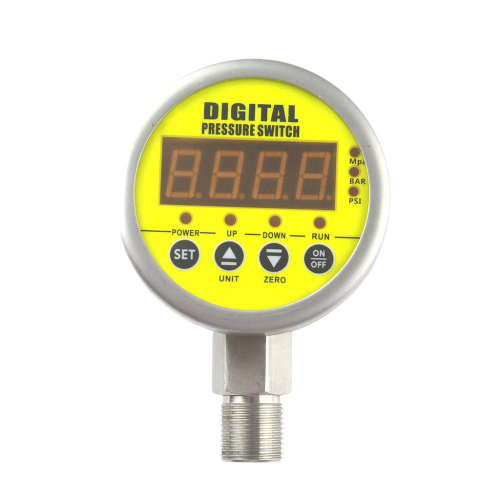
Digital Pressure Switch
Stable pressure control is critical in hydraulic units, compressors, pumps, process lines, and utility systems where a simple visual indication is not enough. In these applications, a digital pressure switch helps operators and control systems monitor pressure values clearly while also providing switching output for alarms, interlocks, or automatic machine response.
Compared with conventional mechanical switching devices, this product group supports easier setpoint adjustment, readable digital indication, and more flexible unit selection. That makes it a practical choice for OEM machinery, industrial automation panels, and maintenance teams that need repeatable pressure monitoring across different operating ranges.
Where digital pressure switches are used
A digital pressure switch is commonly installed where the system must do more than display pressure. It can trigger a relay or output signal when pressure rises above or falls below a defined threshold, helping protect equipment, stabilize operation, and support automated control logic.
Typical use cases include pump protection, compressed air systems, hydraulic circuits, vacuum monitoring, filtration skids, and process equipment. In many plants, these devices are selected when users want the visibility of a digital display together with switching control in one compact instrument.
What matters when selecting the right model
The first decision is the operating range. This category includes models covering vacuum and positive pressure, from the KDS KT-S828E Digital Pressure Switch in the (-1~0) bar range to versions for 0~6 bar, 0~10 bar, 0~16 bar, 0~25 bar, 0~40 bar, 0~60 bar, 0~100 bar, 0~160 bar, 0~250 bar, 0~400 bar, and up to 0~600 bar. Choosing a range that matches the real operating window is important for readable resolution and reliable switching behavior.
Accuracy is another practical point. The listed KT-S828E models are specified at ±0.5% FS, which is suitable for many industrial monitoring and control tasks. Buyers should also check the required supply voltage, process connection, and available engineering units so the instrument fits the machine design, existing pipework, and operator preference.
KDS digital pressure switch options in this category
This category highlights models from KDS, with the KT-S828E series covering a broad range of industrial pressure applications. The series supports selectable engineering units such as Bar, PSI, KPa, Kg/cm², and MPa, which can be helpful for multinational factories or equipment built to different user standards.
For connection flexibility, the available specifications include common pressure ports such as M20×1.5, G1/4, G1/2, NPT1/2, and NPT1/4, with custom-made options noted in the product data. Supply options listed across the series include 24VDC, 220VAC, and 380VAC, allowing the switch to be considered for both control cabinet integration and broader industrial power environments.
Digital switch vs. digital gauge vs. analog gauge
Although these products are closely related, they are not always interchangeable. A digital pressure switch is mainly selected when pressure indication and output-based control are both required. If the application is focused more on display and measurement without switching logic, a single pressure digital gauge may be more appropriate.
For straightforward local indication in less complex systems, many users still choose a single pressure analog gauge. Analog models remain common where operators prefer a simple dial view, while digital switch models are often favored where thresholds, alarm outputs, or automation integration are part of the process requirement.
Range selection for low, medium, and high pressure duties
Lower-range models such as 0~6 bar, 0~10 bar, and 0~16 bar are often relevant for pneumatic systems, utilities, and general machine pressure monitoring. Mid-range options like 0~25 bar, 0~40 bar, and 0~60 bar can suit broader industrial service where pressure varies more significantly but still remains below heavy-duty hydraulic levels.
For hydraulic and high-pressure equipment, the higher KT-S828E ranges such as 0~100 bar, 0~160 bar, 0~250 bar, 0~400 bar, and 0~600 bar provide coverage for more demanding applications. The vacuum version in the (-1~0) bar range is also useful where negative pressure needs to be monitored, such as suction lines or vacuum-assisted process systems.
Installation and compatibility considerations
Before ordering, it is worth checking more than pressure range alone. Process connection type should match the installation point, while the available supply voltage should align with the control architecture already in use. A mismatch in thread standard or power requirement can create unnecessary adaptation work even when the pressure range itself is correct.
Users should also think about display readability, mounting space, and the required unit of measurement for operators or service personnel. The listed 80 mm diameter option in this series can be relevant where the display needs to remain visible on machinery or panels during routine inspection and troubleshooting.
How this category fits into a broader pressure instrumentation setup
In many systems, pressure switching devices work alongside other instruments rather than replacing them completely. A machine builder may use a digital pressure switch for control action, then add dedicated gauges elsewhere in the system for operator checks, diagnostics, or monitoring of separate pressure points.
Where the application involves pressure difference rather than line pressure alone, users may need instruments from the differential pressure digital gauge range instead. Looking at the full measurement objective helps avoid selecting a device based only on appearance or display format.
Choosing with confidence
This Digital Pressure Switch category is designed for industrial users who need a practical combination of pressure display and switching functionality. With KDS KT-S828E models spanning vacuum through high positive pressure ranges, the selection supports a wide variety of machine and process requirements.
When comparing options, focus on the real operating range, accuracy, supply voltage, connection standard, and how the switch will interact with the rest of the control system. A well-matched device will not only measure pressure clearly but also contribute to safer, more consistent, and more efficient equipment operation.
Get exclusive volume discounts, bulk pricing updates, and new product alerts delivered directly to your inbox.
By subscribing, you agree to our Terms of Service and Privacy Policy.
Direct access to our certified experts