
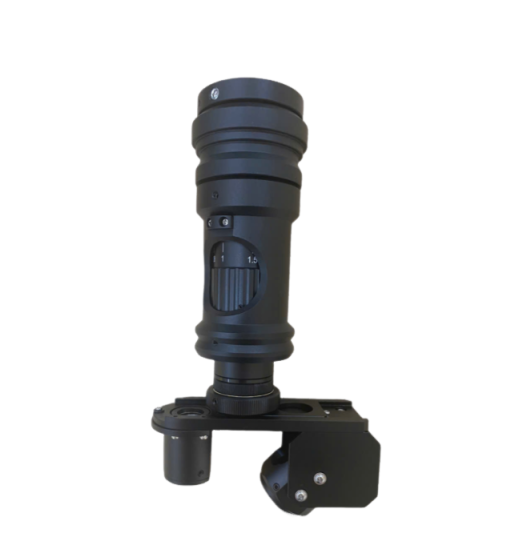
Troy Intelligent L1045 1X Eye Lens with Max 4.5x Object Lens (1X ~ 4.5X)
Can magnify 1X to 4.5X
Can rotate 360 degrees to every angle of the object
For use with popular microscopes from TROYVN
DESCRIPTION:
Lenses for microscopes play an important role in magnifying and clarifying images of specimens. These lenses help create detailed, sharp, and accurate images of small structures that are invisible to the naked eye.
Here are the main functions of lenses in microscopes:
1. Magnify the specimen
• The main function of the lens is to magnify the image of the specimen. The lens in the microscope is designed to increase the size of the specimen many times, from several tens to thousands of times, helping the user see the smallest details of the structure.
2. Create sharp and clear images
• The lens is responsible for focusing light from the specimen to the observer's eye or camera sensor. Lenses are designed to optimize the ability to focus light and produce sharp images with minimal aberration (distortion or blurring of the image).
3. Adjust the magnification
• Microscopes usually have a variety of lenses with different magnifications (usually 4x, 10x, 40x, 100x). Users can change these lenses to choose the magnification level that suits their needs for observing the specimen. Lenses with higher magnifications will allow for more detailed observation of small parts of the specimen.
4. Improve resolution
• Resolution is the ability to distinguish between two closely spaced points on a specimen. A high-quality lens improves the resolution of an image, allowing for more precise observation of details. This is important in studies that require high precision, such as cell biology or bacteriology.
5. Adjust the focus
• The lens in a microscope can adjust the focal length, that is, the distance between the specimen and the lens. This allows the observer to focus on specific parts of the specimen and see more clearly. This ability is essential when working with specimens that have multiple layers or when wanting to switch between different magnifications.
6. Reduces aberrations and light disturbances
• Modern lenses are designed to minimize aberrations, such as color dispersion or distortion at the edges. This helps ensure the best possible image quality, without blur or noise.
7. Support observation with special light
• Some lenses are specially designed to facilitate observation with special light sources such as fluorescent or ultraviolet light. These lenses help optimize the observation of specimens processed using methods such as fluorescence or other advanced biological techniques.
8. Enhance 3D viewing capabilities
• Some microscopes use special lens systems to view 3D images of specimens. This is especially useful when viewing complex structures or when measuring dimensions in three dimensions.
9. Analyze specimens without damaging them
• The lens allows the specimen to be viewed at high magnification without having to interfere with the specimen structure, helping to preserve the specimen's state. This is important in biological research or when working with delicate, vulnerable specimens.
10. Diverse applications
• Lenses can be used for a wide range of applications, from biological and medical observation to chemical, materials, and industrial research. Each lens is designed to suit a specific purpose, such as lenses with anti-reflective coatings for observing samples in bright light conditions.
Thus, the lens in a microscope not only magnifies the specimen but also helps improve image quality, increase clarity and provide the ability to observe specimen details accurately and conveniently.
Get exclusive volume discounts, bulk pricing updates, and new product alerts delivered directly to your inbox.
By subscribing, you agree to our Terms of Service and Privacy Policy.
Direct access to our certified experts