For full functionality of this site it is necessary to enable JavaScript.
EMIN.COM.MM
0

Common Mistakes Buyers Often Make When Purchasing Industrial Dry Air Generators

07/23/2025 10:27:40

When selecting an industrial Dry Air Generator, many businesses frequently make common mistakes such as choosing the wrong capacity, overlooking the quality of the output air, or neglecting warranty services. These errors can cause the compressed air system to operate inefficiently, increase maintenance costs, and disrupt production. This article will help you identify common mistakes when buying industrial Dry Air Generators, along with practical examples and solutions.

Common Mistakes When Buying Industrial Dry Air Generators

Choosing the Wrong Capacity for the Industrial Dry Air Generator

One of the most frequent mistakes is selecting an industrial Dry Air Generator that does not match actual needs. Many businesses rely solely on the compressor capacity and overlook factors such as air consumption flow rate, the number of devices used simultaneously, or future expansion potential. For example, a small woodworking workshop uses an industrial Dry Air Generator with a capacity of 2m³/min for a system that requires 2.5m³/min in total. As a result, the output air is not dry enough, affecting product quality and increasing equipment maintenance costs.

Overlooking the Quality of the Output Air

Many buyers focus only on price without thoroughly checking parameters such as dew point, air purity, or the Dry Air Generator's ability to remove moisture. This often leads to output compressed air still containing moisture, which causes corrosion in pipes and production equipment.

Neglecting Warranty Services and Replacement Parts

Industrial Dry Air Generators operate continuously, so maintenance and replacement of parts are inevitable. However, many businesses pay attention only to the initial purchase price and ignore warranty, technical support, and the availability of replacement parts. Choosing an industrial Dry Air Generator from a lesser-known brand can result in no replacement parts being available when the machine breaks down, forcing production to stop for several days and causing significant losses.

Consequences of Making Mistakes When Buying Industrial Dry Air Generators

Increased operating and maintenance costs: When the industrial air dryer is not suitable, the system often has problems, leading to increased repair costs, replacement of components and having to invest in buying a new machine in the evening. 

Reduced product performance: Poor quality compressed air will directly affect the equipment using air, reducing productivity and quality of output products.

Risk of production line failure: Moisture in compressed air is the main cause of corrosion and deposits in pipes, valves, cylinders... leading to production line failure and business interruption.

Experience in choosing to buy an effective industrial air dryer

Determine the correct usage needs: Calculate the required air flow based on the total actual usage needs, plus a reserve factor (usually 1.3 - 1.5 times the current demand). This helps the system operate stably and be ready to expand when necessary.
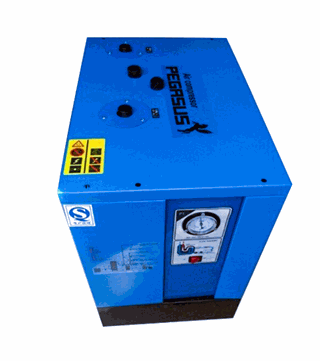
Figure 2. Pegasus Dry Air Generator

Prioritize products with clear technical specifications: You should choose an industrial air dryer with a dew point index, air cleanliness, and water vapor removal capacity that meets your industry standards. In particular, please refer to international standards on Dry Air Generator to ensure the quality of output compressed air.

Choose a reputable brand with good after-sales service: A large brand with a wide distribution and warranty system will help you feel more secure when using an industrial air dryer. In addition, carefully check the ability to provide replacement parts and after-sales technical support.
Related News

Which Vacuum Pump Should You Choose for a Microbiology Lab to Avoid Affecting Samples?
07/15/2026 14:45:07

Vacuum pumps are utilized in a wide range of microbiology laboratory procedures, from membrane filtration and the aspiration of supernatants following centrifugation to sample concentration and the support of negative-pressure systems. Selecting the appropriate pump not only ensures more stable operational processes but also minimizes the risk of sample contamination, reduces maintenance costs, and extends the equipment's lifespan

QCVN 25:2025/BKHCN Takes Effect: Do Businesses Need to Prepare Electrical Safety Testing Equipment?
07/15/2026 09:15:04

Electrical safety is consistently one of the primary criteria evaluated before electrical or electronic equipment—or industrial components—are released to the market. A product may operate reliably yet still fail to meet requirements if its insulation lacks sufficient durability, its grounding resistance exceeds permissible limits, or leakage current occurs during operation.

Why Is Associated Research Considered an Icon of Hipot Technology?
07/14/2026 09:05:30

When it comes to electrical safety testing equipment specifically Hipot testers—many QA/QC and testing engineers are familiar with the globally renowned brand Associated Research. A subsidiary of the parent company IKONIX, Associated Research (ARI) invented the world's first commercial Hipot tester.

What Is the Standard 3-Phase Voltage? How to Read Cabinet-Mounted Meters Without Errors
07/13/2026 15:09:18

Voltmeters are almost invariably found on the panels of electrical cabinets in factories, power stations, or generator systems. A glance lasting just a few seconds allows an operator to determine whether the power supply is stable or showing signs of abnormality. However, not everyone understands the significance of the displayed readings, particularly regarding three-phase electrical systems.

Distinguishing between ARI’s Hypot, HypotUltra, and HypotMax: Which device is right for your factory?
07/13/2026 09:48:30

Few people realize that the concept of the "Hipot Test"—or electrical safety testing—has long existed within the electrical equipment manufacturing industry. Driven by the growing need to verify the voltage withstand capabilities of conductors, motors, and electrical devices, the industry required a robust and virtually fail-safe method to detect insulation weaknesses before products reached the market.

Stay Updated with Offers

Get exclusive volume discounts, bulk pricing updates, and new product alerts delivered directly to your inbox.

By subscribing, you agree to our Terms of Service and Privacy Policy.

Quick Support

Direct access to our certified experts