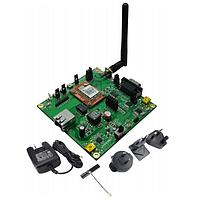
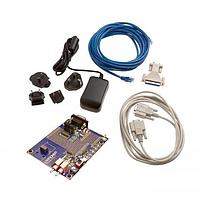
Networking Development Tools
Building and validating a communication design usually takes more than selecting a chipset. Engineers often need a practical way to evaluate interfaces, test protocol behavior, and reduce risk before moving into full hardware integration. That is where Networking Development Tools become especially useful across embedded systems, industrial communication, and connected device development.
This category brings together evaluation kits, development boards, and platform-level tools that support early-stage testing for wired, wireless, and power line communication applications. Whether the goal is to assess a modem, explore a PLC approach, or prototype a connected node, these tools help teams move from concept to implementation with clearer technical direction.
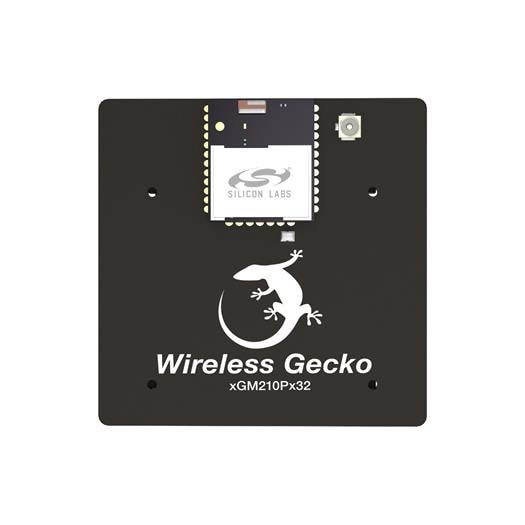
Why networking development tools matter in real projects
In technical B2B environments, communication performance is rarely judged by a datasheet alone. Developers need to verify interoperability, interface behavior, physical connectivity, and software bring-up under realistic conditions. A well-chosen evaluation platform can shorten this process by providing a known hardware baseline for testing.
These tools are commonly used to examine protocol feasibility, compare implementation paths, and identify integration constraints before committing to production design. For teams working across industrial automation, smart infrastructure, or embedded networking, this can save engineering time and reduce redesign effort later in the cycle.
Typical technologies covered in this category
The category spans multiple communication approaches rather than a single protocol family. This includes platforms for power line communication, industrial modem evaluation, wireless mesh networking, and mixed connectivity environments where UART, SPI, Ethernet, or USB may be involved during development.
For example, engineers exploring PLC can look at solutions such as the Dialog Semiconductor SM2400-EVK2M5-A or the Analog Devices MAX2982EVSYS, both relevant when evaluating communication over existing power infrastructure. In another use case, tools like the onsemi A5191HRTNGEVB support HART modem evaluation, which is often relevant in process instrumentation and industrial field communication.
Some products in the category are intended for broader connected-node prototyping. The Adafruit 3993 BLE and WiFi kit is a good example of a platform that can support early experimentation with wireless connectivity when the focus is on firmware, peripheral interaction, and proof-of-concept development.
Examples from leading manufacturers
Several established suppliers appear in this range, each with a slightly different focus. Analog Devices is represented by development systems and evaluation kits that support networking and power line communication assessment, including MAX2990EVKITF# and DC9020B SmartMesh IP-related tools. These are useful when a project requires closer analysis of communication behavior in embedded or industrial contexts.
Microchip and Microchip Technology contribute platform-oriented options such as the PL460 Evaluation Kit and system server products including 090-15200-605 and 090-15200-651. Depending on project scope, these can help with early ecosystem validation, infrastructure testing, or solution-level development work around connected systems.
onsemi adds evaluation boards such as NCN5110ASGEVB and NCN5130ASGEVB, which are positioned around communication device evaluation using familiar development formats like Arduino shields. PHOENIX CONTACT and Dialog Semiconductor also appear in the category with tools that support targeted communication and networking assessment in more specialized applications.
How to choose the right development platform
A good starting point is the communication method you need to evaluate. If your project is focused on PLC, select tools built specifically for that environment rather than a general networking board. If you are validating industrial field communication or a modem interface, choose a kit that exposes the relevant interfaces and aligns with the device under test.
It also helps to check the development interfaces available on the board. Products in this category may include combinations such as SPI, UART, Ethernet, or USB, which affect how quickly a team can connect the tool to a host system, automate tests, or integrate firmware workflows. Evaluation platforms with common interfaces can simplify lab setup and reduce bring-up effort.
Another practical consideration is whether the tool is intended for silicon evaluation, application prototyping, or broader network experimentation. Some boards are tightly centered on a specific component, while others are better suited to demonstrating system behavior. If you are comparing adjacent options, browsing the wider range of networking development platforms can help narrow the selection by protocol and use case.
Common use cases in industrial and embedded design
Networking development tools are often used during feasibility studies, reference design validation, and pre-compliance preparation. In industrial systems, they can support lab testing for smart metering, building connectivity, remote monitoring, and machine communication concepts. The ability to prototype quickly is especially valuable when multiple teams need to align hardware, firmware, and system architecture decisions.
They are also useful in training and internal technical evaluation. An engineering team may use an evaluation kit to understand stack behavior, verify throughput expectations, or review signal and interface requirements before creating a custom PCB. This makes development tools relevant not only for product design, but also for technical benchmarking and solution planning.
Relationship to the wider communication development workflow
Networking-focused platforms are often only one part of a broader engineering toolkit. Teams may combine them with debugging hardware, measurement instruments, embedded processors, and software stacks during a complete validation process. In that sense, this category fits naturally within the broader area of communication development tools, especially for projects where connectivity is central to system performance.
As development progresses, engineers often move from evaluation boards to application-specific prototypes, then into integration testing with real field devices or network infrastructure. Choosing the right development tool early can make that transition more efficient by providing better visibility into protocol behavior, interoperability, and implementation limits.
What to review before ordering
Before selecting a product, review whether the tool is designed for the exact device or communication family you plan to evaluate. Many items in this category are purpose-built for a named IC or platform, such as the MAX2990/MAX2991, SM2400, LTP5902-IPR, NCN5110MNTWG, or NCN5130MNTWG. That makes them highly useful in the right context, but less interchangeable than general-purpose development boards.
You should also confirm the expected lab environment, available host interfaces, and the stage of development you are supporting. Some tools are best for quick proof-of-concept work, while others are better suited to deeper protocol analysis or system-level validation. Matching the tool to the task is usually more important than selecting the most feature-rich board.
Final thoughts
Choosing networking development hardware is ultimately about reducing uncertainty in communication design. The right platform helps engineers test sooner, learn faster, and make better-informed decisions about architecture, integration, and deployment.
From PLC and industrial modem evaluation to wireless and mixed-interface prototyping, this category supports a wide range of technical workflows. If you are comparing options for a new design or validating a specific communication IC, starting with the appropriate development tool can provide a more reliable path toward implementation.
Get exclusive volume discounts, bulk pricing updates, and new product alerts delivered directly to your inbox.
By subscribing, you agree to our Terms of Service and Privacy Policy.
Direct access to our certified experts