Amplifier IC Development Tools
Early-stage analog and RF design work moves faster when engineers can validate signal behavior before committing to a full hardware revision. That is where Amplifier IC Development Tools become useful: they help teams evaluate gain stages, signal conditioning paths, related RF blocks, and interface behavior in a more controlled and repeatable way.
On this category page, you can explore development boards and evaluation kits used to assess amplifier-adjacent IC performance in lab, prototype, and system-integration workflows. These tools are relevant for engineers working on communications, mixed-signal systems, embedded wireless devices, and broader analog front-end development.
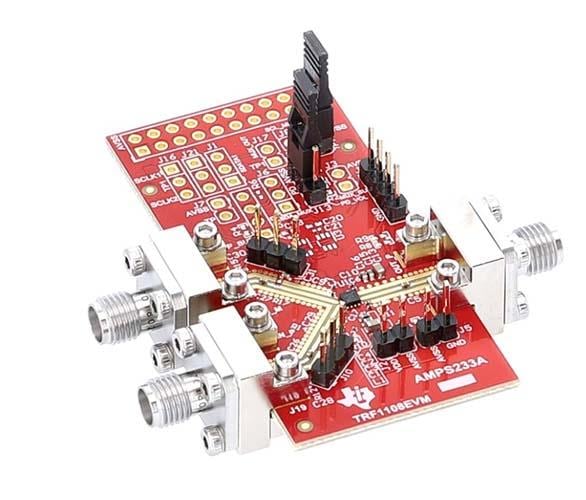
Why these development tools matter in practical design work
An evaluation board helps reduce uncertainty when testing an IC in a realistic setup. Instead of building a custom test platform from scratch, engineers can quickly review signal response, biasing behavior, frequency handling, and interoperability with surrounding circuitry. This is especially valuable when amplifier performance is closely tied to filters, mixers, clocks, converters, or wireless transceiver sections.
In many projects, amplifier-related validation is not isolated. It often sits within a larger signal chain that includes conversion, timing, switching, and RF routing. For that reason, teams comparing products in this category may also review nearby platforms such as data conversion IC development tools or clock and timer development tools when building a complete evaluation environment.
What you will typically find in this category
This category includes boards and kits designed to support bench evaluation of analog and RF ICs that influence amplification paths or interact closely with them. Depending on the design objective, the board may focus on gain stages, mixer behavior, switching, attenuation, oscillation, or wireless transceiver signal handling.
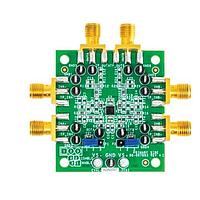
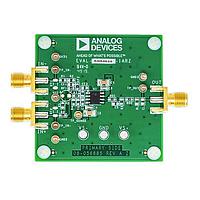
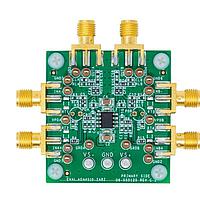
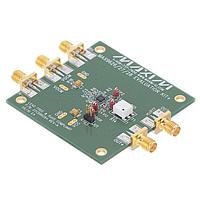
Examples from this range illustrate that scope well. The Analog Devices ADL5801-EVALZ board supports evaluation of an active mixer across a wide frequency span, while the Honeywell HRF-AT4510-E board is used in attenuator-related testing. Kits such as the Maxim Integrated MAX2609EVKIT for VCO evaluation or the MAX2671EVKIT for mixer-related development are also relevant when amplifier design depends on frequency generation and RF signal translation rather than gain alone.
Typical applications and engineering use cases
These tools are commonly used during proof-of-concept work, reference testing, and subsystem optimization. In RF and wireless projects, engineers may use an evaluation board to verify how an amplifier path behaves alongside mixers, oscillators, or 2.4 GHz transceiver sections before integrating everything onto a custom PCB.
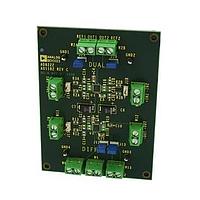
For example, the Microchip Technology RN-XV-EK1 and Maxim Integrated MAX2830EVKIT+ are useful in wireless development scenarios where signal integrity and front-end interaction matter. In a different context, a board such as the Analog Devices AD8174-EBZ can support switching and routing evaluation in systems where multiple analog paths need to be managed efficiently. If your design also involves neighboring analog stages, it may be worth reviewing active filter development tools as part of the same signal-chain study.
How to choose the right board or evaluation kit
The best starting point is the signal-chain role of the IC you need to test. Some boards are intended for direct RF signal translation, some for wireless transceiver validation, and others for supporting functions such as attenuation, switching, or frequency generation. Choosing by application first is usually more effective than comparing boards only by name or package format.
Frequency range is another practical filter. A board intended for 10 MHz to 6 GHz work, such as the ADL5801-EVALZ, serves a very different task from a kit built around a lower-band oscillator or a fixed 2.4 GHz wireless transceiver. Supply content also matters: some kits arrive as a board only, while others include accessories such as cables that make bench setup easier. When your work extends into adjacent analog subsystems, this amplifier development tools range can be compared alongside related options for broader evaluation planning.
Featured manufacturers and platform examples
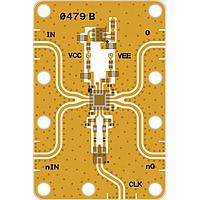
Analog Devices is strongly represented in this category with several evaluation platforms covering mixers, RF ICs, and analog switching. Examples include the ADL5801-EVALZ, AD6654/PCB, 109998-HMC522LC4, 109998-HMC521LC4, and AD8174-EBZ, each relevant to different parts of an analog or RF design workflow.
Maxim Integrated also appears prominently with kits such as the MAX2609EVKIT, MAX2830EVKIT+, and MAX2671EVKIT, supporting oscillator, transceiver, and mixer evaluation. Other useful examples in the broader lineup include the Infineon EVALBGA125N6TOBO1 for RF/radio development, the Microchip Technology RN-XV-EK1 for Wi-Fi-related work, and the Adafruit 1697 nRF8001 Bluetooth breakout board for compact wireless prototyping and interface testing.
Where these tools fit in a broader development ecosystem
Amplifier-related evaluation rarely happens in isolation. Engineers often combine these boards with lab power supplies, spectrum or network measurement equipment, signal generators, and embedded controllers to characterize real operating conditions. The goal is not only to confirm that the IC works, but to understand how it behaves within the larger architecture.
That broader view is especially important in mixed-signal and communications projects. A design may require coordination between gain stages, converters, oscillators, and wireless modules, so platform selection should reflect the whole system path. In some cases, teams also compare options from adjacent categories such as audio IC development tools when amplifier behavior is tied to end-application signal quality.
Points to review before ordering
Before selecting a board, check whether the tool matches your target IC or related device family, intended operating band, and bench setup requirements. It is also worth confirming whether you need a compact breakout-style platform for fast prototyping or a more complete evaluation kit intended for deeper characterization.
In B2B purchasing environments, this step helps engineering and procurement stay aligned. A suitable development board can shorten validation time, reduce rework, and provide a more reliable path from lab testing to production design decisions.
Choosing the right development platform depends on how the amplifier function interacts with the rest of your analog or RF design. By reviewing application fit, frequency context, and ecosystem compatibility, teams can narrow the options to boards that support meaningful testing rather than just basic bring-up. This category is designed to help that selection process with practical tools from established suppliers and representative evaluation platforms.
Get exclusive volume discounts, bulk pricing updates, and new product alerts delivered directly to your inbox.
By subscribing, you agree to our Terms of Service and Privacy Policy.
Direct access to our certified experts