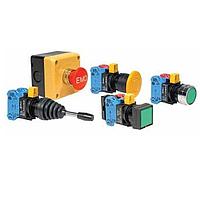
Control Switches
Clear operator input is still essential in modern control panels, machine stations, and power distribution assemblies. Whether the goal is to select an operating mode, start a sequence, isolate a circuit, or provide a keyed control point, Control Switches help bridge human action and electrical control logic in a reliable, panel-ready format.
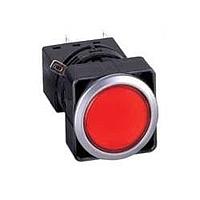
This category brings together panel-mount switching devices used across industrial automation, OEM equipment, building systems, and electrical control cabinets. The range includes selector styles, lever-operated devices, key-operated configurations, disconnect-oriented products, and related auxiliary or transfer components that support a broader switching architecture.
Where control switches fit in industrial systems
In practical use, these devices are chosen when an operator needs a defined manual command with a clear mechanical position. That may mean a maintained 2-position or 3-position selector, a spring-return lever, a keylock function for restricted access, or a disconnect-oriented handle for switching power paths in a controlled way.
Unlike sensors or software-only interfaces, control switches provide a direct and visible control point on the panel. In many applications they work alongside contactors, relays, indicators, and protective devices, and in some designs they are paired with safety switch solutions when operator access and machine state must be managed more carefully.
Common types found in this category
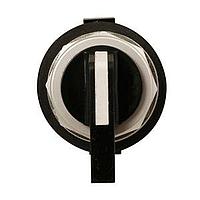
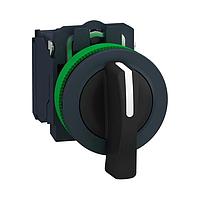
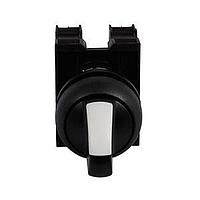
The category scope is broad enough to cover several functional styles. Selector switches are among the most common, often used for Auto/Manual, Forward/Off/Reverse, Local/Remote, or similar control logic. Lever and knob actuators are typical where tactile position feedback matters and where the switch state must be obvious at a glance.
Key-operated models are useful when a machine mode or electrical function should only be changed by authorized personnel. For example, the SIEMENS 3SU11502BL601NA0 keylock switch illustrates a 3-position, panel-mount approach for controlled access at the operator interface. Auxiliary switching elements and transfer components also appear in this category because they help extend or adapt the main switching assembly rather than acting as standalone signaling devices.
Representative products and application context
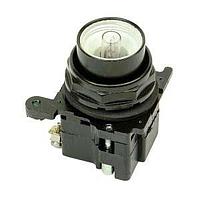
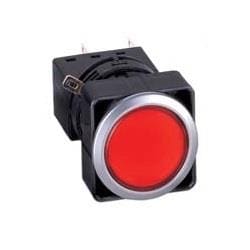
Several listed products show how varied control switch requirements can be. The Eaton Q18LWK3-RT/WB is an illuminated 3-position selector style suited to panels where switch visibility is important, while the Eaton M22-WRK3-1-K11 represents a non-illuminated 3-position option with a more conventional selector role. These examples reflect the common need to balance operator feedback, panel space, and environmental protection.
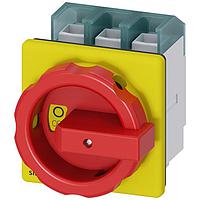
For more heavy-duty or power-oriented applications, the category also includes products such as the Littelfuse 08080200 battery disconnect and Eaton Bussmann switching-related items like the RD1200-4 and BDZW30 transfer component. In these cases, the switch function connects more directly to circuit isolation or fusible disconnect arrangements, which may overlap with applications commonly associated with disconnect switches.
Key selection criteria before ordering
Choosing the right device starts with the required actuation method and operating behavior. Knob, lever, handle, and keylock designs all serve different user interactions. You should also confirm whether the switch is maintained or momentary, and whether a 2-position or 3-position arrangement matches the intended control sequence.
Electrical and mechanical details also matter. Contact form, number of poles, termination style, mounting format, and voltage or current suitability all affect compatibility with the final assembly. Environmental conditions should not be overlooked either, especially when panel equipment may be exposed to dust, washdown, oil, or outdoor service; this is where IP-rated options can become important.
Illumination is another decision point. An illuminated switch can improve status recognition in low-light or busy panel environments, while a non-illuminated model may be preferred when separate pilot lights already provide state indication. In higher-duty applications, expected operating life and temperature range are also useful considerations during specification review.
Leading manufacturers in this range
This category includes products from established industrial brands, with Eaton and SIEMENS especially visible in the representative product set. Eaton models in this category cover compact illuminated selectors, heavy-duty operator devices, and panel control components used in a wide range of OEM and industrial installations. SIEMENS contributes selector and keylock styles that align well with structured control panel design.
Eaton Bussmann and Littelfuse are also relevant where switching functions relate more closely to circuit isolation, fusible arrangements, or battery disconnect applications. While brand preference often depends on installed system standards and panel architecture, it is usually more important to match the switch type, contact configuration, mounting format, and operating environment to the actual application.
How control switches relate to accessories and surrounding hardware
A control switch is rarely selected in isolation. Many installations also require contact blocks, legends, mounting hardware, adapters, or transfer-related parts depending on the switch family and enclosure design. That is why accessory compatibility should be checked early in the selection process, particularly when replacing an existing operator on a legacy panel.
If your project includes auxiliary mounting parts or complementary hardware beyond the switch body itself, it may also be helpful to review other switch accessories. Looking at the surrounding ecosystem can reduce fitment issues and help maintain consistency across the finished control station.
Typical use cases across panels and equipment
Control switches are widely used in machine tools, HVAC control assemblies, generator and power systems, material handling equipment, and process control panels. A 3-position selector may be used to choose an operating mode, while a spring-return lever can issue a temporary command. Keylock variants are often selected for maintenance mode, override functions, or restricted system changes.
At the same time, disconnect-oriented products support battery systems, service isolation points, and power distribution tasks where manual switching must be deliberate and robust. This breadth is what makes the category useful for both compact operator stations and larger electrical assemblies.
Choosing with fewer surprises
When comparing options, it helps to begin with the control function rather than the product family name. Define the operator action, number of positions, contact logic, mounting constraints, and environmental exposure first, then narrow the selection to the appropriate switch style. That approach is usually more reliable than choosing by appearance alone.
For buyers sourcing replacement parts or specifying new builds, this category offers a practical starting point for panel-mounted manual control devices. Reviewing switch behavior, enclosure conditions, and accessory needs up front will make it easier to identify a control switch that fits the application cleanly and supports dependable operation over time.
Get exclusive volume discounts, bulk pricing updates, and new product alerts delivered directly to your inbox.
By subscribing, you agree to our Terms of Service and Privacy Policy.
Direct access to our certified experts