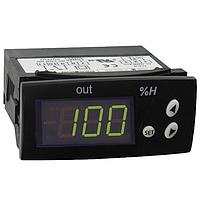
Humidity Switches
Stable humidity control matters in far more places than comfort alone. In process rooms, cabinets, storage areas, packaging lines, and HVAC-related applications, the ability to monitor relative humidity and trigger a switching action at the right point helps protect equipment, maintain product quality, and support consistent operating conditions.
Humidity switches are designed for exactly that role. They combine humidity sensing with on/off control logic, making them a practical choice when a system needs to activate a fan, alarm, relay-driven device, or other control element once a defined humidity threshold is reached.
Where humidity switches are typically used
These devices are commonly selected when operators need a straightforward control response rather than continuous closed-loop regulation. Typical use cases include condensation prevention in electrical enclosures, humidity management in air handling systems, environmental control in storage spaces, and process support in areas where excess moisture can affect materials or electronics.
In many installations, a humidity switch acts as a field-level decision point. When humidity rises above or falls below the configured setpoint, the switch output can start or stop connected equipment. That makes this category especially relevant for users looking for reliable threshold-based control with simpler integration than a full building management or PLC-driven strategy.
What to look for when selecting a humidity switch
The right choice usually depends on a few practical factors: input type, supply voltage, switching method, display requirements, and environmental protection. For panel or machine integration, buyers often compare whether the device supports a voltage or current signal, whether it uses AC supply power, and whether the relay output matches the load being controlled.
It is also important to consider the operating environment. Features such as IP-rated enclosure protection, visible LED display, and non-volatile memory can be useful in industrial settings where operators need clear local indication and stable settings retention after power interruptions. If the switch will be installed near washdown areas, dusty machinery, or variable ambient conditions, enclosure and temperature range become especially relevant.
Dwyer options in this category
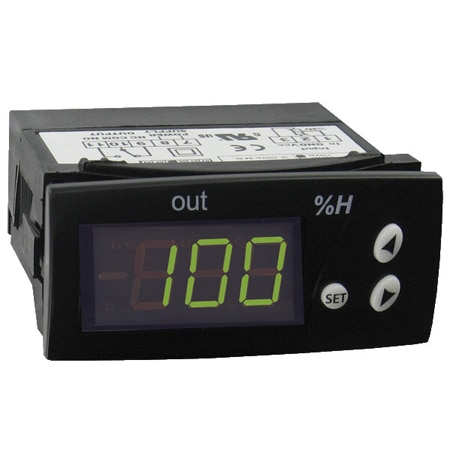
This category includes models from Dwyer, a well-known name in environmental and process instrumentation. Within this range, several models are built around compact form factors, relay-based control output, and a digital display that supports local visibility during setup and operation.
Examples include the Dwyer HS-111 and HS-112 for 0 to 1 V applications, the HS-311 and HS-312 for 0 to 3 V input requirements, and the HS-411 and HS-412 for 4 to 20 mA signal configurations. Across these variants, users can identify a common design approach focused on threshold switching, local indication, and practical integration into control panels or equipment where humidity status needs to trigger an action.
Understanding input and control differences
Not every installation uses the same signal standard, which is why input compatibility is a key selection point. Some systems are based on voltage signals such as 0 to 1 V or 0 to 3 V, while others rely on the widely used 4 to 20 mA current loop. Choosing a humidity switch that aligns with the existing sensor or control architecture can simplify commissioning and reduce the need for additional signal conversion.
On the control side, these models use relay outputs with selectable SPDT NO/NC switching, which is useful when interfacing with fans, alarms, contactor coils, or other control devices. If your project involves broader switching hardware, it may also be useful to review related categories such as solid state switch options for applications where electronic switching is preferred over mechanical relay behavior.
Display, setup, and day-to-day operation
For many industrial buyers, usability matters almost as much as the switching function itself. Models in this category feature a 3-digit LED display that helps operators confirm readings and settings directly at the device. This can be valuable during startup, troubleshooting, or routine maintenance, especially in cabinets or local control stations where quick visual feedback saves time.
Some featured units also include password protection and error message functions, which can help reduce unintended parameter changes and support more controlled operation in shared or production environments. These are practical features rather than marketing extras: they can improve consistency when multiple technicians or shifts interact with the same equipment.
How humidity switches fit into a broader switching system
Humidity-based control is often only one part of a larger electrical or automation setup. A switch may be paired with contactors, alarms, ventilation equipment, heaters, or interlocks depending on the process objective. In that context, the device should be evaluated not only for sensing range and accuracy, but also for how it interacts with the rest of the control chain.
Where isolation and maintenance safety are part of the design, related switching products such as disconnect switches or safety switches may also be relevant. These are not substitutes for humidity switches, but they often appear in the same cabinet or machine design where environmental control needs to work alongside safe electrical operation.
Choosing the right model for your application
If you are narrowing down options, start with the basics: required signal type, available supply voltage, and the load that the relay output will control. Then confirm whether the installation needs local display visibility, password-protected setup, or enclosure protection suited to the environment. A technically correct match usually comes from system compatibility first, and convenience features second.
For users specifically comparing this category with adjacent products, you can also browse the full range of humidity switches on this page to evaluate fit by application and control preference. The best option is usually the one that integrates cleanly into the existing sensing and switching architecture without unnecessary complexity.
Final considerations
When moisture levels can influence equipment reliability, material condition, or room stability, a humidity switch offers a focused and efficient control solution. The models highlighted here are suited to applications that need clear setpoint-based switching, practical panel integration, and dependable local operation.
By comparing input type, relay behavior, supply requirements, and environmental suitability, buyers can select a device that supports both immediate control needs and long-term maintainability. A well-matched humidity switch helps turn environmental monitoring into actionable control without overcomplicating the system.
Get exclusive volume discounts, bulk pricing updates, and new product alerts delivered directly to your inbox.
By subscribing, you agree to our Terms of Service and Privacy Policy.
Direct access to our certified experts