Power Transformer
Stable power distribution is a basic requirement in HVAC panels, building automation cabinets, industrial control systems, and measurement loops. When equipment depends on clean secondary voltage and predictable isolation, selecting the right Power Transformer becomes more than a wiring decision. It directly affects reliability, protection, and long-term operation of connected devices.
On this page, you can explore power transformer options commonly used to step voltage, isolate circuits, and supply 24 Vac or regulated DC power to transmitters, controllers, and related field instruments. The range shown here is especially relevant for panel builders, maintenance teams, and OEMs looking for practical solutions for low-voltage control power.
Where power transformers fit in control and instrumentation systems
In many industrial and commercial installations, incoming supply voltage is not always suitable for direct use by sensors, transmitters, or control electronics. A transformer helps convert available input power to a usable secondary voltage while also providing a degree of electrical isolation between circuits. This is especially important in building automation, HVAC equipment, and distributed control panels.
Depending on the application, users may need a classic AC transformer for 24 Vac loads or a compact supply that supports DC-powered instrumentation. If your project also involves broader voltage conditioning requirements, related solutions such as 1-phase voltage stabilization may be worth reviewing alongside transformer selection.
Typical configurations available in this category
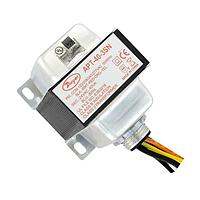
The products highlighted in this category reflect several common approaches to low-voltage control power. The Dwyer APT series represents isolated AC transformers designed around 24 Vac output, a standard choice for HVAC and building automation devices. These models are offered in multiple input voltage ranges and mounting styles, which helps simplify integration into different panel layouts.
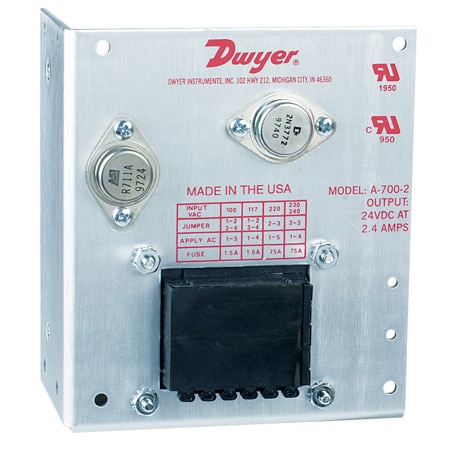
For applications that require DC output rather than AC secondary voltage, products such as the Dwyer BPS-005 compact DC power supply provide adjustable DC output from a 24 Vac/Vdc input. Open-frame options such as the Dwyer A-700, A-700-2, and A-700-4 are also relevant where instrumentation power must be delivered efficiently inside a protected enclosure.
Common applications for 24 Vac and DC control power
A large share of control transformers in this segment are selected for 24 Vac service. That output is widely used across actuators, thermostatic controls, relays, and building management interfaces. In these systems, the transformer is not simply a power accessory; it is part of the control architecture that keeps field devices supplied with the correct operating voltage.
DC power supplies become more relevant when pressure, temperature, or air velocity transmitters require regulated DC input. The Dwyer A-700 series is specifically positioned for Dwyer pressure, temperature, and velocity transmitters, making it suitable for instrumentation loops where stable DC output and low ripple matter. For buyers already standardizing around Dwyer instrumentation, matching the power source to the transmitter environment can help streamline installation and maintenance.
How to choose the right power transformer or supply
The first step is matching the input voltage available in the panel or field enclosure. Some transformer models in this category are designed for 120 Vac input, while others accommodate wider ranges such as 120 to 480 Vac. This matters in retrofit work, multi-site deployments, or export-oriented systems where supply conditions vary.
The next consideration is output type and load requirement. If the downstream device expects 24 Vac, an isolated AC transformer is usually the correct choice. If the load requires regulated DC voltage, a DC power supply is more appropriate. Capacity should also be checked carefully, whether expressed in VA for transformers or current output for DC supplies, so that the selected unit supports the connected devices without pushing the power source too close to its limit.
Mounting style and protection details also play a practical role. In real control cabinets, slotted foot mounting, conduit hub arrangement, pigtail lead termination, and built-in overcurrent protection can influence installation time and service access. These mechanical and electrical details are often just as important as nominal voltage values when selecting equipment for B2B projects.
Examples from the available product range
Several Dwyer APT models illustrate how transformer selection changes with installation requirements. The APT-100-1SB and APT-100-1DB are 24 Vac isolated AC transformer options for 120 Vac input, with different hub configurations. Models such as APT-100-2SB and APT-100-2DB target 240 Vac input, while APT-100-5SB and APT-100-5DB cover wider 120 to 480 Vac input ranges for more flexible deployment.
Where higher control power capacity is needed, the APT-150-1DB extends the available VA rating within the same general 24 Vac application space. On the DC side, the BPS-005 is useful for compact panel-mount conversion, while the A-700 family addresses transmitter power requirements with open-frame construction. Together, these examples show that this category supports both classic transformer-based control power and supporting DC conversion needs within the same ecosystem.
Related solutions worth comparing
Not every power issue is solved by a transformer alone. In facilities with unstable supply conditions, users may also need equipment that addresses voltage fluctuation before power reaches the control circuit. In those cases, it can be useful to compare this category with 3-phase voltage stabilization solutions for larger systems or power distribution environments.
Likewise, projects focused on lighter-duty single-phase conversion may benefit from reviewing 1-phase transformer LiOA options. Looking across these related categories helps buyers decide whether they need isolated control power, broader voltage correction, or a combination of both in the final design.
What matters in day-to-day operation
For maintenance teams, a good transformer or power supply is one that performs consistently with minimal intervention. That means choosing units suited to the site’s ambient conditions, expected humidity, enclosure space, and connected load profile. Protection features such as fusing or resettable breakers can also reduce downtime and simplify troubleshooting when an abnormal condition occurs.
Compliance markings and standard low-voltage output formats are also relevant in commercial and industrial procurement. They support easier specification, safer integration, and more predictable replacement planning over the life of the system. In practice, the best choice is usually the model that aligns cleanly with the actual control architecture rather than the one with the broadest headline rating.
Find the right transformer for your control power design
This category is intended for users who need dependable low-voltage power conversion for automation, HVAC, and instrumentation tasks. Whether you are selecting a 24 Vac isolated transformer, comparing input voltage options, or identifying a DC supply for transmitters, the available range provides practical choices for panel and field applications.
Review the electrical input, output type, capacity, and mounting format of each model in relation to your actual load and installation conditions. A well-matched power transformer or supply helps create a more stable, serviceable, and scalable control system from the start.
Get exclusive volume discounts, bulk pricing updates, and new product alerts delivered directly to your inbox.
By subscribing, you agree to our Terms of Service and Privacy Policy.
Direct access to our certified experts