Decoding and Resolving Power Quality Issues
Continuous operation pressure in modern manufacturing plants places severe demands on low-voltage power distribution systems. The dense presence of non-linear loads—such as large variable frequency drives (VFDs), electric arc furnaces, and power converters—generates complex distorted currents. Instead of operating steadily, internal power grids continuously suffer from high-order harmonics, voltage sags, phase unbalance, frequency anomalies, and leakage currents. These hidden culprits cause thermal losses in transformer windings and force automation lines to shut down abruptly.
The key to breaking this vicious cycle lies in shifting strategies from reactive troubleshooting to advanced monitoring, precisely isolating each type of power anomaly from its earliest stages.
Voltage Sag and Transient Spikes Causing Semiconductor Component Damage
Whenever high-power motors start or transient short circuits occur on the upstream power grid, sudden voltage drops drag along transient spikes lasting mere microseconds. Invisible to the naked eye and easily missed by standard relays, this energy is capable of quietly puncturing the insulation of semiconductor components and freezing PLC control systems.
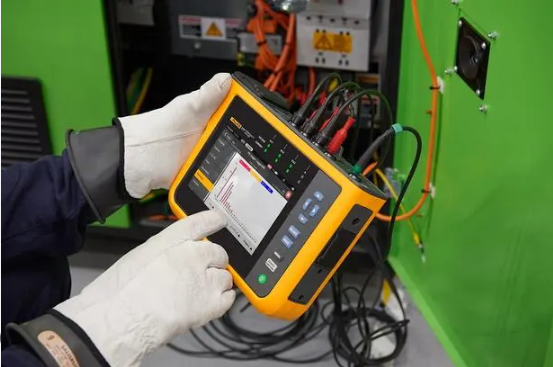
To keep production lines safe from unexpected paralysis, technical teams require the capability to capture high-voltage transients up to 20 kV directly at the main switchboard (MSB). The
High-Order Harmonics and Voltage Flicker Eroding Performance
The proliferation of switch-mode power supplies, power electronics, and LED lighting systems causes consumed current to fall completely out of phase with voltage. Third, fifth, seventh, and eleventh-order harmonics circulate through the neutral conductor, overheating cables, blowing power factor correction capacitors, and corrupting metering indices. Operating alongside harmonics, voltage flicker generated by welding machines or screw compressors causes light amplitude fluctuations, fatiguing operators and disturbing sensitive measurement equipment.
Pinpointing dominant harmonic orders according to the IEC 61000-4-30 standard requires specialized testing tools. The
Phase Unbalance and Short-Term Voltage Sags Damaging 3-Phase Motors
Load imbalances across phases A, B, C—stemming from improper single-phase load distribution or a blown fuse branch at a substation—produce large negative-sequence currents. The direct consequence is severe mechanical vibration in 3-phase motors, high heat generation in the stator, and a sharp decline in electromechanical conversion efficiency. Concurrently, short-term root-mean-square (RMS) voltage sags dropping 10% to 90% below nominal levels trigger reboots in automated welding robots or trip critical contactors.
Resolving this challenge thoroughly requires testing individual phase currents under full-load conditions combined with long-term monitoring of voltage sag events. The
Frequency Variations, Leakage Current, and Low Power Factor
Beyond the phenomena above, factory power grids also face frequency variations when generator output or renewable energy fails to match load demands, disrupting real-time clocks and synchronous motors. Another hazardous issue is ground/earth leakage current caused by insulation degradation or grounding faults, which easily leads to electrical shock hazards and smoldering fires. Additionally, a low power factor caused by large inductive loads (such as motors running under light loads) incurs monthly reactive power penalties from the electric utility.
Strictly controlling these parameters demands flexible measurement solutions right at the source. The high-end
=> Register to attend the Seminar to listen to EMIN analyze electrical anomalies and discover power quality monitoring solutions at:
SEMINAR: "Early Detection & Prevention of Plant Failures, Solutions Ensuring Continuous Operation"