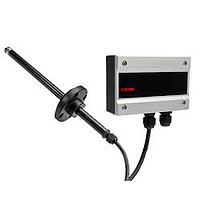
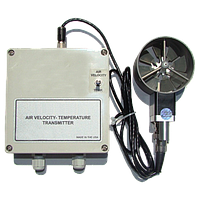
Air Velocity Transmitter
Stable airflow data is essential in ventilation control, cleanroom monitoring, HVAC balancing, and process environments where air movement directly affects product quality, comfort, or energy performance. An Air Velocity Transmitter helps turn that airflow condition into a continuous signal that can be monitored by a PLC, BMS, or other control system.
In practical installations, these transmitters are often selected not only for air speed measurement, but also for how well they fit the full application: probe length, cable length, output type, environmental conditions, and whether temperature and humidity should be monitored at the same point. That combination matters when engineers need reliable field data rather than a simple spot reading.
Where air velocity transmitters are commonly used
Air velocity transmitters are widely applied in ducts, air handling systems, technical rooms, laboratories, and controlled production spaces. They are especially useful where airflow must be tracked continuously instead of being checked occasionally with a handheld meter.
Typical use cases include verifying minimum airflow in ventilation systems, supporting room pressurization strategies, monitoring local air movement in process areas, and feeding live data into automation platforms. In many projects, they are paired with other environmental devices such as carbon monoxide and carbon dioxide transmitters or particulate transmitters to create a broader air quality monitoring setup.
Why output type matters in system integration
One of the first selection points is the transmitter output. In this category, available examples include both Modbus output and 0-10 Vdc output, which suit different control architectures.
For digital networks, Modbus can simplify communication where multiple parameters are collected and managed centrally. For more conventional analog integration, 0-10 Vdc remains a practical choice in many building and industrial control panels. Choosing the right output early helps avoid unnecessary interface hardware and makes commissioning more straightforward.
If your application focuses specifically on airflow monitoring without additional environmental variables, it may also be useful to review the broader air velocity transmitter range to compare installation styles and signal options.
Combined measurement of air speed, temperature, and humidity
Several products in this category illustrate a more integrated approach: measuring air speed together with temperature and humidity. This can be valuable in ventilation studies, conditioned air distribution, storage environments, and process spaces where airflow alone does not give the full picture.
Examples from Senseca include the HD29S371TC and HD29V371TC series, which combine these parameters in one transmitter assembly. For designers and maintenance teams, a combined device can reduce the number of field instruments needed at the measurement point and support more coherent environmental monitoring.
Probe length and cable length in real installations
Mechanical fit is often underestimated during specification. In practice, the available probe length can influence how well the sensor reaches the correct measurement zone, especially in ducts or installations where the sensing point is not close to the mounting location.
The listed Senseca models show several probe configurations, including 215 mm, 415 mm, and 570 mm versions, along with cable lengths such as 2 m, 5 m, and 10 m. A shorter cable may be adequate for compact panels, while longer cable versions can make installation easier when electronics and sensing point must be separated. Matching these dimensions to the actual layout can save time during mounting and reduce the need for field modifications.
Examples from the current product range
For projects requiring Modbus communication, models such as Senseca HD29S371TC302, HD29S371TC205, and HD29S371TC310 represent different combinations of probe and cable dimensions. This gives integrators some flexibility without changing the basic measurement concept.
Where analog control input is preferred, products such as Senseca HD29V371TC302, HD29V371TC305, and HD29V371TC310 provide 0-10 Vdc output while maintaining the same general application focus. Across these examples, the stated air speed ranges support low to moderate airflow measurement scenarios often seen in HVAC and environmental monitoring.
Beyond the featured products, buyers may also compare manufacturers such as Dwyer, OMEGA, KANOMAX, Rotronic, Sauermann, and Adtek depending on project standards, preferred interfaces, and installation requirements.
Key factors when selecting an air velocity transmitter
Selection should start with the measurement task rather than the model code. Consider the airflow range you need to monitor, whether the process involves low air speed detection, and whether the transmitter will be mounted in a duct, room, cabinet, or localized air stream.
It is also important to review the electrical and environmental requirements. In the available products, the stated power supply options and probe operating conditions indicate suitability for a range of industrial and building applications, but final selection should always reflect the real installation environment. If temperature and humidity data are also relevant, a multifunction transmitter may be more efficient than deploying separate devices.
- Output signal: Modbus for networked systems or 0-10 Vdc for analog integration
- Probe geometry: choose a length that reaches the intended sensing area
- Cable length: align with panel position and mounting constraints
- Measured parameters: air velocity only, or air velocity with temperature and humidity
- Application environment: verify operating temperature, humidity, and installation conditions
How this category fits into wider air monitoring projects
In many facilities, airflow is only one part of the environmental control strategy. Air velocity transmitters are often deployed alongside gas, particle, temperature, and humidity instrumentation to build a more complete picture of indoor air conditions and process stability.
That is why category-level comparison is useful. Instead of selecting purely by part number, engineers can evaluate whether the requirement is basic airflow transmission, a multi-parameter environmental transmitter, or a broader monitoring solution that combines several sensing technologies in the same area.
Choosing the right option for your application
The right transmitter depends on how and where the measurement will be used. Some applications prioritize communication protocol, others need a specific probe length, and many require a balance between installation practicality and control system compatibility.
This category is intended to support that comparison process with models suited to continuous airflow measurement in technical and industrial environments. By focusing on output type, probe format, cable length, and the need for additional temperature and humidity data, it becomes much easier to narrow down the most appropriate air velocity transmitter for the job.
Get exclusive volume discounts, bulk pricing updates, and new product alerts delivered directly to your inbox.
By subscribing, you agree to our Terms of Service and Privacy Policy.
Direct access to our certified experts