Automotive Fuses
Electrical faults in vehicles and mobile equipment can escalate quickly when high current circuits are left unprotected. In applications ranging from passenger cars to lift trucks, the right Automotive Fuses help isolate overloads and short circuits before they damage wiring, control units, battery systems, or auxiliary devices.
This category brings together fuse formats commonly used in automotive and transport-related DC systems, including blade, cartridge, glass, torpedo, and bolt-down styles. For buyers, maintenance teams, and design engineers, the key is not only matching current and voltage ratings, but also selecting a fuse body style and response characteristic that suits the installation environment.
Where automotive fuses are used
Automotive fuse protection is found across low-voltage and higher-voltage DC circuits in vehicles, commercial fleets, material handling equipment, and related electrical subsystems. These components are used to protect power distribution lines, lighting, control circuits, battery-connected accessories, HVAC branches, charging paths, and other loads exposed to vibration, temperature variation, and intermittent inrush current.
Compared with many general-purpose fuse types, automotive designs are often selected with practical installation constraints in mind. Space limits, service access, mounting method, and visual identification all matter, especially in compact fuse blocks or battery-adjacent assemblies. In some cases, engineers may also compare these devices with resettable fuse options when maintenance access and automatic recovery are part of the design strategy.
Common fuse styles in this category
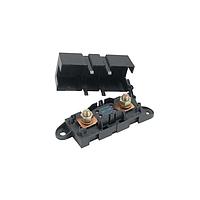
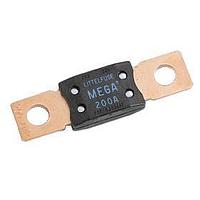
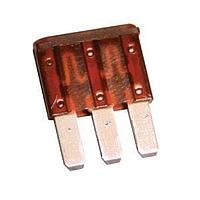
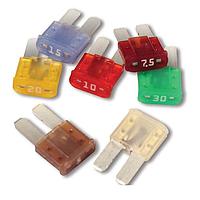
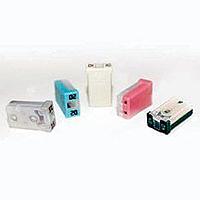
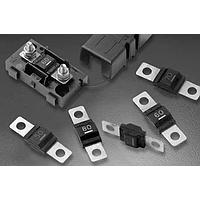
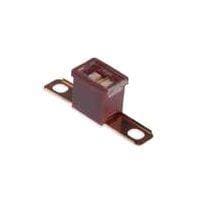
This range covers several familiar physical formats. Blade fuses are widely used where easy replacement and standardized holders are required, while glass cartridge styles remain relevant in certain legacy or compact circuits. Torpedo designs can appear in specific automotive applications, and bolt-down fuses are typically chosen for higher-current branches where secure mechanical fastening and lower-resistance connections are important.
For example, Eaton SFE-14 represents a glass automotive cartridge approach for lower-current protection, while Eaton AMG-100 illustrates a bolt-mounted format intended for substantially higher current levels. On the higher-power side, Bel fuse families such as 0ALA, 0AKN, 0AKR, and 0AKK show how blade-style automotive fuses can extend into demanding DC applications with larger physical sizes and elevated current ratings.
How to choose the right automotive fuse
The first step is to confirm the electrical requirements: rated current, system voltage, and expected fault conditions. A fuse should carry normal operating current without nuisance opening, yet respond predictably when an overload or short circuit occurs. That means the protection device needs to be coordinated with wire size, connector capability, and the behavior of the load.
Mounting style is equally important. Holder-mounted fuses are practical for serviceable panels, while bolt-down versions are more suitable for battery feeds, distribution blocks, and heavy-current equipment. Response characteristic also matters: fast-acting options may be preferred where semiconductor-sensitive circuits are involved, while slower cutoff behavior can be useful where temporary inrush must be tolerated. Buyers evaluating broader protection strategies may also review HRC fuse solutions for applications that demand a different interruption profile.
Examples of products in this range
Several representative products help illustrate the scope of this category. The Littelfuse 0AGW02.5V is a compact glass automotive fuse suited to lower-current circuits, while the Littelfuse 156.5611.5401 is a stud-mount ceramic fuse designed for bolt-down installation in more demanding environments, including lift truck-related use noted in the product data.
For medium to high current protection, Eaton AMG-100 and Littelfuse 142.5631.5502 show how bolt-mount automotive fuses are used where current capacity, mechanical security, and DC performance are critical. Bel devices such as 0ALABK150-BA, 0AKNBK125-BB, 0AKRBK200-BB, and 0AKK-K250-BA further demonstrate that automotive fuse selection can extend into higher-voltage DC architectures, where fuse size, terminal arrangement, and application-specific integration become more important than a simple amperage match.
Manufacturer coverage and sourcing considerations
This category includes products from widely recognized circuit protection suppliers such as Littelfuse, Eaton, and Bel. Each brand has a different footprint across automotive and industrial-adjacent vehicle systems, so availability of replacement parts, compatibility with installed holders, and preferred package style may influence the final selection.
For B2B procurement, it is often useful to standardize around a manageable set of approved manufacturers and fuse formats. This can simplify maintenance, reduce mismatched replacements, and improve consistency across fleets, control panels, or mobile machinery platforms. When comparing options, buyers should also verify whether the requirement is for OEM replacement, new design integration, or an equivalent form factor within a qualified sourcing framework.
Selection factors beyond the datasheet headline
Headline specifications such as current and voltage are essential, but they are not the whole story. Breaking capacity, temperature exposure, body material, and the intended installation environment can all affect long-term reliability. In vehicle and mobile equipment use, vibration resistance and secure termination are especially relevant, particularly for high-current battery-connected circuits.
Serviceability should also be considered early. If a fuse is expected to be replaced in the field, a familiar and accessible holder-based format may save time. If the goal is robust protection in a distribution point that should not be disturbed frequently, a bolt-down fuse can be the better fit. In mixed systems, teams may also use complementary categories such as alarm indicating fuses where fast troubleshooting and fuse status visibility are important.
Supporting reliable vehicle and mobile equipment protection
Choosing from an automotive fuse category is ultimately about matching the protection method to the real operating conditions of the circuit. A small glass fuse, a torpedo style, or a high-current bolt-mounted fuse may all be correct choices depending on load profile, service approach, and installation constraints.
By focusing on electrical rating, fuse format, mounting method, and application context, buyers can narrow the range efficiently and avoid overspecifying or underprotecting the circuit. If your project involves compact control branches, battery-connected feeders, or higher-power DC systems, this category provides a practical starting point for selecting automotive fuse solutions that align with both performance and maintenance needs.
Get exclusive volume discounts, bulk pricing updates, and new product alerts delivered directly to your inbox.
By subscribing, you agree to our Terms of Service and Privacy Policy.
Direct access to our certified experts