Fuse Kits
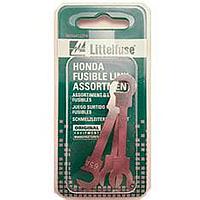
When maintenance teams, panel builders, and service departments need to replace protection devices quickly, having the right assortment on hand matters just as much as choosing the correct fuse. Fuse Kits help streamline troubleshooting, field service, prototyping, and inventory control by grouping commonly used fuse types, values, holders, or related accessories into a practical package.
For industrial and commercial buyers, this category is especially useful when the goal is to reduce downtime, support multiple equipment platforms, or simplify replenishment across maintenance stock. Instead of sourcing individual parts one by one, buyers can compare kits built around specific fuse families, application formats, or service needs.
Where fuse kits are most useful
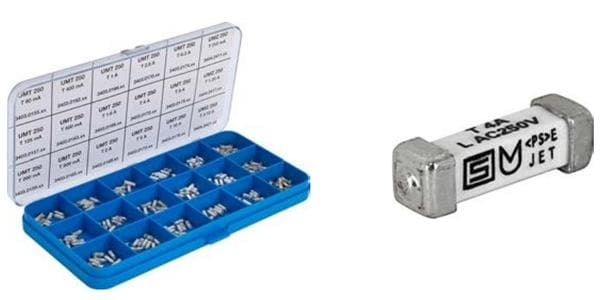
In many real-world environments, replacement speed and organization are critical. Fuse kits are commonly used in maintenance workshops, field service vehicles, electrical panels, repair benches, and production support areas where technicians need immediate access to replacement fuses without searching through mixed inventory.
They are also useful during design validation and service preparation. A kit may support evaluation of different current ratings or package styles, while a holder-focused assortment can help teams standardize installation hardware. In applications that require compact board-level protection, buyers may also compare these solutions with SMD fuse options when selecting parts for electronics assemblies.
What you will typically find in this category
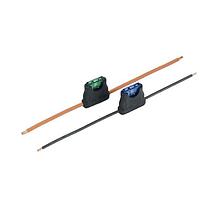
This category covers more than simple fuse assortments. Depending on the product, a kit may include a selection of fuse values, a group of related holders, pullers, display packs, or application-specific packaging intended to support servicing and stock management. That makes the category relevant not only for replacement purchasing, but also for workshop organization and distributor-style replenishment.
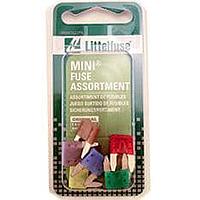
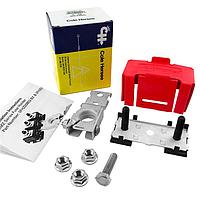
Examples from this range illustrate that variety. The Littelfuse 185.6100.9612 kit is oriented toward a holder and puller assortment approach, while the Littelfuse 0FHZ00853-BX kit focuses on a fuse holder format. Other items, such as the Eaton Bussmann NO.150 ATM mini fuse assortment, are designed around a specific fuse family that can be useful for technicians supporting compact low-voltage systems.
Selection factors that matter for B2B buyers
The most effective way to choose a kit is to start with the equipment base you support. If your team services automotive-style blade fuses or compact DC systems, a mini fuse assortment may be more practical than a broad mixed kit. If the main requirement is service readiness for panel repair or field replacement, assortments that include handling accessories or holder-related parts may be a better fit.
Buyers should also review the fuse format, current range coverage, and whether the kit is intended for replenishment, design evaluation, or display use. Some products in this category are clearly suited to workshop stocking, while others are better for engineering review or organized service programs. Where systems involve vehicle and transport-style protection layouts, it can also help to compare with automotive fuse categories to align the kit with the installed base.
Illustrative product types in this range
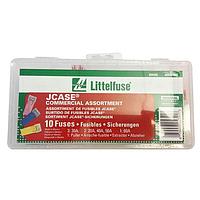
Several products in this category show how different kit strategies support different workflows. The Littelfuse 0695030.U Fuse Kits 32VDC 30A MCase is an example of a kit centered on a defined fuse style and rating family, which can be useful where consistency of replacement parts is important. The Littelfuse 00940381Z SMD Kit highlights the role of compact protection assortments for electronics-related applications.
On the industrial service side, larger assortments such as the Littelfuse FRCK-OG or the Eaton Bussmann 1A9722 6-bin display can support organized storage and quick part identification in maintenance environments. For specialized design work, the Bourns SF-KIT-HV-1 SinglFuse Design Kit - High Voltage illustrates how a kit can serve as a development or evaluation resource rather than only a replacement stock item.
Leading manufacturers commonly considered
Brand choice often reflects the protection architecture already used in the equipment you maintain. Littelfuse appears strongly in this category with kits covering holder assortments, compact fuse families, and workshop-oriented packaging. These options can be relevant for buyers managing mixed service requirements across electronics and power distribution tasks.
Eaton Bussmann is also a key reference for fuse assortments and related service accessories, including mini fuse assortments, display-oriented packs, and supporting hardware such as the H79-1 door handle kit. Depending on the application, buyers may choose between a manufacturer-specific ecosystem for consistency or a kit structure that best matches stocking and maintenance practices.
How fuse kits fit into a broader protection strategy
A kit is most valuable when it supports a clear maintenance or engineering process. For example, a service department may keep fast-moving assortments near equipment lines, while engineering teams use dedicated kits to validate protective device choices during development. In either case, the benefit comes from reducing delays in identifying and installing the correct part.
Fuse kits also work best when viewed as part of a wider circuit protection plan. If the application requires high breaking capacity in demanding installations, buyers may need to review HRC fuse solutions alongside service assortments. In low-power electronics or self-recovering designs, replacement kits may be complemented by resettable protection approaches in other parts of the system.
Practical buying considerations
Before ordering, it is worth checking whether the priority is broad assortment coverage, compatibility with a known fuse family, inclusion of holders or pullers, or storage convenience for technicians. Packaging style can be especially important for maintenance teams that need clear organization, bin-level access, or portable stock for field use.
It is also useful to think about consumption patterns. A compact assortment may be enough for occasional service work, while a larger drawer or display format may better support repetitive maintenance and distributed inventory. Choosing the right kit structure can improve replacement speed, reduce stock duplication, and make procurement more predictable over time.
Conclusion
Choosing from this Fuse Kits category is less about finding a generic assortment and more about matching the kit to the way your team designs, services, or stocks protection components. Whether you need a compact mini fuse assortment, a holder-focused service kit, or a more structured workshop package, the right option can simplify maintenance and improve parts availability where downtime matters.
By comparing kit scope, fuse family, accessory content, and manufacturer alignment, B2B buyers can build a more practical and organized protection inventory. That makes this category a useful starting point for teams that want faster replacement workflows and better day-to-day control of fuse-related maintenance items.
Get exclusive volume discounts, bulk pricing updates, and new product alerts delivered directly to your inbox.
By subscribing, you agree to our Terms of Service and Privacy Policy.
Direct access to our certified experts