Industrial & Electrical Fuses
Protecting electrical circuits is rarely about choosing a generic replacement part. In industrial panels, power distribution systems, control cabinets, and electronic assemblies, the right fuse helps limit damage, improve serviceability, and support safer fault isolation when overloads or short circuits occur. This page brings together Industrial & Electrical Fuses used across a wide operating range, from small glass cartridge formats to high-capacity industrial protection devices.
For buyers, maintenance teams, and design engineers, fuse selection usually depends on more than current rating alone. Voltage class, interrupting capacity, response characteristic, mounting style, and physical size all matter, especially when the fuse must match the protection philosophy of the equipment and the available holder or fuse block.
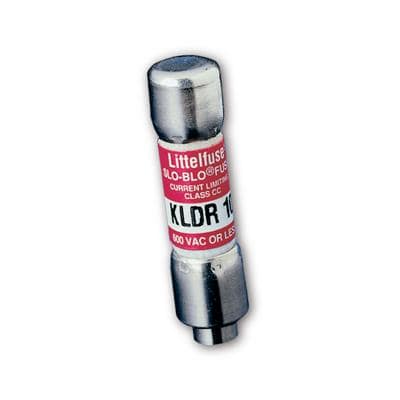
Where industrial and electrical fuses are used
These fuses are commonly specified in machinery, industrial power systems, control enclosures, utility-related equipment, and electronic devices that need predictable overcurrent protection. In practice, they may protect branch circuits, control transformers, semiconductor devices, low-voltage distribution sections, or dedicated subcircuits inside OEM equipment.
The category spans several protection scenarios. Some applications need time-delay protection to tolerate inrush current from motors or transformers, while others require fast interruption to protect sensitive electronics and semiconductor assemblies. That is why industrial fuse ranges often include cartridge, glass, ceramic, midget, square-body, and bolt-mount formats rather than a single universal style.
Common fuse types in this category
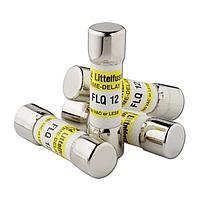
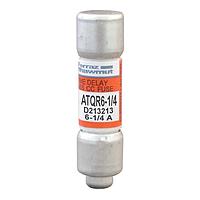
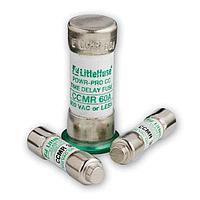
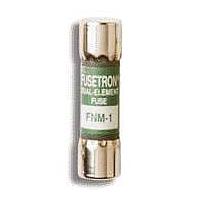
A large part of the range consists of cartridge fuses for holder-based installation. These are widely used because they are easy to replace and available in compact formats such as 5.2 x 20 mm, as well as larger industrial sizes. Glass and ceramic cartridge designs are both represented, with each format suited to different visibility, thermal, and breaking-capacity requirements.
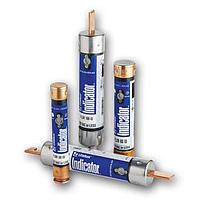
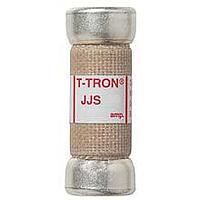
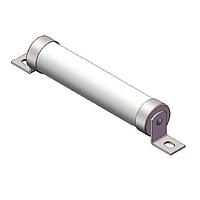
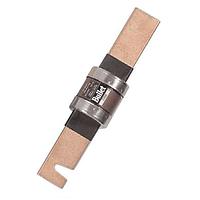
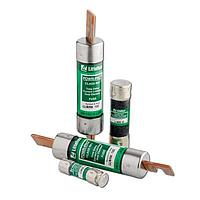
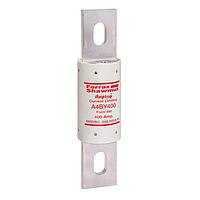
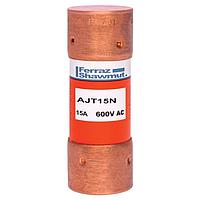
You will also find specialized industrial formats such as midget fuses, Class RK5 and Class K5 types, as well as square-body and bolt-mount designs for higher-power duty. For example, Eaton BAF-25 Midget and Eaton FRS-R-3-1/2 illustrate how industrial fuse construction changes as current level, installation environment, and fault energy increase. Where applications demand very high fault interruption or protection of power semiconductors, engineers may also compare this range with dedicated HRC fuse options.
Time-delay, fast-acting, and high-speed behavior
One of the first selection decisions is the fuse response characteristic. A time-delay fuse is designed to withstand temporary surge current without opening unnecessarily. That makes it useful in equipment with startup inrush, such as transformers, relays, solenoids, or certain motor-related circuits. A good example is the Eaton Bussmann MDL-1/2-R time-delay glass tube fuse, which suits applications where nuisance opening must be minimized.
Fast-acting or high-speed cutoff fuses are chosen when the protected circuit includes sensitive components that can be damaged quickly under fault conditions. Littelfuse 0217.400H Fast and Littelfuse 021606.3TXP show the type of compact fuse often used where quick interruption is more important than temporary surge tolerance. In power electronics or semiconductor protection, response speed and let-through energy can be especially important.
Examples from leading manufacturers
This category includes products from established circuit protection suppliers such as Eaton, Eaton Bussmann, Littelfuse, and Bourns. Each brand is relevant in different parts of the protection landscape, from general-purpose cartridge fuses to more application-specific industrial formats.
Representative products in the range include Eaton NON-40 Class K5 for traditional industrial protection, Eaton ACK-400 Slow Blow for higher-current DC-related applications, Littelfuse LA070URD32LI1000 for high-speed industrial duty, and Bourns SF1206SA200W2 for compact board-level use. These examples show that the category is not limited to one installation style; it supports both panel-level and device-level circuit protection needs.
How to choose the right fuse for your application
Start by confirming the electrical basics: rated current, AC or DC voltage, and the prospective fault current the fuse may need to interrupt. The breaking capacity must be appropriate for the circuit, because a fuse that matches the current rating but not the available fault level may not provide the intended protection.
Next, verify the required operating characteristic. If the circuit has startup surges, a slow-blow or time-delay model may be more suitable. If the load includes electronics, instrumentation, or semiconductors, a fast-acting design may be preferred. Physical considerations also matter, including dimensions, mounting method, and compatibility with existing holders or clips.
In many projects, it is also useful to look at adjacent protection technologies. Compact electronic assemblies may be better served by SMD fuses, while applications exposed to repetitive temporary faults may benefit from resettable fuse solutions. The best choice depends on whether the priority is one-time fault isolation, easy field replacement, or automatic recovery.
Industrial selection considerations beyond the datasheet headline
In real-world maintenance and procurement, the nominal current value is only the starting point. Service teams often need to match the original fuse class, physical envelope, and response curve to avoid unexpected downtime or coordination issues with upstream and downstream protection devices. This is particularly important in legacy equipment, where a replacement that physically fits may still behave differently under overload or fault conditions.
Environmental and operational conditions should also be reviewed. Ambient temperature, repetitive cycling, vibration, and the nature of the load can all influence fuse performance over time. For compact or board-level designs, smaller formats may be preferable, while large industrial feeders or high-energy circuits may require physically larger, higher-capacity fuse constructions.
Finding the right fit for maintenance, retrofit, and OEM supply
For replacement work, the most efficient path is to match the installed fuse by class, dimensions, voltage rating, current rating, and speed characteristic, then confirm the interrupting capability. For new designs, engineers typically start from the circuit behavior and protection target, then narrow the options by package style and installation method.
This category is intended to support both approaches. Whether you are sourcing a common cartridge fuse for a control cabinet, a midget fuse for industrial distribution, or a high-speed model for equipment protection, the range helps you compare practical options from recognized manufacturers without losing sight of the application requirements.
Choosing the right fuse is ultimately about coordination between the circuit, the fault risk, and the maintenance strategy. By reviewing response type, voltage class, interrupting rating, and form factor together, you can narrow the selection more confidently and identify the industrial fuse that fits the equipment as well as the protection objective.
Get exclusive volume discounts, bulk pricing updates, and new product alerts delivered directly to your inbox.
By subscribing, you agree to our Terms of Service and Privacy Policy.
Direct access to our certified experts