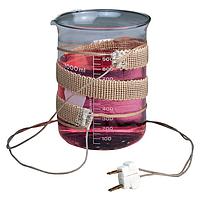
Surface Heaters
When heat needs to be applied directly onto a vessel, pipe, plate, or other contact surface, the heating method matters as much as the target temperature. Surface heaters are used in many laboratory, industrial, and process environments because they transfer heat through direct contact, helping users warm media, maintain temperature, or reduce heat loss in a controlled way.
On this page, you can explore surface heating solutions suited to practical B2B applications, from small-scale lab setups to process support tasks. The category is especially relevant where flexible installation, localized heating, and repeatable thermal performance are required.
Where surface heaters are commonly used
Unlike heating systems that warm air or immerse directly into liquid, surface heaters work by contacting the outside of the object being heated. This makes them suitable for containers, metal parts, tubing, glassware support, and other applications where external heat transfer is preferred. In many cases, they are chosen to improve process stability without redesigning the main equipment.
Typical use cases include maintaining sample temperature, supporting fluid handling, preventing condensation, and assisting thermal processes around lab reactors or process lines. Depending on the installation, users may also compare these products with strip heaters when a rigid, linear heating format is more appropriate.
Flexible heating for round and irregular surfaces
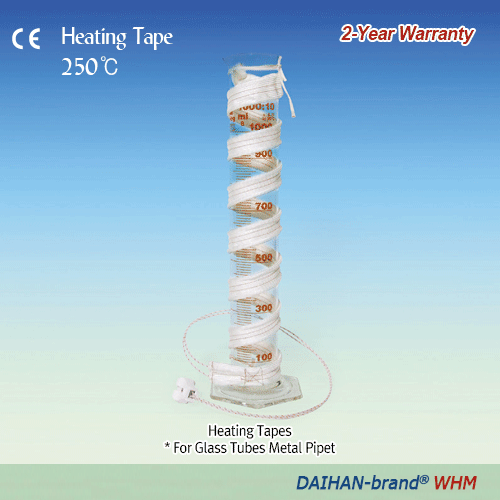
One of the most practical formats in this category is the heating tape. This design is useful when the heated object is cylindrical, narrow, or difficult to cover with a solid heater body. A tape-style heater can wrap around the target area and deliver more focused thermal contact than a general ambient heating method.
Several listed products illustrate this approach, particularly the heating tape range from DaiHan. Examples include the DH.WHM12322, DH.WHM12324, and DH.WHM12328, which span different lengths and wattages while sharing a maximum temperature rating of 250℃. This variation helps buyers match heater size and power level to the geometry and thermal demand of the application rather than relying on a one-size-fits-all setup.
How to choose the right surface heater
Selection usually starts with the shape and dimensions of the part or vessel being heated. For a narrow section, a smaller tape width may be easier to install, while a longer wrap length can help cover more surface area on larger components. Buyers should also consider how tightly the heater must conform to the surface, since contact quality directly affects heat transfer efficiency.
The next step is evaluating wattage, operating temperature, and the purpose of the heating task. If the goal is temperature maintenance, lower power may be sufficient. If the heater must raise temperature more quickly or compensate for heat loss in an exposed environment, a higher wattage model may be more suitable. Products such as the DaiHan DH.WHM12311 at 200W and DH.WHM12327 at 550W show how the category can support different heating loads within the same general product family.
Understanding size, power, and installation fit
In surface heating applications, dimensions are not just a mechanical detail; they strongly influence real-world performance. A heater that is too short may create uneven warming, while one that is too large may be awkward to mount or may heat beyond the intended zone. Matching the heater length to the circumference or coverage area is often one of the most important practical decisions.
For example, this category includes models in narrower 1.3 cm formats such as DH.WHM12314, DH.WHM12315, and DH.WHM12316, as well as wider 2.5 cm options like DH.WHM12323 through DH.WHM12328. That gives buyers flexibility when balancing coverage, mounting space, and heating density. In some systems, users may also evaluate cartridge heaters if internal bore heating is needed instead of surface wrapping.
Comparing surface heaters with other industrial heating methods
Surface heaters are often selected when direct contact heating is required without placing the heating element inside the process medium. That makes them a useful option for external thermal support, especially in retrofits or modular setups. They can be easier to integrate than immersion-style products in applications where the process fluid must remain isolated from the heater.
However, they are not the right choice for every duty. If the application involves heating liquid from within a tank, immersion heaters may be the more suitable category. If the process depends on non-contact radiant energy over an exposed area, users may instead review radiant heaters. The best result usually comes from matching the heater form factor to the heat transfer path required by the process.
Manufacturer options and product consistency
This category may be relevant to buyers looking across multiple industrial heater brands, including OMEGA and DaiHan. In the current product examples, DaiHan is strongly represented with a range of heating tapes that make it easier to compare similar designs across different lengths and power ratings. That kind of consistency is useful in purchasing environments where standardization matters across multiple stations or repeated installations.
For engineering, maintenance, and procurement teams, a structured product family also simplifies replacement planning. When heater width, temperature class, and construction style remain consistent across several variants, it becomes easier to scale from a small bench setup to a broader operational requirement without changing the basic heating concept.
What buyers should confirm before ordering
Before selecting a surface heater, it is worth checking the heated object's dimensions, material, target temperature, and expected heat-up behavior. Surface condition also matters: smooth, stable contact areas generally support more predictable heating than loose or uneven mounting conditions. Where thermal control accuracy is important, the heater should be evaluated as part of the full system rather than as an isolated component.
It is also helpful to confirm the practical operating environment, including insulation, exposure to ambient airflow, and whether the heater is being used for warming, maintaining temperature, or compensating for losses. These factors affect the required power more than the nominal heater rating alone. Reviewing the available length and wattage combinations in this category can help narrow the shortlist efficiently.
Find the right surface heating format for your application
Choosing among surface heaters is usually less about finding a generic product and more about matching the heater to the actual thermal task. Tape-style models are especially useful where flexibility, wrap-around installation, and external contact heating are priorities. For buyers working with laboratory equipment, process tubing, containers, or compact heated zones, that can make this category a practical starting point.
If you are comparing options for direct-contact heating, review the available dimensions, power levels, and manufacturer range carefully. A well-matched surface heater can support safer installation, more stable thermal performance, and easier integration into existing systems.
Get exclusive volume discounts, bulk pricing updates, and new product alerts delivered directly to your inbox.
By subscribing, you agree to our Terms of Service and Privacy Policy.
Direct access to our certified experts