Blender
Fast sample preparation often depends on having the right mixing and size-reduction tool at the bench. In laboratory workflows, a compact blender or pulverizer can support tasks such as homogenizing liquid samples, reducing dry materials, and preparing small batches for analysis, formulation, or routine process checks. This category brings together practical equipment for those needs, from hand blenders to grinder-equipped units and compact pulverizers.
Where blender and pulverizer equipment fits in lab work
Blender equipment is commonly used when materials need to be mixed, dispersed, or homogenized quickly and consistently. Depending on the sample form, users may need a hand blender for flexible liquid preparation, a blender with grinder for broader material handling, or a pulverizer for dry sample reduction into finer particles.
In many labs, these tools support pre-treatment before measurement, inspection, or further processing. They are also useful when repeatability matters, because a stable preparation step can improve downstream consistency. If your application also involves related sample handling tools, it may be helpful to review other laboratory equipment around the same workflow, though selection should always be based on the material type and target result.
Typical product groups in this category
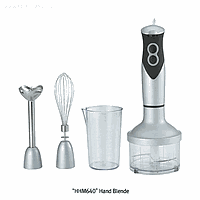
This category includes several practical formats. Hand blenders are suitable for direct mixing of liquids or semi-liquid samples in smaller vessels, while blender-with-grinder models offer added versatility for users who need both blending and basic grinding capability in one setup.
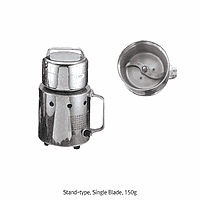
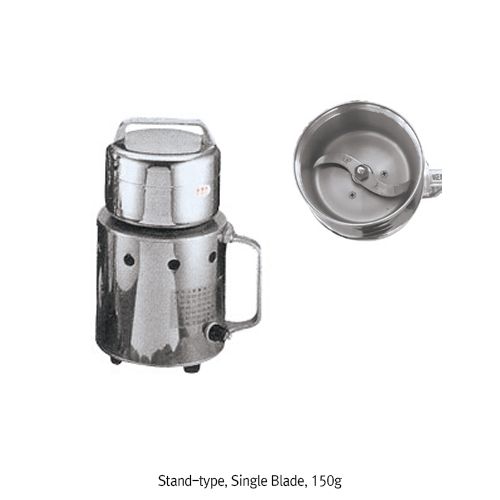
For dry materials that require stronger particle reduction, compact pulverizers are often the better fit. Models such as the Mill Powder Tech M8.RT02, M8.RT04, and M8.RT08 illustrate how this category can cover different batch sizes and form factors, including stand-type and tilt-type designs. On the blending side, examples like the HappyLock H2.HHM800 hand blender and HappyLock SL3.Ble3805 blender with grinder show the range from compact handheld use to larger-volume preparation.
How to choose the right unit for your application
The first factor is the sample form. Liquid and semi-liquid materials usually call for a blender-based solution, while dry, brittle, or granular materials are more likely to require a pulverizer. Choosing the wrong tool can affect processing time, ease of cleaning, and the consistency of the prepared sample.
The second factor is batch volume. In this category, available examples range from smaller 600 ml and 800 ml blender formats up to 1,600 ml and 3,200 ml units, as well as compact pulverizers designed for 150 g, 250 g, or 350 g handling. Matching the vessel size or processing capacity to your actual routine use helps avoid overloading, underutilization, and unnecessary cycle repetition.
It is also worth considering operating style. A hand blender may be more convenient for flexible bench use and fast transfer between containers, while a stand-type or tilt-type pulverizer can be more appropriate when dry sample preparation needs a more defined and repeatable setup.
Featured brands and representative models
Mill Powder Tech is represented here with compact pulverizer models intended for small-scale material reduction. The M8.RT02 stand-type unit is a compact option for lighter batches, while the M8.RT04 and M8.RT08 tilt-type versions address larger capacities within the same general bench-top preparation context. These models are useful examples when the main requirement is grinding or pulverizing rather than liquid blending.
HappyLock appears in this category with a broader mix of blending formats. The H2.SGMF600 supports smaller-volume work, the H2.HMF1600PB and SL3.Ble3804 move into larger-volume preparation, and the H2.HMF3250S and SL3.Ble3805 represent higher-capacity blender-with-grinder options. For users focused on direct handheld mixing, the H2.HHM800 and SL3.Ble3801 provide a more compact hand blender approach.
Selection considerations beyond capacity
Capacity is important, but it should not be the only criterion. In practice, buyers also look at the intended duty pattern, bench space, material transfer method, and how easily the equipment can be cleaned between runs. For example, a larger vessel may be attractive on paper, but a smaller unit can be more efficient if your lab primarily handles frequent, low-volume batches.
Material compatibility matters as well. Stainless-steel construction, where specified in the product listing, may be relevant for users who prioritize durability and easier cleaning in routine operations. If your workflow involves adjacent preparation steps, you may also want to compare this category with related burner and torch equipment or sample-handling accessories used elsewhere in the lab environment.
When to choose a hand blender, blender with grinder, or pulverizer
A hand blender is generally the simplest choice when the main task is mixing liquids, suspensions, or soft materials directly in a beaker or container. It suits users who value mobility, quick setup, and straightforward operation for everyday bench work.
A blender with grinder is more suitable when one workstation needs to support more than one preparation style. This can be practical for labs or technical workspaces that handle varied materials and want a more flexible countertop solution. By contrast, a pulverizer is the stronger fit when the process centers on dry material reduction and finer particle preparation rather than fluid blending.
If you want to compare more options within related preparation tools, you can browse the wider blending equipment range in this section and narrow the choice by sample type, batch size, and operating format.
Supporting a more consistent preparation workflow
In laboratory and technical environments, sample preparation is rarely just a preliminary step. It can directly influence the quality of testing, inspection, or subsequent processing. Choosing equipment that matches the physical properties of the material and the scale of work helps reduce variation between runs and improves day-to-day usability for operators.
This Blender category is designed for users who need practical options across compact blending and pulverizing tasks. Whether the requirement is a handheld unit for smaller liquid batches or a dedicated dry-material pulverizer, the most effective choice will usually come from aligning the tool with the sample, the workload, and the way your team actually works at the bench.
Get exclusive volume discounts, bulk pricing updates, and new product alerts delivered directly to your inbox.
By subscribing, you agree to our Terms of Service and Privacy Policy.
Direct access to our certified experts