Outside Micrometers
When consistent dimensional control matters on the shop floor, a mechanical micrometer remains one of the most practical tools for checking external size, thickness, and diameter. Outside Micrometers are widely used in machining, metalworking, maintenance, inspection, and workshop environments where users need fine resolution without relying on batteries or electronic components.
Compared with faster but less precise handheld tools, an outside micrometer is designed for close-tolerance measurement of shafts, wires, sheet thickness, small parts, and finished components. For many B2B buyers, this category is not only about finding a measuring range, but also choosing the right frame style, contact geometry, and brand ecosystem for the application.

Where outside micrometers are typically used
An outside micrometer is built to measure the external dimension of a workpiece with high repeatability. Typical use cases include checking bar diameter, tube wall-related outer dimensions, plate or sheet thickness, small turned parts, and finished components before assembly or shipment.
In production and QA settings, these instruments are often selected where operators need dependable readings in repeated manual inspection routines. They are also useful in workshops where environmental conditions may not favor electronic devices. If your process also involves internal bore measurement, it can be helpful to compare with inside micrometers for the corresponding internal dimension tasks.
Why mechanical outside micrometers still matter
Even with the availability of digital models, many users still prefer the simplicity of a mechanical design. A traditional micrometer uses a precision screw mechanism to convert spindle movement into a readable measurement, making it suitable for routine inspection where durability, portability, and low maintenance are important.
Mechanical models are especially relevant in environments where operators value direct reading from the scale, stable use over long periods, and independence from power sources. For teams comparing manual and electronic workflows, this category often sits alongside digital outside micrometers, which may be preferred when faster data reading is the main priority.
Common types found in this category
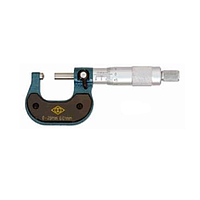
Not every outside micrometer is designed the same way. Standard external micrometers are the most common choice for general-purpose measurement of external diameters and thicknesses. Models such as the MOORE & WRIGHT MW200-02 External Micrometer and the MOORE & WRIGHT MW200-01BL Outside micrometer represent this familiar format for everyday workshop and inspection use.
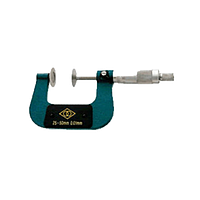
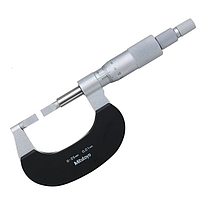
There are also more specialized variants for specific geometries. A point micrometer, such as the MOORE & WRIGHT MW270-06 Point Micrometer, is useful when the measuring contact needs to reach narrow features or particular profiles. A blade micrometer, like the MOORE & WRIGHT MW275-01 Workshop Blade Micrometer, is better suited to applications where thin edges, grooves, or restricted access make standard anvils less practical.
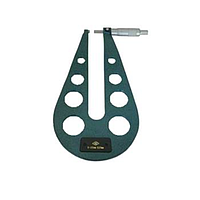
For larger workpieces, extended-range frames become important. The MOORE & WRIGHT MW210-06, MW210-07, and MW210-08 large external metric micrometers illustrate how this category can support measurement well beyond small-part inspection, while still maintaining fine resolution.
How to choose the right model
The first selection factor is the measuring range. In this category, examples include 0-25 mm, 25-50 mm, 50-75 mm, 75-100 mm, and much larger ranges up to 300 mm in the listed products. Buyers should choose a range that covers the target dimension without unnecessarily increasing frame size, since a more compact micrometer is often easier to handle and position correctly.
Resolution and accuracy also matter, but they should be considered in relation to the inspection requirement. Several products here use 0.01 mm resolution, which is suitable for many workshop and production measurement tasks. Accuracy values vary by model and range, so the right choice depends on the tolerance band of the part being checked rather than simply picking the smallest number available.
Another important point is the anvil and spindle geometry. Standard faces suit general external dimensions, while point or blade styles are better for narrow lands, thin sections, or features that cannot be reached with flat measuring faces. If the instrument will be used repeatedly at a bench, a micrometer stand can improve handling consistency and operator comfort.
Representative brands and product examples
This category includes products from well-known names used in industrial measurement. MOORE & WRIGHT appears prominently in the available selection, covering standard outside micrometers, special-purpose point and blade designs, and large-range external models. That makes it a practical reference brand when buyers need to compare general workshop tools with more application-specific instruments.
Other examples in the category include the METROLOGY OM-9003 Outside Micrometer for the 50-75 mm range and the SATA 91532 Outside Micrometer for 25-50 mm measurement. The broader manufacturer context on the site also includes brands such as MITUTOYO, Mahr, TPI, YATO, MICROTECH, and Samyon, giving purchasers more options depending on standardization needs, budget, and preferred brand ecosystem.
Good measurement practice for reliable results
Micrometer performance depends not only on the instrument itself, but also on how it is used. For better repeatability, the workpiece and measuring faces should be clean, the tool should be applied squarely to the part, and excessive measuring force should be avoided. Small handling errors can influence the result, especially when checking narrow tolerances or smaller diameters.
Users should also consider temperature effects and the physical size of the part. In routine inspection, stable technique matters as much as nominal instrument resolution. For this reason, many workshops standardize on a few preferred ranges and frame styles rather than mixing too many different formats in the same station.
When this category is the right fit
Outside micrometers are a strong fit when the task is focused on external dimensions and the process requires precise manual verification. They are commonly selected for incoming inspection, in-process checks, toolroom work, maintenance support, and final dimensional confirmation of machined or fabricated parts.
If your measurement scope includes internal diameters or blind bores, another micrometer type may be more appropriate. Likewise, if speed of reading or digital data capture is central to the workflow, a digital alternative may be worth evaluating. The right choice depends on the part geometry, tolerance, measurement frequency, and operator environment.
Choosing with confidence
A well-matched outside micrometer can improve daily inspection reliability without adding unnecessary complexity to the process. From compact 0-25 mm tools to larger external models for oversized parts, this category supports a wide range of workshop and industrial measurement needs.
When comparing options, focus on the actual measuring range, contact style, resolution, and working conditions rather than choosing by brand name alone. That approach makes it easier to identify a micrometer that fits the job, integrates smoothly into existing inspection routines, and delivers dependable mechanical measurement over time.
Get exclusive volume discounts, bulk pricing updates, and new product alerts delivered directly to your inbox.
By subscribing, you agree to our Terms of Service and Privacy Policy.
Direct access to our certified experts