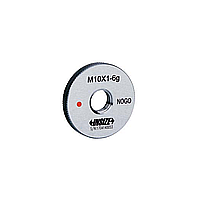
Thread Ring Gage
In threaded part inspection, a quick visual check is rarely enough. When a component must mate correctly in production, assembly, or final quality control, the practical question is simple: does the external thread pass or fail within the required tolerance? That is where Thread Ring Gage solutions are widely used across machining and metrology workflows.
These gauges help operators verify external threads consistently, without relying on subjective judgment or repeated dimensional interpretation. For manufacturers working with precision fasteners, shafts, fittings, and threaded mechanical parts, thread ring gauges remain a reliable tool for routine acceptance checks and process control.
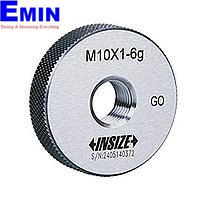
Why thread ring gauges are important in quality control
A standard ring gauge setup for external threads commonly follows a GO/NO-GO inspection principle. The GO side is intended to confirm that the thread can enter properly over the required length, while the NO-GO side helps identify threads that exceed the acceptable limit. This method is fast, repeatable, and highly practical on the shop floor.
Compared with purely visual checks or manual comparison, a thread ring gauge reduces operator variation. Instead of interpreting tiny graduations or making assumptions from appearance, the user verifies the functional fit of the thread directly. That makes these gauges especially useful for incoming inspection, in-process checks, and final release inspection.
How a thread ring gauge is typically used
In normal use, the threaded workpiece should be clean and free from burrs, chips, oil buildup, or contamination that could affect the result. The gauge is then applied carefully by hand, without forcing engagement. If the part enters the GO ring correctly and is rejected appropriately by the NO-GO ring, the thread can be judged against the intended acceptance criteria.
For accurate and repeatable results, handling conditions matter. Temperature stability, clean thread flanks, and proper storage all help maintain gauge performance over time. In controlled inspection environments, these details are important because even a robust gauge can produce misleading results if dirt, wear, or misuse is ignored.
What to consider when selecting a thread ring gauge
Choosing the right model starts with the thread form and size required by the application. Buyers typically look at the nominal thread designation, pitch, tolerance class, and whether the gauge is needed for production use, inspection use, or periodic verification. In many facilities, the goal is not simply to buy a gauge, but to match it to the actual inspection process.
Material quality and wear resistance are also key considerations. A thread ring gauge is a contact measuring standard, so repeated use inevitably creates friction on the thread surfaces. This is why buyers often prefer established metrology brands such as SOKUHANSHA or Niigata Seiki when consistent long-term inspection performance is important.
Representative products in this category
This category includes a range of SOKUHANSHA thread ring gauges used for external thread limit checking. Examples include the SOKUHANSHA M1182 GRIR II Screw Thread Limit Ring Gauge, SOKUHANSHA M115x1.5 GRIR II Screw Thread Limit Ring Gauge, and larger-size models such as the SOKUHANSHA M2003 GRIR II Screw Thread Limit Ring Gauge and SOKUHANSHA M2006 GRIR II Screw Thread Limit Ring Gauge.
Other listed options such as the SOKUHANSHA M1953 GRIR II, M1956 GRIR II, M1904 GRIR II, and M1853 GRIR II illustrate that this category covers multiple thread sizes for different inspection requirements. Rather than comparing products only by name, it is more useful to choose based on the actual thread specification used in your parts and the inspection frequency in your process.
Related gauging tools in the same inspection workflow
Thread inspection is often not done in isolation. In many workshops, operators also use a pitch gage to identify or confirm thread pitch before performing acceptance checks with a ring gauge. This helps reduce selection errors, especially when similar thread sizes are handled in the same production line.
Other supporting standards may also be relevant depending on the job. For example, a setting ring can be useful in gauge verification contexts, while a pin gauge may support dimensional checks on related features of the part. Using the right combination of tools improves traceability and makes inspection routines more efficient.
Handling, care, and maintenance
Because thread ring gauges are precision standards, everyday handling has a direct effect on service life. The gauge and the part should be cleaned before use, and engagement should always be done gently by hand. Forcing the gauge onto a damaged thread can accelerate wear and may also damage the inspection standard itself.
After use, it is good practice to remove residue and apply suitable protective oil if required for storage conditions. Keeping the gauge in a clean, dry location helps reduce corrosion risk and preserves measurement reliability. Over time, regular inspection and calibration review become important, especially in plants with frequent gauge usage.
When this category is the right fit
This category is suitable for users who need a straightforward pass/fail method for checking external threaded parts. It is particularly relevant in machining, component manufacturing, maintenance workshops, and QA departments where threaded fit must be controlled quickly and consistently.
If your application involves repeated verification of production threads, a properly selected thread ring gauge offers a practical balance between speed and control. Review the listed models against your required thread designation and inspection routine to choose a gauge that fits your process with fewer errors and more stable results.
Conclusion
Reliable thread inspection depends on more than just reading dimensions on a drawing. A well-matched thread ring gauge helps translate thread tolerance requirements into a clear pass/fail decision that operators can use with confidence. For manufacturers and inspection teams, that means faster checking, better consistency, and improved control over threaded part quality.
Explore the available models in this category according to your thread size and application needs. If your inspection process also includes thread identification or supporting dimensional checks, related tools such as pitch gages, setting rings, and pin gauges can help build a more complete gauging workflow.
Get exclusive volume discounts, bulk pricing updates, and new product alerts delivered directly to your inbox.
By subscribing, you agree to our Terms of Service and Privacy Policy.
Direct access to our certified experts