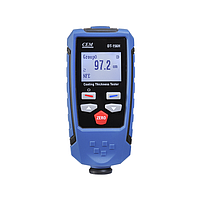
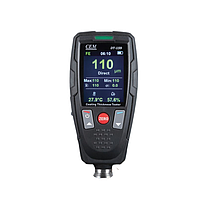
Coating thickness meter
Consistent film build is one of the key factors behind coating performance, corrosion resistance, product appearance, and process control. A coating thickness meter helps manufacturers, inspectors, and maintenance teams verify whether a paint or protective layer has been applied within the required range on metal substrates, without slowing down routine inspection work.
On this page, you can explore instruments used for dry film thickness measurement across common industrial applications such as painted steel parts, plated components, aluminum surfaces, fabricated structures, and general quality control in production or field inspection. The category includes compact handheld gauges, separate probe systems, and related probe accessories for different measuring conditions.
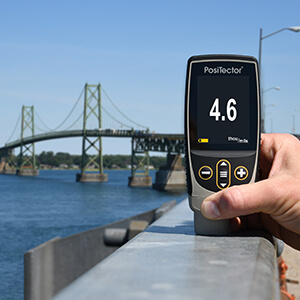
Why coating thickness measurement matters in industry
Coatings are applied for more than appearance. In many environments, they are critical for protecting the substrate against corrosion, wear, moisture, or chemical exposure. If the layer is too thin, protection may be insufficient; if it is too thick, it can affect curing behavior, dimensional tolerance, finish quality, or material consumption.
That is why dry film thickness is routinely checked in manufacturing, incoming inspection, maintenance, and coating verification. A suitable gauge supports repeatable measurements, faster documentation, and better control over rework, compliance, and coating cost.
Common measurement principles for metal substrates
Most instruments in this category are designed for coated metal surfaces and typically work using either magnetic induction or eddy current measurement. Magnetic induction is generally used for non-magnetic coatings on ferrous substrates such as steel, while eddy current measurement is typically used for insulating coatings on non-ferrous metals such as aluminum.
Some gauges are dedicated to one substrate type, and others support both Fe and NFe measurement. This distinction is important when choosing equipment for mixed-material production lines, contract inspection work, or maintenance teams that regularly move between steel and aluminum components.
For broader coating quality evaluation, users may also combine thickness measurement with tests such as adhesion testing or checks using coating hardness testers, depending on the inspection scope.
Typical instrument formats in this category
This category covers more than one instrument style. Compact handheld meters are often preferred for quick shop-floor checks and routine QC because they are easy to carry, simple to calibrate, and practical for spot measurements. Models such as the PCE CT 26FN and MOORE & WRIGHT MWT-2100 or MWT-2105 reflect this type of use, where portability and straightforward operation are important.
There are also advanced gauge systems with separate probes, useful when access is restricted or when a specific probe geometry is needed. Examples from ELCOMETER, such as the A456 series and T456 probe variants, illustrate how probe selection can affect usability on flat, curved, recessed, or difficult-to-reach surfaces.
In addition, some items in the listing are not standalone meters but supporting parts within the measurement ecosystem. Accessories such as the ELCOMETER T95016896 Mini Probe Housing Adaptor help adapt a probe setup to particular inspection tasks rather than acting as the main measuring device themselves.
What to consider when selecting a coating thickness meter
The first point is the substrate type. If you only measure coatings on steel, a ferrous-only solution may be enough. If your work includes aluminum or other non-ferrous substrates, a dual Fe/NFe instrument may be more practical and reduce the need for multiple devices.
Measurement range and accuracy are also important. Some typical products in this category cover ranges up to around 1250 μm, 1500 μm, or even 2000 μm, depending on the model. For example, the PCE CT 29-ICA is positioned for wider-range measurement, while ELCOMETER T456CF1R and T456CF1S probe options are designed for controlled coating thickness inspection with application-specific probe formats.
Beyond the core reading, buyers often look at resolution, memory, display readability, and data transfer. If inspection records must be documented or reviewed later, models with onboard memory or USB output can be useful. Where the gauge will be used outdoors or in more demanding environments, housing durability and resistance to dust or impact can also influence the decision.
Examples of products and use cases
For routine metal coating inspection, the PCE CT 26FN offers Fe/NFe capability in a compact handheld format, making it suitable for general-purpose checks across different metallic substrates. The PCE CT 29-ICA extends the concept with broader functionality, including statistical features and environmental readings in the supplied specification context, which may be helpful for users who want more than a basic spot-check instrument.
ELCOMETER products are well represented in this category, especially where probe configuration matters. The ELCOMETER A456CFBS and A456CFNFBS are examples of gauge platforms used with separate probes, while the ELCOMETER T456CF1R, T456CF1S, and T456CNM5R90A show how ferrous or non-ferrous measurement can be matched with probe style and access requirements.
For users looking for straightforward digital gauges, MOORE & WRIGHT MWT-2100 and MWT-2105 provide options based on magnetic induction or eddy current test methods. This kind of distinction is useful when the inspection task is clearly tied to one substrate family and the measurement workflow needs to stay simple.
Where these meters are commonly used
Coating thickness meters are used in metal fabrication, finishing lines, protective coating inspection, maintenance workshops, and incoming or outgoing quality control. Typical applications include painted steel structures, coated machine parts, aluminum components, powder-coated assemblies, and maintenance inspection of protective layers on industrial assets.
They are also relevant when coating quality needs to be assessed alongside other defects or discontinuities. In some workflows, thickness verification may be followed by checks using a holiday detector to identify coating discontinuities, especially when surface protection performance is critical.
Choosing by workflow rather than by specification alone
In practice, the right instrument is not selected by range alone. It should fit the actual inspection workflow: the substrate material, access to the test area, expected thickness band, reporting needs, and whether the meter will be used in a lab, on a production line, or in the field. A compact handheld unit may be ideal for fast pass/fail checks, while a separate-probe system may be better for tighter access or more varied part geometry.
It is also worth considering whether your quality process only involves coated metal surfaces or extends to other materials. If your work includes layers on non-metal substrates, a dedicated gage for non-metal applications may be more suitable than a standard metal-substrate coating meter.
Final thoughts
A reliable coating thickness meter supports better coating control, clearer inspection decisions, and more efficient use of materials across manufacturing and maintenance. Whether you need a simple handheld gauge, a dual-substrate model, or a probe-based system for more specific geometries, the most effective choice is the one that matches your substrate, measurement environment, and documentation needs.
Explore the products in this category to compare measuring approaches, probe configurations, and practical features for your coating inspection workflow.
Get exclusive volume discounts, bulk pricing updates, and new product alerts delivered directly to your inbox.
By subscribing, you agree to our Terms of Service and Privacy Policy.
Direct access to our certified experts