Embedded Computers
When control systems, edge data collection, and machine-level computing need to run reliably in limited space, selecting the right embedded computers becomes a practical engineering decision rather than a simple hardware purchase. This category is built for industrial and technical B2B use cases where compact design, stable operation, flexible I/O, and long-term deployment matter more than consumer-style specifications.
Within this range, buyers can evaluate systems for factory automation, gateway tasks, DIN-rail control cabinets, and edge processing applications. The focus is on hardware that can support continuous operation, connect to field devices, and fit into broader industrial architectures with fewer integration compromises.
Where embedded computers fit in industrial systems
In many installations, an embedded computer acts as the local processing layer between field signals, network infrastructure, and higher-level software platforms. It may collect sensor data, communicate with PLCs or serial devices, run visualization software, or support protocol conversion at the edge. Compared with general-purpose office PCs, these systems are typically designed for harsher environments, compact mounting, and more predictable long-term operation.
This makes them especially relevant in machine automation, transportation systems, building control, and distributed monitoring. If your application requires a broader comparison across industrial computing platforms, you can also review related embedded computing options alongside device-specific selections in this category.
Typical form factors and deployment styles
A large share of industrial embedded systems is designed around DIN-rail installation, compact wall mounting, or cabinet integration. This helps simplify deployment inside control panels where space is limited and wiring density is high. Enclosures in aluminum or other rugged housings also support better thermal behavior and mechanical durability in demanding sites.
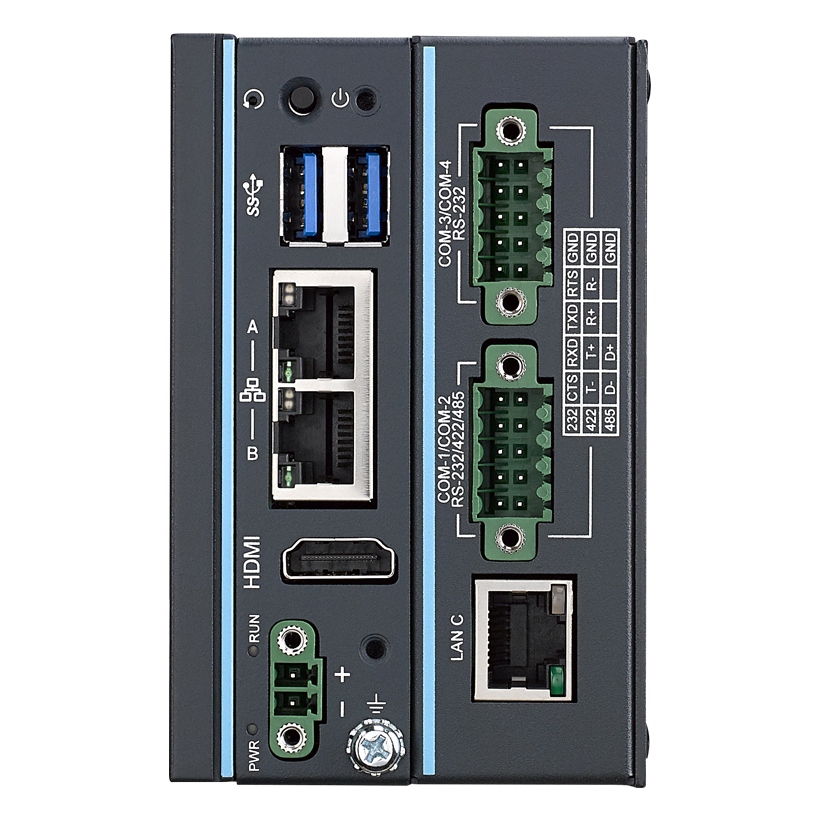
Examples in this category illustrate several deployment styles. The Advantech UNO-127-E22BA and UNO-127-E23BA are pocket-size DIN-rail edge IPCs suited to compact installations, while the UNO-148 series targets applications that need more performance and broader expansion. For data acquisition and lightweight gateway roles, the UNO-420 shows how embedded platforms can combine processing with field connectivity in a highly integrated package.
Key selection criteria for industrial buyers
The most effective way to compare embedded computers is to start from the application rather than the processor alone. Buyers typically look at processing class, power input range, operating temperature, network interfaces, serial communication, storage options, security functions, and available expansion. In industrial environments, these factors often have more impact on project success than headline CPU speed.
For example, a control cabinet application may prioritize multiple isolated serial ports, wide DC input, and DIN-rail mounting. An edge analytics node may place more weight on Ethernet capacity, SSD support, memory headroom, and supported operating systems. In both cases, it is useful to confirm whether the target device must support Windows, Linux, or Ubuntu-based environments before standardizing a platform.
Examples from the Advantech range
Advantech is one of the most visible manufacturers represented in this category, and the available models show how embedded computers can be matched to different workloads. The UNO-137-E13BA and UNO-1372G fit smaller machine or gateway deployments where a compact footprint and integrated I/O are important. These systems are often considered for equipment interfaces, distributed monitoring points, and cabinet-level control tasks.
For projects that need higher computing performance, the UNO-148-B33BA, UNO-148-B53BA, and UNO-148-B73BA provide a step up with fanless DIN-rail IPC design and broader connectivity. On the other end of the spectrum, the rack server listing demonstrates that some industrial environments require a more centralized compute platform rather than an ultra-compact edge node. This variety is useful for teams building a consistent hardware ecosystem across machine level and supervisory level deployments.
Interfaces, connectivity, and expansion that matter
Industrial embedded computers are often chosen because they bring together the interfaces needed for real-world integration. Depending on the model, that can include multiple GbE ports, USB, HDMI or DP display outputs, isolated RS-232/422/485 serial channels, digital I/O, and expansion through mPCIe or M.2. These features allow one platform to bridge sensors, controllers, HMI functions, and upstream networks without excessive external adapters.
Connectivity flexibility is especially important in brownfield environments where modern Ethernet networks must coexist with legacy serial devices. Storage architecture also plays a role: eMMC, mSATA, NVMe, or 2.5-inch SSD support can influence boot strategy, logging capacity, and maintenance planning. Where system architecture depends heavily on supporting components, related categories such as memory ICs and specialized ICs can provide useful additional context.
Environmental and lifecycle considerations
Industrial projects rarely evaluate hardware in laboratory conditions alone. Temperature range, vibration resistance, shock tolerance, ingress protection level, and DC power flexibility all affect whether a system can operate reliably on the plant floor, in a roadside cabinet, or in a mobile application. Fanless construction is also commonly preferred because it reduces maintenance points and helps avoid dust-related issues.
Several products shown here are built for extended operating conditions, with compact enclosures, DIN-rail mounting, and support for common industrial OS environments. Features such as TPM 2.0 can also be relevant when cybersecurity policies, device identity, or secure edge deployment are part of the project scope. In long-life B2B installations, these practical details usually matter as much as raw compute performance.
How to choose the right platform for your application
A useful shortlisting approach is to divide requirements into three layers: application workload, required interfaces, and installation environment. If the workload is limited to protocol conversion, light data logging, or gateway duties, a compact platform such as the UNO-127 series or UNO-420 may be sufficient. If the system must support more demanding visualization, software services, or multiple communication channels at once, a higher-performance fanless IPC may be the better fit.
It is also worth checking future expansion needs before purchase. A project that starts with basic I/O may later require wireless modules, additional storage, or more network segmentation. Choosing an embedded computer with the right expansion path can reduce redesign work and help maintain consistency across deployed systems.
Supporting a scalable industrial computing architecture
Embedded computers are often most valuable when they are selected as part of a broader architecture rather than as isolated devices. Standardizing around compatible platforms can simplify imaging, maintenance, remote management, spare parts planning, and software rollout across multiple sites. That is particularly helpful for OEMs, machine builders, and system integrators handling repeat deployments.
Whether the requirement is a compact DIN-rail edge IPC, a small integrated controller computer, or a more powerful industrial processing node, this category provides a practical starting point for evaluating platforms that balance size, connectivity, and deployment resilience. A careful comparison of interfaces, environmental fit, and computing headroom will usually lead to a more stable long-term solution than selecting on processor class alone.
Get exclusive volume discounts, bulk pricing updates, and new product alerts delivered directly to your inbox.
By subscribing, you agree to our Terms of Service and Privacy Policy.
Direct access to our certified experts