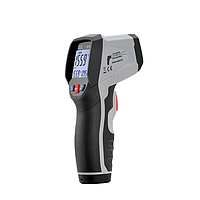
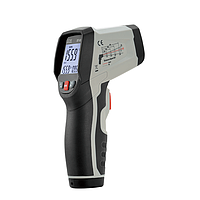
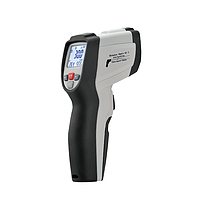
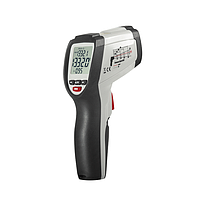
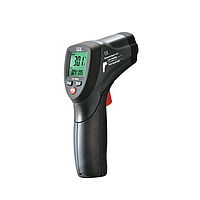
InfraRed Thermometer
Fast, safe temperature checks are essential in maintenance, production, utilities, and building services. When a surface is hot, moving, energized, difficult to access, or should not be touched directly, an InfraRed Thermometer gives technicians a practical way to measure temperature without physical contact.
This category brings together handheld non-contact temperature instruments used for spot checking equipment, process surfaces, electrical components, HVAC systems, and many other industrial tasks. Compared with contact probes, infrared models are especially useful when speed, operator safety, and convenience matter most.
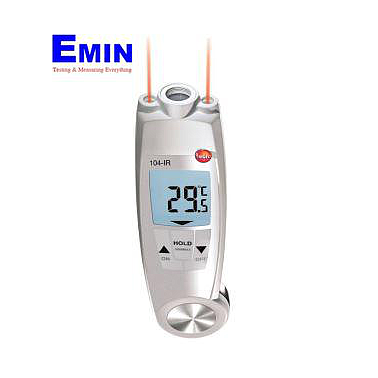
Where infrared thermometers are most useful
Infrared temperature measurement is widely used for troubleshooting and preventive maintenance. Technicians often rely on it to scan motor housings, bearings, switchboards, cable connections, ducts, pipes, heat exchangers, ovens, molds, and insulation surfaces without shutting down the process or touching the target.
These instruments are also helpful when checking many points in sequence. Instead of attaching a probe to each location, the user can quickly compare readings across multiple assets and identify abnormal hot or cold spots. For broader temperature patterns across an area rather than a single spot, a thermal imaging camera may be the better fit.
Why non-contact measurement matters in industry
The main advantage of this product group is non-contact temperature measurement. It reduces the need to approach hazardous surfaces too closely and helps when the target is rotating, electrically live, contaminated, elevated, or physically inaccessible.
Infrared thermometers are also useful in applications where touching the surface is not desirable. That can include finished products, coated materials, or sensitive process surfaces. In routine maintenance, they support quick screening, while contact methods can still be used later for verification when required.
How to choose the right InfraRed Thermometer
Selection should start with the actual measurement task, not just the maximum temperature range. A few core factors usually have the biggest impact: target temperature, working distance, spot size, emissivity adjustment, response time, alarms, and whether data logging or probe input is needed.
One of the most important parameters is the distance-to-spot ratio. A higher ratio helps when measuring smaller targets from farther away. For example, FLIR TG54-2 offers a 20:1 ratio for general industrial use, while FLIR TG56-2 extends to 30:1 for higher temperatures and longer-distance targeting. For demanding long-range spot measurement, FLUKE-572-2 is designed with a much higher optical ratio and a high-temperature range that suits more challenging industrial environments.
Emissivity is another key consideration. Dark, matte surfaces are usually easier to measure accurately than shiny or reflective metal. Models with adjustable emissivity, such as many units from FLUKE, FLIR, and Chauvin Arnoux, give users more flexibility across different materials and surface finishes.
Typical product types in this category
Not all infrared thermometers are intended for the same level of work. Entry and mid-range handheld units are commonly used for general maintenance, utilities, and building inspection. Models such as FLUKE FLK-62 MAX/SNG and FLUKE FLK-62 MAX+/SNG are well aligned with routine spot checks on HVAC equipment, electrical panels, and mechanical assets.
There are also more advanced handheld instruments that combine infrared measurement with added analysis functions. Examples in this category include FLUKE-566, FLUKE-568, and FLIR TG56-2, which support features such as min/max monitoring, alarms, memory, or Type K input depending on the model. These are useful when the job involves more than a simple one-time reading.
For users who want dependable non-contact measurement in a compact industrial format, HIOKI FT3700-20 and Chauvin Arnoux CA 1862 are relevant examples. They represent the type of instrument often selected for field maintenance, inspection rounds, and plant support work.
Understanding accuracy, emissivity, and real-world readings
An infrared thermometer does not measure internal temperature; it measures the thermal radiation emitted from the surface. That means reading quality depends on the target material, surface condition, viewing angle, ambient influences, and whether the measured spot fully covers the intended target.
This is why emissivity matters so much. Painted, oxidized, or non-reflective surfaces are generally straightforward, while polished metals can produce misleading values if settings are not adjusted. In practice, many users improve consistency by measuring a prepared surface, applying emissivity correction, or confirming critical points with a contact method and suitable temperature accessories.
For applications that need a local display but still use more conventional sensing methods, it can also be useful to compare options in temperature meters & indicators. The right choice depends on whether the job calls for fast scanning, continuous monitoring, or direct probe contact.
Examples of instruments for different tasks
For everyday maintenance and facility work, FLUKE FLUKE-64 MAX IR Thermometer and FLUKE FLK-62 MAX/SNG are practical examples of handheld tools suited to general-purpose surface checks. They cover the temperature ranges commonly encountered in mechanical rooms, electrical maintenance, and building services.
Where higher temperature capability or expanded measurement functions are needed, FLUKE-566, FLUKE-568, and FLIR TG56-2 offer a more advanced feature set. Some models in this group include Type K thermocouple input, allowing users to combine infrared spot checks with contact verification in one workflow.
For compact industrial inspection with reliable basic functions, Chauvin Arnoux CA 1862 and HIOKI FT3700-20 illustrate another common selection path. They are well suited to technicians who need robust handheld instruments for routine rounds, troubleshooting, and service diagnostics.
When to use an infrared thermometer instead of other temperature tools
An infrared thermometer is usually the right choice when the target is unsafe to touch, moving, difficult to reach, or when many measurement points must be checked quickly. It is ideal for comparative checks, trend observation during inspections, and identifying potential issues before deeper testing begins.
However, it is not always the only tool needed. If the application requires continuous measurement, signal transmission, or direct immersion/contact sensing, other temperature instruments may be more appropriate. Infrared units work best as fast diagnostic tools within a wider measurement workflow rather than as a universal replacement for every contact sensor.
Choosing with confidence for maintenance and process work
This category covers a wide range of handheld solutions, from simple point-and-measure devices to higher-specification models with alarms, memory, logging, and contact probe support. Brands such as FLIR, FLUKE, Chauvin Arnoux, and HIOKI appear frequently because they address different working distances, temperature ranges, and field requirements.
If your priority is safer spot checking, faster inspection rounds, and quick surface temperature verification, an infrared thermometer is often the most efficient starting point. The best choice depends on the target surface, required measuring distance, temperature range, and whether your workflow also calls for logging or contact confirmation.
Get exclusive volume discounts, bulk pricing updates, and new product alerts delivered directly to your inbox.
By subscribing, you agree to our Terms of Service and Privacy Policy.
Direct access to our certified experts