J-Type Temperature Sensor
When process temperature needs to be measured reliably in ovens, machinery, pipework, or general industrial installations, sensor type matters as much as the controller or indicator connected to it. J-Type Temperature Sensor products are widely used where thermocouple-based measurement is preferred for robust operation, fast response, and practical installation in production environments.
On this page, you can explore J-type temperature sensing options suited to industrial temperature monitoring, especially mineral insulated assemblies with different head styles and insertion lengths. This makes the category useful not only for replacement purchasing, but also for new machine builds, plant retrofits, and maintenance planning.
Where J-type temperature sensors fit in industrial measurement
A J-type sensor is typically based on a thermocouple junction designed to generate a small voltage corresponding to temperature. In practical terms, this technology is commonly selected for industrial duties that require durable construction, straightforward integration, and compatibility with standard temperature instrumentation.
Compared with more application-specific sensing technologies, J-type thermocouples are often chosen for general process measurement where probe construction, sheath material, mounting style, and termination head are key decision factors. If your application involves harsher mounting conditions or plant equipment, it may also be helpful to review broader industrial temperature sensor options alongside this category.
Typical constructions available in this category
This category centers on mineral insulated thermocouple assemblies, a format valued for mechanical strength, compact probe geometry, and dependable thermal response. A mineral insulated design is especially useful when the probe needs to be routed into equipment while maintaining durability under vibration, heat, or repeated service cycles.
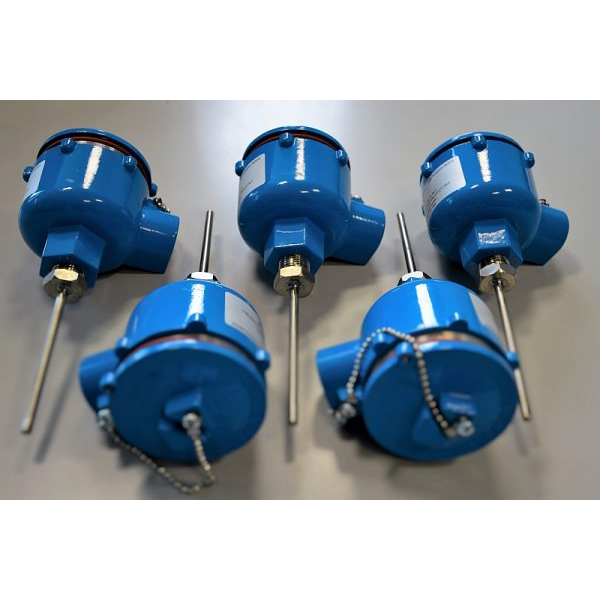
Several representative products from Sterling Sensors illustrate the range. Examples include the TMNPIJ6MM150002N and TMNPIJ6MM01M002N with standard head and process fitting, the TMBHIJ6MM300002B and TMBHIJ6MM02M002B with industrial head, and the TMMHIJ6MM500002M and TMMHIJ6MM02M002M with miniature head. These variations show how the same sensing principle can be adapted for different mounting depths, enclosure needs, and wiring preferences.
How to choose the right J-type sensor
The best selection process usually starts with the installation rather than the part number. Probe diameter, insertion length, head style, and fitting arrangement all affect how well the sensor will perform in the real application. For example, a short probe may suit compact machinery or surface-near measurements, while a longer assembly may be needed to reach the correct immersion depth in tanks, ducts, or process lines.
Connection style is another important factor. A standard head can be suitable where conventional termination space is available, while an industrial head may be preferred for more rugged field mounting. A miniature head can be practical where space is limited or the assembly needs a smaller overall form factor. Reviewing these physical details often helps narrow the options faster than comparing model names alone.
Why mineral insulated probes are commonly specified
Mineral insulated thermocouples combine a metal sheath with insulated internal conductors, giving the assembly a good balance of toughness and sensing performance. In industrial settings, that usually translates into better survivability during installation, resistance to mechanical stress, and easier routing through process equipment compared with more fragile sensor forms.
The products listed here also show a consistent 6 mm probe format and multiple insertion lengths such as 150 mm, 300 mm, 500 mm, 1000 mm, and 2000 mm. That kind of range is useful when standardizing across machines with similar measurement points but different installation depths. Where temperature sensing is part of a wider thermal control setup, users may also compare with a K-type temperature sensor category if the application calls for a different thermocouple type.
Common application scenarios
J-type temperature sensors are often used in industrial heating systems, processing equipment, OEM machinery, and maintenance replacement work. They are suitable wherever a thermocouple assembly must be mounted securely and connected to indicators, transmitters, controllers, or data acquisition equipment that support the sensor type.
In practice, buyers often focus on the mechanical environment: exposure to vibration, expected insertion depth, terminal enclosure requirements, and how the probe will be fixed into the process. That is why models such as the Sterling Sensors TMNPIJ6MM300002N or TMBHIJ6MM150002B are relevant examples here—they represent the kind of configurable industrial assemblies engineers use when matching a sensor to real installation constraints.
J-type sensors compared with other temperature sensing approaches
Not every temperature measurement task is best served by the same sensor technology. Thermocouples are often selected for their ruggedness and broad industrial usability, while other solutions may be preferred for electronics, compact assemblies, or resistance-based measurement strategies. If your application involves PCB-level integration or embedded electronic assemblies, board mount temperature sensors may be more appropriate than a probe-style thermocouple.
Likewise, some systems use thermistor-based sensing where a different response profile or packaging style is needed. In those cases, browsing a thermistor sensor range can help clarify whether a probe thermocouple or another sensor family is the better fit for the application.
Working with manufacturers and product ranges
This category sits within a broader ecosystem of temperature measurement brands, including Jumo, KEYSIGHT, OMEGA, Onset, Senseca, and Sterling Sensors. For buyers, the practical goal is usually not to compare brand names in isolation, but to match construction style, installation method, and instrument compatibility to the process requirement.
The current featured products highlight Sterling Sensors assemblies with standard, industrial, and miniature head formats. That makes this page especially useful for engineers and purchasers looking for replacement probes with familiar mechanical configurations, or for teams standardizing on mineral insulated thermocouple assemblies across multiple assets.
Choosing with confidence
A well-matched J-type sensor should fit the process mechanically, connect cleanly to the measurement chain, and provide stable service in the operating environment. Looking closely at sheath construction, insertion length, head style, and process fitting will usually lead to a better result than choosing by product code alone.
If you are comparing options for maintenance stock or new equipment builds, this category provides a focused starting point for thermocouple selection in industrial settings. Use the available product range to align sensor format with your installation needs, and explore related temperature sensor categories when your application may call for a different sensing approach.
Get exclusive volume discounts, bulk pricing updates, and new product alerts delivered directly to your inbox.
By subscribing, you agree to our Terms of Service and Privacy Policy.
Direct access to our certified experts