For full functionality of this site it is necessary to enable JavaScript.
EMIN.COM.MM
0

Test Script Applications -Solving Complex Test Patterns

04/12/2018 11:45:05

The uniqueness of GW Instek Test Script function is to streamline test operator’s complex measurement work by directly planning a set of changing voltage and

The uniqueness of GW Instek Test Script function is to streamline test operator’s complex measurement work by directly planning a set of changing voltage and current parameters via Microsoft Excel and uploading the edited Excel file to GW Instek power supplies so as to execute sequential power outputs. The following five test applications with different test patterns were easily executed by GW Instek Test Script function without software programming.       
 
Test Script allows users to run repetitive cycle tests by setting parameters including output voltage, current, time, cycle, OVP, OCP, Bleeder, etc. Four GW Instek power supplies support Test Script, including PFR, PSU, PSW, and PSB.     

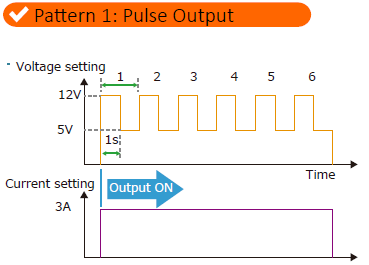
Settings: Set and execute a pattern that switches 12V/1sec to 5V/1sec for 6 times with the current setting of 3A.

The output voltage rises from 0V to 5V in 50 seconds at the current setting of 10A and maintains the settings for 30 minutes and then the output is turned off automatically

* The above waveform is an ideal waveform. The actual waveform is limited by the voltage setting and bandwidth of the power supply models.

Burst signals are applied in the middle of the constant voltage output. For example, a continuous voltage output generates a burst noise that fluctuates between 12V and 8V. Each burst signal is 100ms and the burst signals last 1.5s that appears after every 10 minutes (600 s) of constant 12V output.

For durability tests such as lights, heaters, etc., the pattern that repeats for 18-hour output on and 6-hour output off for 100 days is as follows.

A test example of self-resetting PTC verifies its open circuit characteristic by increasing current from 0 to 3A with 16-step resolutions. 
Test Script can easily execute a series of different currents under a constant voltage setting to test the blown and reset characteristic of a self-resetting PTC.

To download Test Script and its setting procedures please go to http://www.gwinstek.com/en-global/Page/The_setting_of_Test_Script
Four GW Instek Power supplies support Test Script, including PFR, PSU, PSW, and PSB.
Related News

What Is the Standard 3-Phase Voltage? How to Read Cabinet-Mounted Meters Without Errors
07/13/2026 15:09:18

Voltmeters are almost invariably found on the panels of electrical cabinets in factories, power stations, or generator systems. A glance lasting just a few seconds allows an operator to determine whether the power supply is stable or showing signs of abnormality. However, not everyone understands the significance of the displayed readings, particularly regarding three-phase electrical systems.

Distinguishing between ARI’s Hypot, HypotUltra, and HypotMax: Which device is right for your factory?
07/13/2026 09:48:30

Few people realize that the concept of the "Hipot Test"—or electrical safety testing—has long existed within the electrical equipment manufacturing industry. Driven by the growing need to verify the voltage withstand capabilities of conductors, motors, and electrical devices, the industry required a robust and virtually fail-safe method to detect insulation weaknesses before products reached the market.

What Is Resonant Frequency? Why Can a Single Frequency Range Damage the Entire Product?
07/10/2026 15:10:46

A device may operate stably for months, yet suffer cracks, broken solder joints, or snapped component leads after being transported. What surprises many engineers is that the vibration amplitude during transport is no greater than usual. The root cause lies in a specific frequency range where the product's structure absorbs energy most intensely, triggering resonance and causing continuous stress concentration at a single point.

Should Carton Packaging Undergo Vibration Testing or Drop Testing First?
07/10/2026 10:38:40

Một kiện hàng gần như không bao giờ bị rơi ngay khi vừa rời khỏi nhà máy. Quãng đường hàng trăm kilomet trên xe tải, container hay băng chuyền mới là giai đoạn diễn ra đầu tiên, nơi bao bì liên tục chịu rung lắc trong nhiều giờ. Chỉ sau đó mới đến những cú va chạm khi bốc xếp, giao nhận hoặc rơi ngoài ý muốn.

Stay Updated with Offers

Get exclusive volume discounts, bulk pricing updates, and new product alerts delivered directly to your inbox.

By subscribing, you agree to our Terms of Service and Privacy Policy.

Quick Support

Direct access to our certified experts