A closer look reveals the cause is related to residual chlorine remaining after the disinfection process.
This is also why almost all RO systems nowadays include an additional chlorine removal step before the water passes through the fine filter membrane.
RO membranes are very sensitive to free chlorine, even at low concentrations
Most RO membranes currently in use utilize polyamide material. This material offers excellent filtration capabilities but is quite sensitive to the oxidizing properties of chlorine.
Initially, the changes are often difficult to notice. Water flows steadily, and pressure doesn't fluctuate much, leading to the assumption that the membrane is functioning normally. After prolonged exposure to residual chlorine, the membrane surface begins to degrade in its ability to retain ions and impurities.
At this point, symptoms often appear such as: gradually increasing output TDS, erratic water flow, increased filter pressure, and shorter membrane replacement cycles.
Many mistakenly believe the membrane is damaged due to sediment or hard water, but the actual cause is the residual chlorine input slowly oxidizing the membrane material over a long period.
Even low but persistent residual chlorine levels are enough to significantly reduce membrane lifespan
It's not necessary to have extremely high chlorine concentrations to affect RO membranes. Simply having free chlorine continuously present in the feedwater for many hours each day can significantly reduce membrane lifespan.
This is more evident in continuously operating systems such as:
+ Industrial RO
+ Food production
+ Bottled water
+ Pharmaceuticals
+ Laboratories
The frustrating aspect is that the degradation process is quite slow. By the time the output water quality begins to deviate from standards, the inner membrane layer is usually already considerably affected.
Stainless steel is highly resistant, but chlorine can still cause corrosion over time
Many people think stainless steel is almost completely immune to chlorine. In reality, a continuous exposure to residual chlorine can still gradually degrade the natural protective layer on the stainless steel surface over time.
Initially, this manifests as small spots or slightly discolored areas. Later, the surface begins to show tiny pitting corrosion, especially in the following areas:
- Welds
- Joints
- Water accumulation points
- Valves and threaded joints
This phenomenon is quite common in storage tanks, CIP units, stainless steel pipes, or heat exchangers that operate continuously with chlorine-treated water. Even 304 stainless steel can degrade faster than normal with prolonged exposure to free chlorine combined with high temperatures.
Many modern water treatment systems now include an additional dechlorination step before reverse osmosis (RO)
To minimize the impact on the membranes and downstream equipment, many factories now add chlorine removal processes such as:
- Activated carbon for chlorine adsorption
- Chemical neutralization
- Catalytic filters
- Continuous monitoring of residual chlorine
The goal is to maintain sufficient chlorine levels for disinfection but prevent it from reaching the RO membrane area or the oxidation-sensitive stainless steel components. For large production lines, premature RO membrane degradation within a few months can lead to significant replacement costs.
Regular monitoring of residual chlorine helps detect many problems early
In many cases, excessive chlorine levels are only detected after the RO membrane begins to lose efficiency or the stainless steel pipes show signs of corrosion.
Among the current range of rapid measurement devices, the Hanna HI701 chlorine meter is commonly used for drinking water, tap water, and quick sampling points due to its compact operation and relatively fast response time.
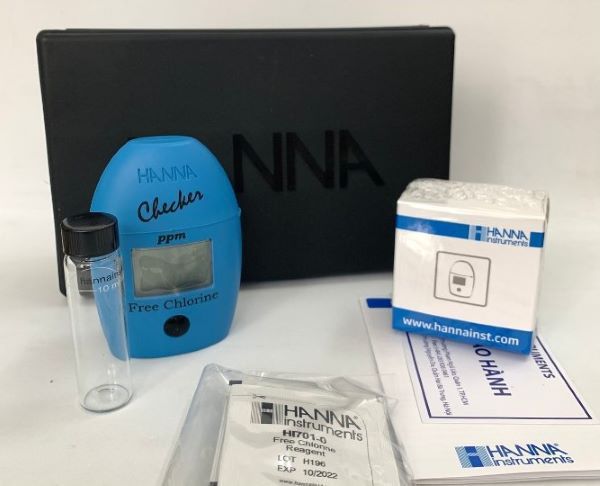
Larger production lines often incorporate additional online monitoring equipment to detect abnormal chlorine levels early, before the effects begin to spread to the filter membrane or the stainless steel components downstream.
In many cases, RO membranes degrade quickly
Pressure, flow rate, and conductivity are often closely monitored in water treatment lines. However, residual chlorine input is sometimes overlooked because it's thought that low concentrations won't have a significant impact.
In reality, if chlorine levels consistently exceed permissible limits for an extended period, the lifespan of RO membranes and many stainless steel components can be significantly reduced, a fact that is often difficult to detect in the early stages.