A brushless rotary torque sensor is generally the stronger choice when brush friction, brush wear, vibration-related brush bounce, or high-speed operation could affect a torque-testing process. A brush-type sensor remains a rotary measurement option, but its physical brushes introduce operating limitations that should be evaluated against the application.
Both designs are used to measure torque on rotating drives and fastening joints. They connect to a torque tester or torque meter and support torque evaluation, verification, quality control, research and development, and calibration work.
Summary: Brush sensors use physical contact and can experience friction and wear. Brushless sensors transfer power and torque information without mechanical contact. Brushless designs are particularly relevant for pulse tools with significant vibration and for applications where brush-related high-RPM limits matter.
What is a rotary torque sensor used for?
A rotary torque sensor measures torque applied to a rotating shaft or fastening joint. It is commonly used to test and monitor rotating-drive and assembly applications where actual applied torque needs to be evaluated or recorded.
In manufacturing and assembly, torque measurement can help assess process consistency and quality. Insufficiently tightened fasteners may loosen through vibration, while excessive torque may damage threaded fasteners.
What is the main difference between brush and brushless rotary torque sensors?
The key difference is how the rotating shaft communicates with the fixed outer body. A brush rotary torque sensor uses brushes that contact the shaft, whereas a brushless rotary torque sensor transfers the required power and torque information without mechanical contact.
| Consideration | Brush rotary torque sensor | Brushless rotary torque sensor |
|---|---|---|
| Connection method | Uses brushes in contact with the measuring shaft. | Transfers information without mechanical contact. |
| Friction effect | Additional torque is needed to overcome brush friction. | Avoids brush-contact friction. |
| Pulse-tool vibration | May be affected by brush bounce. | Designed to avoid brush bounce. |
| Wear and maintenance | Brush wear can increase maintenance needs, especially with frequent use. | Eliminates brush wear as a maintenance factor. |
| High-RPM operation | Brush force can decrease because of centrifugal force at high RPM. | Does not rely on brush contact. |
Why can brush sensors be less suitable for pulse-tool testing?
Brush sensors may experience brush bounce when used with pulse tools that create significant vibration. This intermittent brush-contact behavior can create a measurement concern when evaluating torque accuracy.
A brushless design removes the physical brush interface, addressing this specific source of disturbance. For this reason, applications involving pulsed fastening tools are an important case to consider when selecting a rotary torque sensor.
When does brush friction matter in torque measurement?
Brush friction matters when the extra torque required to overcome the brushes could be meaningful to the measurement task, particularly with low torque readings. The source identifies brushless sensors as suitable when low-torque measurement and the avoidance of brush bounce are both priorities.
The selection should therefore consider the torque range being evaluated, not just whether the shaft rotates. A sensor that avoids contact-related resistance can be advantageous where small torque values need close attention.
Why can high RPM be a limitation for brush-type sensors?
At high rotational speeds, centrifugal force can reduce the force of brushes against the shaft in a brush-type sensor. This can prevent operation at very high RPM, according to the source material.
A brushless sensor does not depend on brush contact for signal transfer. However, the appropriate operating range should still be confirmed for the specific sensor and test setup rather than assumed from the design type alone.
How does a brushless rotary torque sensor transmit torque information?
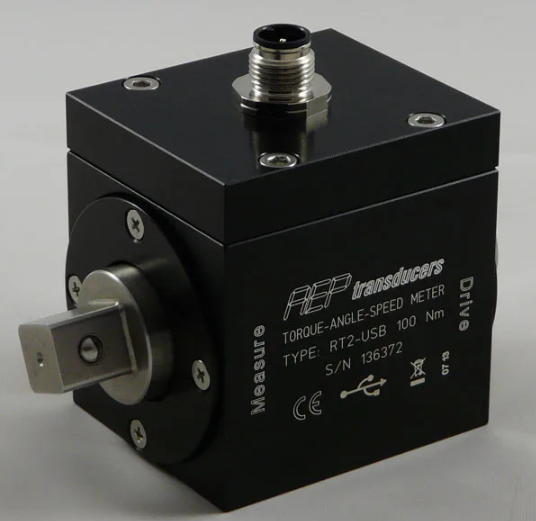
A brushless rotary torque sensor can use strain-gauge technology with electronics that communicate between the rotating shaft and stationary body through coils. In the described Mountz approach, one set of coils performs two functions: providing power to electronics on the rotating shaft and receiving torque information from the strain gauges.
The stationary and rotating portions each contain a coil. Power is transmitted across the coils in one frequency band, while the torque signal is transmitted back in another band; the stationary electronics then converts and processes that signal for torque indication.
What electrical details are described for the brushless sensor approach?
The described transducer accepts a DC supply from 15V to 24V and converts it to ±12 VDC for stationary electronics. The source states that voltage conversion and regulation mean the supply does not need the precision required by excitation voltage in a brush-type sensor.
The same description states that the processed torque indication is provided as a single-ended 0V to ±5V signal. It also describes a +5V input used to force a full-scale clockwise torque reading for calibration-related checking.
Note: Electrical values and signal behavior above describe the specific brushless technology presented in the source. They should not be treated as universal specifications for every rotary torque sensor.
How should a team choose between brush and brushless rotary torque sensors?
Choose based on the measurement conditions that can affect the test: required torque sensitivity, pulse-tool vibration, expected usage frequency, and rotational speed. A brushless design is the more relevant option when avoiding brush friction, brush bounce, and brush wear is important.
A brush-type design may require closer consideration of contact wear and high-speed limitations. For either choice, confirm compatibility with the torque tester or torque meter and evaluate the sensor against the actual rotating-drive or fastening application.