Distance Sensor Development Tool
Early-stage ranging and presence-detection design usually moves faster when engineers can validate sensing behavior before committing to a custom PCB. That is where Distance Sensor Development Tool platforms are especially useful: they help teams evaluate measurement principles, interface options, field of view, and integration constraints in a more practical way.
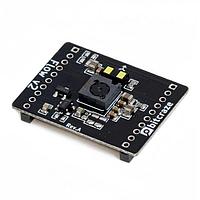
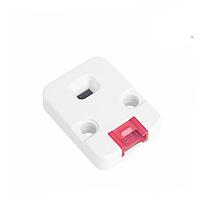
On this page, you can explore development kits, breakout boards, and evaluation modules used for distance sensing across embedded systems, automation concepts, smart devices, robotics, and HMI-related projects. The range includes tools built around Time-of-Flight, ultrasonic, gesture, and motion-oriented sensing approaches, giving design teams a clearer path from proof of concept to product development.
What these development tools are used for
Distance sensing is often needed when a system must detect proximity, estimate range, monitor occupancy, or support touchless interaction. In development work, the goal is not only to confirm that a sensor can detect an object, but also to understand how it behaves under real mounting conditions, target materials, ambient light, acoustic reflections, and controller timing.
Development tools in this category typically support early feasibility testing, firmware bring-up, interface validation, and algorithm experimentation. Depending on the platform, engineers may evaluate simple point measurements, short-range ranging, gesture recognition, or more advanced multizone sensing behavior. If your project extends into nearby sensing functions, it can also be useful to compare with multiple-function sensor development tools for broader environmental or interaction testing.
Common sensing approaches in this category
Not all distance sensing tools work the same way, and choosing the right evaluation board starts with the sensing principle. Time-of-Flight (ToF) solutions are widely used when developers need compact electronic ranging based on emitted and reflected signals. Depending on the design, ToF can be implemented optically or ultrasonically, with each approach offering different trade-offs in target response, operating environment, and integration style.
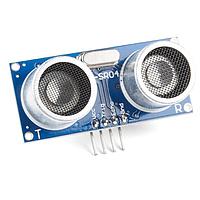
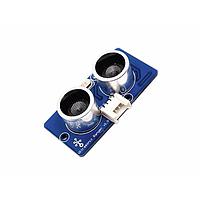
Ultrasonic rangefinders remain relevant for straightforward distance measurement, especially when analog, PWM, or serial output options simplify prototyping. Gesture-oriented platforms add another layer by interpreting movement patterns rather than only reporting distance. Motion sensing tools may also overlap with presence or occupancy detection, which is why some projects benefit from comparing these products with dedicated acceleration sensor development tools when movement context is part of the application logic.
Representative platforms and evaluation kits
Several well-known suppliers are represented in this category, including STMicroelectronics, Microchip Technology, Infineon, TDK InvenSense, Silicon Labs, and Adafruit. These tools are primarily intended to reduce development risk by exposing sensor behavior through accessible hardware interfaces and reference setups.
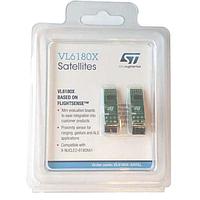
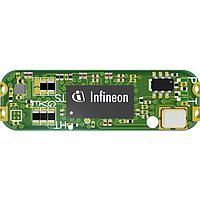
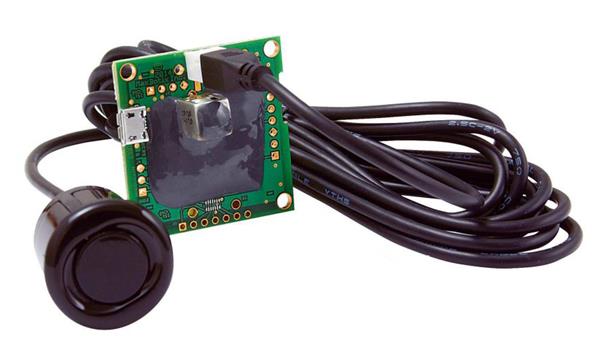
Examples include the STMicroelectronics 53L0-SATEL-I1 for VL53L0X-based integration work, the P-NUCLEO-53L4A3 pack for evaluating VL53L4ED, and the SATEL-VL53L7CX breakout board for multizone ToF exploration. For ultrasonic ToF evaluation, TDK InvenSense offers EV_MOD_CH101-01-02 and EV_MOD_CH201-00-01 modules, while Adafruit provides ultrasonic rangefinder options such as the 981, 982, and 984 boards. Projects focused on touchless control can also look at the Microchip Technology DM160238 Emerald Evaluation Kit and DM160234 gesture controller platform, while the Infineon REFBGT60LTR11AIPM0TOBO1 supports motion-oriented evaluation.
How to choose the right tool for development
A good starting point is the intended sensing task. If you need straightforward object distance feedback, a basic ranging module may be enough. If your design requires zone awareness, people detection, or richer scene interpretation, a multizone or motion-capable evaluation platform will usually be more suitable. For touchless interfaces, gesture-specific kits can shorten development time because they are built around interaction testing rather than raw distance output alone.
Interface requirements also matter. Some tools expose I2C, SPI, USB, PWM, analog voltage, or serial digital output, which can strongly affect how quickly they fit into an existing development workflow. Supply voltage, companion software, and controller ecosystem should be reviewed early as well, especially if the aim is to move from lab validation to embedded integration with minimal redesign.
Another practical factor is whether you are evaluating the sensor itself or the broader system concept. A compact breakout board may be ideal for hardware characterization, while a larger kit can be better for firmware examples, visualization, and proof-of-concept demonstrations. Where current draw and portable operation are important, it may also help to compare with current sensor development tools during power profiling and system optimization.
Typical application areas
Distance sensor development tools support a wide range of B2B and engineering use cases. In industrial and commercial products, they are often evaluated for object detection, drawer or cover sensing, occupancy awareness, equipment approach detection, and user-interface activation. In embedded electronics, they can support compact ranging functions in consumer devices, smart building nodes, and battery-powered edge designs.
They are also relevant for prototyping robotics, kiosks, appliances, and touch-free interfaces where direct mechanical input is not ideal. Optical and ultrasonic approaches may behave differently depending on surface properties, enclosure geometry, and acoustic or lighting conditions, so evaluation hardware is valuable for reducing uncertainty before final sensor selection. For projects involving magnetic position feedback or complementary detection methods, engineers may also review magnetic sensor development tools alongside this category.
Why evaluation hardware matters in the design cycle
Using a dedicated development platform helps teams move beyond datasheet assumptions. It becomes easier to observe response stability, test repeatability, tune thresholds, and identify environmental edge cases before making mechanical and firmware decisions that are harder to reverse later. This is particularly important in distance sensing, where target size, reflectivity, angle, and installation position can significantly affect real-world results.
Evaluation kits also help cross-functional teams work more effectively. Hardware engineers can verify electrical integration, embedded developers can test communication and processing behavior, and product teams can assess whether the sensing experience matches the intended use case. That combination makes development tools an efficient bridge between component selection and application-level validation.
Finding a suitable platform for your project
This category is designed for engineers who need practical tools for exploring ranging, proximity, gesture, or motion-related sensing concepts before product release. Whether the priority is a compact ToF module, an ultrasonic evaluation board, or a more application-focused gesture platform, the right choice depends on sensing method, interface compatibility, and the type of validation you need to perform.
By comparing the available development boards and evaluation modules here, teams can narrow down candidates more confidently and build a more reliable path toward prototype refinement and final sensor integration.
Get exclusive volume discounts, bulk pricing updates, and new product alerts delivered directly to your inbox.
By subscribing, you agree to our Terms of Service and Privacy Policy.
Direct access to our certified experts