Fertigation Control System
Precise nutrient dosing is critical when irrigation and fertilization need to work as one controlled process. In greenhouse cultivation, hydroponics, and intensive agriculture, stable pH and conductivity values help protect crop quality, reduce waste, and keep the feeding program consistent from cycle to cycle. A Fertigation Control System supports that goal by bringing measurement, dosing logic, and switching functions into a single control point.
For buyers evaluating process equipment for water treatment in cultivation systems, this category focuses on controllers designed to monitor key parameters and trigger corrective actions. Instead of treating fertigation as a manual routine, these systems help turn it into a repeatable process with clearer set points and better operational visibility.
Why fertigation control matters in practical operation
In many irrigation setups, nutrient concentration and acidity can drift as water source quality changes, tanks are refilled, or dosing conditions vary over time. Even small deviations in pH or electrical conductivity can affect nutrient availability, crop uptake, and overall process stability. A dedicated controller helps operators maintain target values more consistently than manual adjustment alone.
This is especially important in applications where the same water and nutrient solution must be delivered repeatedly across multiple zones or production cycles. A properly selected system can support dosing pumps, alarms, relay outputs, and level-related inputs, making it easier to coordinate the feeding sequence and reduce intervention time.
Typical functions found in this category
Fertigation controllers are commonly used to supervise the core parameters of nutrient solution quality, especially pH and EC/TDS. Based on configured set points, the controller can activate external devices such as pumps, valves, or alarms to keep the process within the desired operating window. This makes the equipment relevant not only for cultivation, but also for controlled water management tasks tied to dosing and correction.
Compared with broader water quality controllers and monitors, fertigation-focused units are typically aligned with irrigation and nutrient dosing workflows. They are selected less for laboratory-style analysis and more for continuous field or panel-based control where response time, relay logic, and operator adjustment are all important.
Example solution in this category
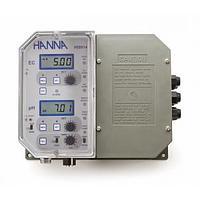
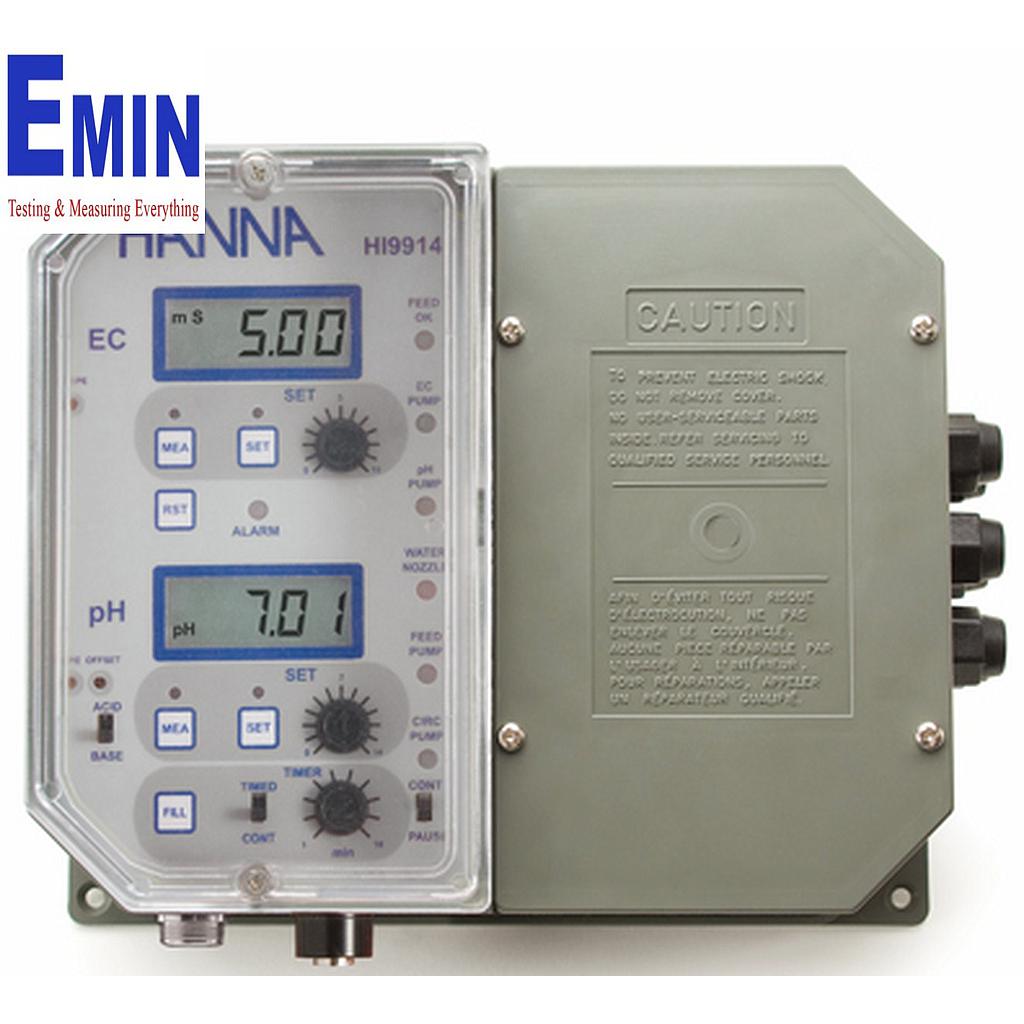
A representative product is the HANNA HI9914-2 Wall Mounted Fertigation Controller. This model is built around pH and EC monitoring with adjustable dosing set points, making it relevant for applications where nutrient strength and acidity need to be controlled together rather than separately.
The unit also illustrates the broader role of fertigation equipment in automation. Features such as relay outputs, analog signaling, timer-based functions, and support for external inputs show how these controllers can be integrated into a working irrigation panel. For users already familiar with HANNA instrumentation, this category can be a practical extension into process control rather than stand-alone measurement.
How to choose the right fertigation controller
The first step is to define which process variables actually need control. In most agricultural and hydroponic applications, pH and conductivity are the primary values, but the required control method may differ depending on whether the system handles simple nutrient correction, staged irrigation, or more coordinated pump and tank management. The best fit depends on the number of devices that must be switched and how tightly the process must be maintained.
It is also important to review installation conditions such as panel mounting, ambient temperature, humidity exposure, and available input or output types. Buyers should confirm whether the controller must interact with level sensors, circulation pumps, feeding pumps, alarms, or external switches. In B2B purchasing, this is often more important than comparing headline specs alone, because integration requirements can determine whether deployment is straightforward or unnecessarily complex.
Relationship to other environmental control categories
Fertigation control sits within a wider environmental and water process control landscape. Some projects require a controller dedicated to one water parameter, while others need a more application-specific approach tied directly to irrigation and nutrient delivery. When conductivity correction is part of a broader water purity strategy rather than nutrient dosing, a water resistivity controller may be the more relevant category.
Likewise, applications focused on dissolved oxygen management in treatment or process water can be better served by DO controllers. Understanding this distinction helps buyers avoid choosing a controller simply because it measures a related parameter, when the real need is process logic built for fertigation.
Common application scenarios
These systems are typically considered for greenhouse irrigation skids, hydroponic nutrient preparation, recirculating feed systems, and cultivation environments where stable dosing improves repeatability. They can also be relevant where operators need local wall-mounted control with clear adjustment of set points and direct switching of external equipment.
In such environments, the controller is not just a display device. It becomes part of the operating sequence by helping coordinate water flow, dosing response, and alarm handling. That role makes the category particularly useful for integrators, maintenance teams, and procurement teams sourcing equipment for controlled agricultural infrastructure.
Support a more controlled irrigation and nutrient process
Choosing from this category is ultimately about matching measurement and control capability to the realities of your irrigation system. A suitable fertigation controller can help reduce manual correction, improve consistency in nutrient delivery, and provide a clearer framework for integrating pumps, sensors, and alarms into one process.
If your application depends on maintaining reliable pH and conductivity conditions during feeding, this category is a practical place to compare control solutions built for that task. Reviewing the available models in context with your dosing logic, output requirements, and installation environment will lead to a more effective long-term selection.
Get exclusive volume discounts, bulk pricing updates, and new product alerts delivered directly to your inbox.
By subscribing, you agree to our Terms of Service and Privacy Policy.
Direct access to our certified experts