Water Resistivity Controller
Maintaining stable water purity is critical in processes where ionic contamination can affect product quality, equipment life, or downstream treatment performance. In these applications, a Water Resistivity Controller helps operators track water quality in real time and trigger control actions when resistivity drops below an acceptable level.
Resistivity is widely used as an indicator of how pure water is, especially in systems such as purified water loops, rinse water management, laboratory utilities, and process water treatment. A controller combines measurement, display, and relay output in one device, making it easier to monitor the process continuously instead of relying only on periodic manual checks.
Why resistivity monitoring matters in water systems
Water resistivity reflects the ability of water to resist electrical current. In practical terms, higher resistivity generally indicates lower ionic content, which is important in applications where dissolved salts and contaminants must be kept under control. When resistivity changes unexpectedly, it can point to membrane performance issues, exhausted resin beds, contamination ingress, or instability in the treatment line.
Using a dedicated controller gives maintenance and process teams a more immediate view of system conditions. Instead of waiting for offline analysis, operators can respond quickly when the measured value moves outside the target range, helping reduce waste, protect sensitive equipment, and support more consistent process quality.
What a Water Resistivity Controller typically does
A controller in this category is designed to measure resistivity from a connected probe and compare the reading against a configurable setpoint. When the measured value crosses that threshold, the relay output can be used to activate an alarm, stop a process stage, or support a dosing or protection sequence, depending on the system design.
Many users looking through broader water quality controllers and monitors are specifically trying to solve one issue: maintaining stable purity in treated water. That is where resistivity-focused devices become useful, because they provide a measurement approach tailored to low-conductivity, high-purity water applications.
Typical applications for resistivity control
Resistivity control is commonly used where water quality must remain within a defined operating window. This may include purified water preparation, final rinse stages, water polishing systems, reverse osmosis and deionization lines, and laboratory or light industrial process utilities. In these setups, even a small shift in ionic content can be meaningful.
It is also relevant in installations where water quality is linked to automatic control. For example, a relay output can be tied to an alarm, interlock, or corrective action when the reading falls below the target value. In this way, the controller becomes part of a broader environmental or process control strategy rather than acting only as a local indicator.
Selection points to compare before choosing a controller
When evaluating a water resistivity controller, the first consideration is the measurement range and whether it matches the expected quality of the water in your process. Resolution and accuracy also matter, especially when the control decision depends on relatively small changes in purity.
Beyond the measurement itself, buyers should check the relay function, setpoint adjustability, compensation method, and probe compatibility. Temperature compensation is especially important because water resistivity varies with temperature, and a controller with automatic compensation helps produce more consistent readings across changing operating conditions.
Mechanical and installation factors also deserve attention. Panel size, wiring method, power supply format, and enclosure suitability can influence how easily the controller integrates into an existing cabinet or skid. For sites that monitor multiple parameters, it may also be useful to compare related solutions such as DO controllers or other dedicated environmental control devices used in the same treatment process.
Featured example from HANNA
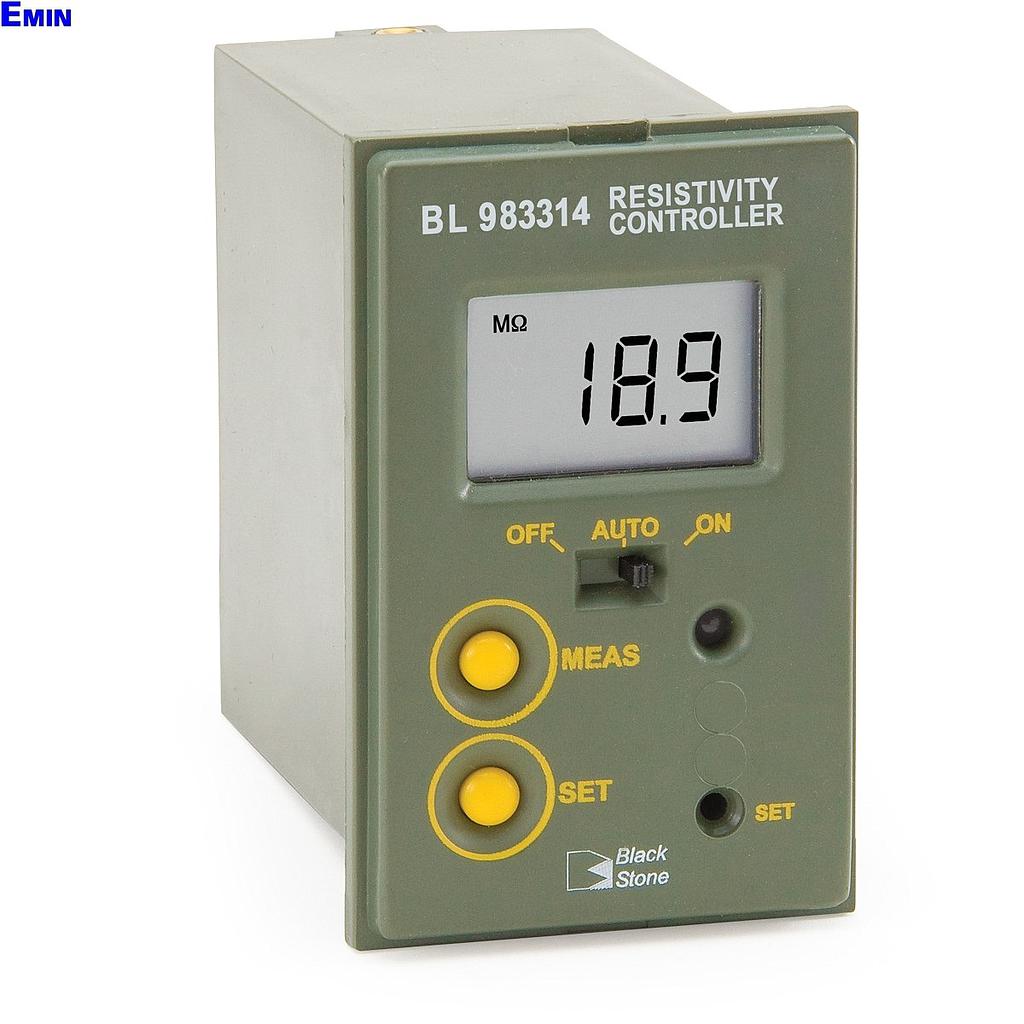
One representative product in this category is the HANNA BL983314-0 Resistivity Mini Controller. It is designed for resistivity measurement and control in water systems, with an included probe and configurable setpoint for relay-based response when the measured value falls below the selected threshold.
This model illustrates the role of compact controllers in practical installations: local measurement, straightforward adjustment, and a form factor suitable for panel integration. Features such as automatic temperature compensation and a protected relay output are relevant in applications where reliable day-to-day monitoring is more important than a complex analyzer platform.
For buyers already standardizing on HANNA instrumentation, this kind of device can fit naturally into a wider water quality monitoring setup. It is particularly suitable when the objective is to maintain a simple and dedicated resistivity control point rather than deploy a multiparameter system.
How resistivity control fits into a broader monitoring strategy
In many facilities, resistivity is only one part of the water quality picture. Depending on the treatment stage and end use, teams may also track dissolved oxygen, nutrient dosing, or organic load indicators. That is why category planning often benefits from looking at the whole measurement chain rather than selecting instruments in isolation.
For example, processes involving irrigation or nutrient management may require a fertigation control system, while other treatment stages may rely on different dedicated controllers. Resistivity control remains especially valuable wherever low ionic contamination is a direct operating requirement.
Choosing the right setup for your application
The best choice depends on how the controller will be used in the field: continuous monitoring, simple alarm management, interlocked process control, or protection of downstream equipment. It is also important to match the controller to the sensor arrangement, expected temperature conditions, and the required response when water quality moves out of range.
This category is intended for users who need a focused solution for continuous resistivity monitoring in water systems. If your process depends on stable purity and timely response to water quality drift, a dedicated controller can be an efficient and practical way to improve visibility and control at the point of use.
By comparing measurement range, compensation method, relay behavior, and integration requirements, you can narrow the options to a controller that fits your operating environment. A well-matched resistivity control setup supports more dependable water quality management without adding unnecessary complexity.
Get exclusive volume discounts, bulk pricing updates, and new product alerts delivered directly to your inbox.
By subscribing, you agree to our Terms of Service and Privacy Policy.
Direct access to our certified experts