Therefore, the goal of modern maintenance is no longer limited to quick repairs when equipment malfunctions, but focuses on the ability to detect signs of abnormality early to proactively plan for intervention before they impact output, product quality, and production costs.
Controlling the status of electrical infrastructure and production equipment
Temperature is an index that clearly reflects the condition of electrical systems. Loose connections, phase imbalances, local overloads, or poor contact often appear as hot spots very early. When detected in time, the technical team can address these issues during scheduled maintenance instead of waiting until the equipment fails completely.
Thermal imaging cameras such as Fluke Ti480 PRO, Fluke TiS60+, or Fluke TiS75+ support rapid surveys of electrical cabinets, transformers, MCCs, busbars, and power distribution systems, helping to identify areas with abnormal temperatures that are invisible to the naked eye.

See more at Fluke Thermal Cameras.
In addition, insulation quality directly affects the reliability of motors, power cables, and industrial electrical equipment. Insulation resistance measurements using the Fluke 1587 FC allow for the assessment of insulation material aging, detecting leakage currents or degradation before leading to short circuits and widespread power outages.
Optimizing mechanical performance and data transmission
Most mechanical failures do not occur suddenly. Worn bearings, shaft misalignment, dynamic imbalance, or concentricity deviations create vibrations that increase over time. If one waits until the equipment emits loud noises or vibrates heavily to inspect, many components may have already entered a stage of severe damage.
Vibration analysis devices such as Fluke 805 FC and Fluke 810/2026 support the assessment of bearings, motors, industrial fans, gearboxes, and centrifugal pumps based on actual measurement data. Consequently, the maintenance department can determine the degradation level of each piece of equipment, building a component replacement plan based on actual status instead of relying entirely on a fixed maintenance schedule.
For compressed air systems, leaks are often overlooked because they are difficult to detect using conventional methods. Each small leak can cause continuous energy loss for months. Fluke ii900 and Fluke ii910 acoustic imaging cameras help pinpoint the exact location of leaks even in noisy environments, thereby reducing the load on air compressors and saving significant energy costs.
Ensuring stable communication infrastructure
As automation levels increase, the stability of industrial network systems becomes the decisive factor in maintaining continuous production. A single faulty network connection, signal loss in cables, or unstable switch can cause PLCs, HMIs, or SCADA systems to lose communication.
Devices such as LinkSprinter and LinkRunner support rapid checks of connection status, network configuration, and transmission quality, helping the technical team identify the cause of interruptions in a short time without performing complex troubleshooting procedures.

Taking a deeper look at power quality and backup sources
Many modern production lines use inverters, servos, and electronic control devices that are highly sensitive to power quality. Harmonics, voltage sags, phase imbalances, or transient phenomena can cause equipment to operate unstably even when the entire system is receiving normal power.
Power quality analyzers such as the Fluke 435-II/Fluke 438-II allow for the full recording of data on voltage, current, harmonics, and abnormal phenomena on the power grid. This data helps identify the root cause of recurring errors that are difficult to trace with conventional measurements.
In parallel, the grounding system plays a foundational role in electrical safety and interference resistance. The Fluke 1625-2 KIT supports assessing earth resistance through various measurement methods, providing a comprehensive view of the grounding system quality at the factory.
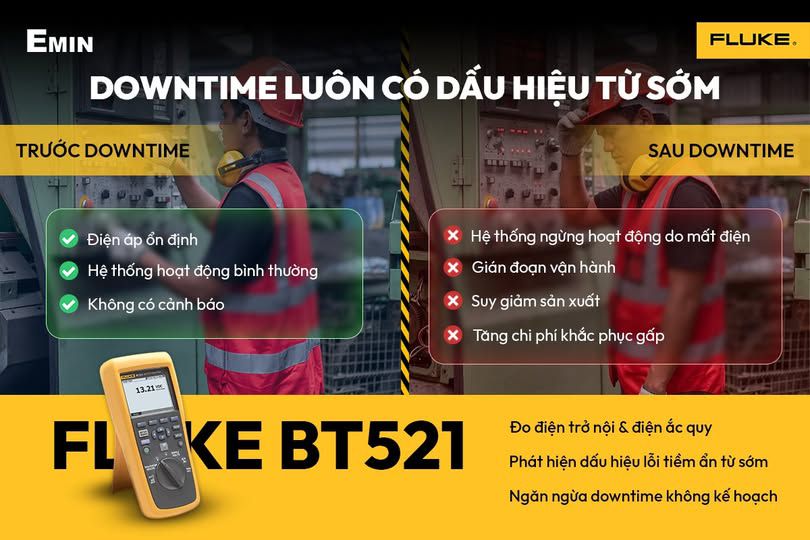
For UPS and backup power systems, battery life often degrades silently over time. Only when a power outage occurs is it discovered that the UPS no longer has the capacity to maintain the load. The Fluke BT521 battery analyzer helps assess the internal resistance, voltage, and health status of each battery cell, supporting the development of replacement plans before risks occur.
Proactively identifying risks to maintain long-term uptime
Every hot spot on an electrical cabinet, every abnormal vibration oscillation, or every small distortion of an electrical waveform carries information about the actual state of the system. When this data is monitored and analyzed regularly, businesses can shift from a reactive mindset to proactive risk management.
Downtime rarely starts from a major failure. It usually originates from very small signs that suitable measurement systems can easily detect early. The more warning signals are identified before failure, the clearer the ability to maintain stable output and optimize maintenance costs becomes.
For detailed information on technical solutions and device configurations suitable for each production environment, please contact EMIN for direct consulting support!