
Vector Signal Transceivers
Modern wireless R&D rarely happens in a single direction. Engineers often need to generate complex RF waveforms, capture the device response in real time, and iterate quickly across changing standards, bandwidths, and test conditions. In that workflow, vector signal transceivers are especially useful because they combine signal generation and signal analysis in one tightly synchronized platform.
For teams working on prototyping, validation, and automated RF measurement, this category brings together instruments designed for flexible test architectures. Whether the goal is PHY-layer research, device characterization, or production-oriented verification, these systems support a more integrated approach than using separate instruments for every task.
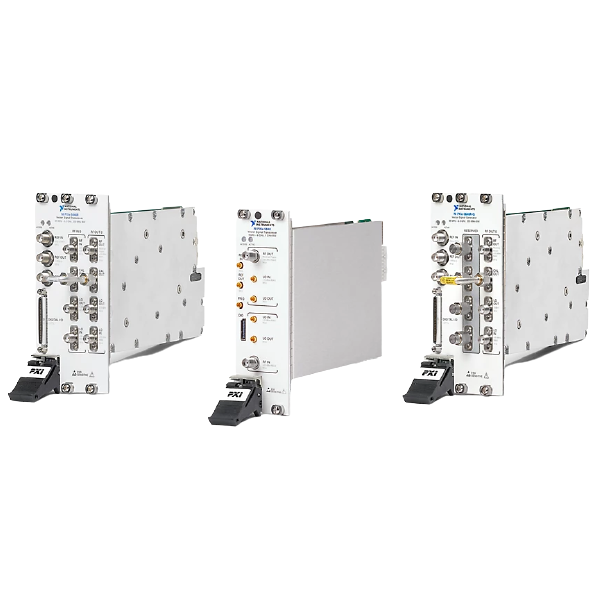
Why vector signal transceivers matter in wireless test
A vector signal transceiver is built around two core capabilities: RF signal generation and RF signal acquisition. Bringing both functions into one platform helps reduce timing uncertainty, simplifies synchronization, and makes closed-loop testing more practical for advanced wireless systems.
This matters in applications such as modulation quality analysis, real-time stimulus and response testing, beamforming research, and rapid prototyping of wireless algorithms. When engineers need to transmit, receive, and process data within one coordinated setup, a transceiver-based architecture can shorten development cycles and improve repeatability.
Typical applications across development and validation
These instruments are commonly used in laboratories where test flexibility is as important as raw RF performance. In early-stage development, they support waveform playback, protocol research, and algorithm validation. In later phases, they can be integrated into automated environments for device verification, regression testing, and performance comparison under controlled conditions.
Vector signal transceivers are also well suited to scenarios that require bidirectional measurement, such as receiver testing, adaptive system evaluation, and MIMO-related workflows. Because generation and capture are coordinated within the same measurement framework, engineers can evaluate system behavior more efficiently than with loosely connected standalone instruments.
How they fit into a broader RF test ecosystem
In many projects, a transceiver is not the only tool in the bench setup. It often works alongside dedicated RF signal generators when additional stimulus channels or specific test configurations are required. This allows teams to scale from core transceiver-based validation to more specialized RF workflows without redesigning the entire measurement approach.
For research environments that prioritize reconfigurability, vector signal transceivers can also complement software defined radios. The combination is relevant when moving between exploratory prototyping and more structured measurement tasks, especially in wireless innovation programs where both flexibility and measurement discipline are needed.
What to consider when selecting a vector signal transceiver
The right platform depends on the signal environment and the purpose of the test. Engineers typically review factors such as operating frequency coverage, instantaneous bandwidth, synchronization requirements, and the level of integration needed with software automation. For some teams, the most important point is waveform fidelity; for others, it is deterministic timing or multi-channel scalability.
It is also important to look at the full test workflow rather than the instrument in isolation. A good fit should support not only current measurements, but also future changes in test scripts, wireless standards, and validation methods. In practice, this means evaluating the instrument as part of a modular test system rather than as a standalone box with fixed use cases.
Advantages for automated and repeatable measurement
One of the key benefits of this category is the ability to build more consistent automated test routines. When generation and analysis are handled within one coordinated platform, software control becomes easier to manage and measurement timing is easier to reproduce. That can be valuable in both engineering validation and production-oriented environments where repeatability directly affects decision quality.
These systems are particularly relevant for users building scripted RF sequences, hardware-in-the-loop setups, or iterative characterization processes. A transceiver-centered architecture supports tighter integration between instrument control, waveform handling, data capture, and analysis logic, which can help reduce setup complexity over time.
When a vector signal transceiver is the right choice
Not every RF task requires a transceiver. If the need is purely one-way stimulus generation, a dedicated generator may be sufficient. If the project is more experimental and communications-focused, some teams may begin with software defined radio platforms and expand later. But when the application requires tightly linked transmit and receive capability, synchronized measurement, and flexible automation, a vector signal transceiver becomes a strong option.
This is especially true in wireless test programs where performance verification, real-time interaction, and rapid iteration all matter at the same time. In those situations, the value comes not only from the instrument functions themselves, but from the efficiency of working within a unified test and measurement workflow.
Supporting more efficient wireless development
As wireless systems become more complex, test strategies need to keep pace with wider bandwidths, more dynamic signals, and shorter development timelines. Vector signal transceivers help address that challenge by combining critical RF functions in a format that supports both experimentation and structured validation.
For organizations building or refining wireless products, this category is relevant when the goal is to move beyond isolated measurements and toward a more connected, scalable approach to RF testing. Reviewing the available platforms alongside related tools such as signal generation solutions can help clarify the best path for your application, budget, and level of automation.
Get exclusive volume discounts, bulk pricing updates, and new product alerts delivered directly to your inbox.
By subscribing, you agree to our Terms of Service and Privacy Policy.
Direct access to our certified experts