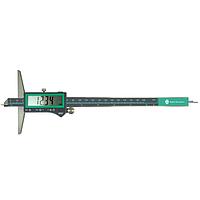
Depth Gauge Repair Service
When depth measurements start to drift, even small errors can affect machining quality, incoming inspection, and final dimensional checks. A reliable Depth Gauge Repair Service helps restore measuring performance, reduce uncertainty in routine inspection work, and extend the usable life of mechanical depth gauges already in service.
This category is intended for businesses that rely on depth measurement in production, maintenance, toolrooms, and quality control. Whether the issue involves wear, sticking movement, loss of repeatability, or general accuracy concerns, repair work is often the practical next step before replacing the instrument.

Why depth gauge repair matters in industrial measurement
Depth gauges are used to check slot depth, hole depth, recesses, shoulders, and step features where direct linear measurement is not always convenient. Because these tools are frequently used on the shop floor and in inspection areas, they can be exposed to dust, impact, improper storage, and gradual mechanical wear.
Over time, these factors may lead to reduced accuracy, inconsistent zero setting, rough movement, or difficulty reading and repeating results. Repair service helps bring the instrument back into a usable condition so it can continue supporting dimensional control processes with better confidence.
Common reasons to send a depth gauge for service
Many users only notice a problem when inspection results no longer match reference values or when measurements vary between operators. In practice, issues can also appear as visible damage, unstable contact, loose mechanical parts, or signs that the gauge no longer moves smoothly through its measuring range.
A professional service request is also appropriate after accidental drops, extended use in harsh environments, or when the gauge has been stored for long periods without verification. In facilities that also maintain related measuring tools, it can be useful to coordinate service planning with callipers repair service or micrometers repair service to keep inspection equipment in consistent working condition.
Typical scope of a depth gauge repair service
The exact repair process depends on the instrument condition, but service generally focuses on restoring proper mechanical function and checking whether the gauge can return to stable measurement performance. This may include inspection of worn or damaged parts, movement and contact condition, scale or reading behavior, and overall operating smoothness.
For many industrial users, the main goal is not only to fix an obvious fault but also to recover repeatability and day-to-day usability. A repaired depth gauge should be easier to operate, more consistent in handling, and better suited for ongoing dimensional verification tasks.
Where a broader maintenance program is needed, companies may also review neighboring services such as thickness gauge repair service for other handheld measuring tools used in similar inspection workflows.
Supported brands and service examples
This category includes service options for widely used brands in precision measurement. Commonly requested examples include Mahr depth gauge inspection service, as well as repair services for MITUTOYO, MOORE & WRIGHT, Niigata Seiki, and TECLOCK instruments.
Representative listings in this category include Mahr Depth Gauge Inspection Service, Mitutoyo Depth Gauge Repair Service, MOORE & WRIGHT Depth Gauge Repair Service, Niigata Seiki Depth Gauge Repair Service, and TECLOCK Depth Gauge Repair Service. These examples help illustrate the range of supported service needs across established manufacturers commonly found in industrial measurement environments.
How to choose the right service option
When selecting a service, it is helpful to identify the brand, the observed fault, and the operating context of the instrument. A gauge used in frequent production checks may need a different level of attention than one used occasionally in laboratory inspection, especially if the tool has experienced contamination, impact, or prolonged wear.
Users should also consider whether the immediate need is troubleshooting, repair, or an inspection-oriented evaluation of the gauge condition. Providing clear information about the instrument’s symptoms can help streamline the service process and improve the chances of returning the tool to suitable working performance.
Who typically uses depth gauge repair services
These services are relevant to machine shops, fabrication facilities, maintenance departments, QA teams, calibration coordinators, and distributors managing customer-owned measuring tools. In all of these settings, keeping handheld mechanical instruments operational supports cost control and helps avoid unnecessary downtime in inspection routines.
Repair is especially valuable when the gauge is part of an established measurement process and operators are already familiar with its handling. Instead of replacing instruments immediately, businesses can assess whether repair is the more efficient route for restoring function and preserving measurement continuity.
Good practice after repair
Once a depth gauge has been serviced, proper handling becomes important for maintaining performance over time. Clean storage, careful transport, protection from impact, and routine condition checks can reduce the chance of repeated faults and help the instrument remain stable in daily use.
For organizations managing multiple mechanical measuring tools, grouping maintenance activities into a planned service cycle often improves equipment availability. This is particularly useful in environments where dimensional checks depend on several handheld instruments working together across production and inspection points.
Final considerations
A depth gauge that no longer performs as expected does not always need to be retired immediately. With the right repair service, many instruments can be restored for continued use in practical industrial measurement tasks, supporting more reliable depth checks and better control of dimensional quality.
If your team uses depth gauges as part of routine inspection, this category provides a focused starting point for evaluating service options by brand and instrument condition. Choosing a suitable service path can help protect your existing equipment investment while keeping measurement work dependable and efficient.
Get exclusive volume discounts, bulk pricing updates, and new product alerts delivered directly to your inbox.
By subscribing, you agree to our Terms of Service and Privacy Policy.
Direct access to our certified experts