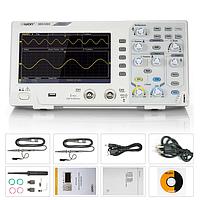
Digital Oscilloscope Repair Service
When a digital oscilloscope starts showing unstable traces, trigger errors, display faults, or channel problems, repair is often the most practical way to restore measurement reliability without interrupting test workflows for long. For laboratories, maintenance teams, production lines, and service centers, choosing the right digital oscilloscope repair service helps protect both instrument value and measurement confidence.
This category focuses on repair support for digital oscilloscopes used in electronics testing, industrial troubleshooting, R&D, and quality control. It is relevant for users working with benchtop scopes from major manufacturers as well as organizations that need a structured way to evaluate faults, restore functionality, and return equipment to service with minimal uncertainty.

Why digital oscilloscope repair matters
A digital oscilloscope is more than a display device. It combines signal acquisition, timing analysis, triggering, internal processing, user interface control, and communication functions in one platform. When any of these areas are affected, troubleshooting results can become inconsistent, which may lead to incorrect diagnosis of circuits, power electronics, embedded systems, or communication signals.
Professional repair is typically considered when the instrument powers on but behaves abnormally, when one or more input channels fail, when the touchscreen or keys are unresponsive, or when waveform capture no longer matches expected behavior. In many cases, restoring the existing instrument is a sensible alternative to immediate replacement, especially when the scope is already integrated into a test procedure or production environment.
Common issues seen in digital oscilloscopes
Repair requests often begin with symptoms rather than a confirmed root cause. Users may report no display output, distorted traces, unstable triggering, front-panel control failure, input channel damage, communication port problems, or power-related startup issues. Because modern oscilloscopes are highly integrated, the visible symptom does not always point directly to the failed section.
This is why fault evaluation is an important part of the service process. A proper repair approach usually starts with checking power behavior, acquisition response, trigger performance, display condition, and signal path integrity. For teams using related instrument types, it may also be useful to review options for analog oscilloscope repair when maintaining mixed fleets of legacy and digital test equipment.
Supported brands and repair coverage
This category is relevant for many widely used oscilloscope brands in professional test environments. Examples include KEYSIGHT, Rohde & Schwarz, TEKTRONIX, YOKOGAWA, BKPRECISION, GW INSTEK, Promax, and TEXIO. Different brands may vary in interface design, acquisition architecture, and hardware layout, but the repair objective remains the same: recover stable and dependable instrument operation.
Representative services in this category include KEYSIGHT Digital Oscilloscope Repair Service, TEKTRONIX Digital Oscilloscope Repair Service, YOKOGAWA Digital Oscilloscope Repair Service, Rohde & Schwarz Digital Oscilloscope Repair Service, and GW INSTEK Digital Oscilloscope Repair Service. These listings help buyers quickly identify brand-specific service options while staying within the broader scope of oscilloscope repair needs.
How to choose the right repair service
The best service path depends on the type of instrument, the operating environment, and the impact of downtime on your work. A bench oscilloscope used in R&D may require different handling priorities than a unit installed in production test, field maintenance, or incoming inspection. Before selecting a service, it is useful to note the exact symptom, the conditions under which the fault appears, and whether the issue affects all channels or only specific functions.
It also helps to match the service to the instrument format. If your equipment is not a standard benchtop digital model, related categories such as handheld oscilloscope repair or PC oscilloscope repair may be more suitable. This distinction matters because portability, interface structure, and accessory dependency can influence diagnosis and repair handling.
Typical use cases for repair requests
Repair demand often comes from organizations that depend on repeatable waveform analysis in daily operations. Electronics manufacturers may need to restore a scope used for production verification. Service departments may need a functioning instrument for board-level troubleshooting. Educational laboratories and industrial maintenance teams may also require repair to keep essential test stations available without replacing every faulty unit.
Digital oscilloscopes are commonly used where timing, signal integrity, switching behavior, and waveform anomalies must be observed quickly. In these environments, a repaired scope is valuable only if it returns to dependable operation in real use, not just basic power-on condition. That is why buyers often look beyond the product name and focus on service suitability, fault handling experience, and application continuity.
Examples of brand-specific service options
Some users search directly by manufacturer because they already know the instrument family in use. In that case, brand-oriented service listings can make selection faster. Common examples include TEKTRONIX Digital Oscilloscope Repair Service, Promax Digital Oscilloscope Repair Service, BKPRECISION Digital Oscilloscope Repair Service, and TEXIO Digital Oscilloscope Repair Service.
For organizations standardizing test systems around a specific vendor, it may also be helpful to explore the broader TEKTRONIX portfolio or compare service needs across installed brands. This is especially relevant when one facility operates multiple oscilloscope platforms and wants a clearer maintenance strategy across departments.
When to repair instead of replace
Replacement is not always the default answer when a digital oscilloscope develops faults. If the instrument still fits your bandwidth, channel count, interface, and workflow requirements, repair may be the more efficient route. This is often true when operators are already familiar with the unit, test procedures are based on that platform, or accessories and bench layouts are built around the existing instrument.
A practical decision usually considers equipment age, fault severity, operational dependence, and the need for measurement continuity. In many B2B settings, serviceability and turnaround planning are just as important as the device itself, because every day of downtime can affect engineering schedules, maintenance response, or production throughput.
Find the right digital oscilloscope repair path
This category is designed for buyers who need a clearer route to restoring faulty digital oscilloscopes from established brands such as KEYSIGHT, Rohde & Schwarz, TEKTRONIX, YOKOGAWA, BKPRECISION, GW INSTEK, Promax, and TEXIO. Whether the issue involves display behavior, input channels, trigger response, or general operation, a focused repair service category makes it easier to identify the most relevant option.
If you are comparing service choices for different oscilloscope formats or managing a mixed instrument inventory, reviewing related repair categories can also help narrow the correct service path. The goal is straightforward: return the instrument to useful working condition and support reliable measurement tasks across testing, maintenance, and industrial diagnostics.
Get exclusive volume discounts, bulk pricing updates, and new product alerts delivered directly to your inbox.
By subscribing, you agree to our Terms of Service and Privacy Policy.
Direct access to our certified experts