Thermal imaging cameras can quickly identify red areas with higher temperatures or significant temperature differences across a solar panel array, but this alone is not enough to determine the cause. The abnormal area may be located on a photovoltaic cell, junction box, bypass diode, MC4 connector, cable, or electrical contact point.
What Causes Hot Spots on Solar Panels?
A hot spot is an area with a significantly higher temperature than its surroundings. On a rooftop solar panel array, this may be associated with degraded, cracked, or malfunctioning photovoltaic cells; faulty bypass diodes; connectors with high contact resistance; or overheated electrical connection points.
Localized shading can also cause uneven current distribution within a solar panel and create areas with different temperatures. Dirt, leaves, or objects partially blocking the panel surface should also be checked before concluding that the panel is damaged.
Highly reflective surfaces can cause thermal imaging results to vary depending on the viewing angle. If reflections are suspected, changing the camera position or viewing angle and repeating the inspection can help determine whether the observed temperature difference is genuine.
Choose the Right Conditions and Scan the Entire Solar Array
Inspection conditions directly affect the results. Solar panels absorb energy from sunlight and release heat over time. If the inspection is performed when solar irradiance is changing significantly or when parts of the array are shaded, the temperature distribution across the panels may be uneven.
Before taking measurements, define the inspection objective and choose an appropriate time. When the solar array is operating under sufficiently high irradiance, temperature differences between areas are generally easier to observe.
The inspection should not begin by measuring individual panels one by one. Instead, scan the entire solar array first, then narrow the inspection from the overall system to individual rows, panels, and finally the abnormal areas.
A panel with a higher temperature does not necessarily indicate a problem if surrounding panels show similar temperatures. Conversely, a localized hot area on a panel with an otherwise uniform thermal distribution may be more significant.
Temperature differences between panels and between different areas of the same panel are often more useful for assessment than a single temperature reading.
Analyze the Shape, Not Just the Color
The shape of a hot area can provide additional information about where further inspection is needed.
A localized hot area on part of a panel may be associated with a photovoltaic cell or shading. A concentrated thermal area around the junction box or bypass diode should be inspected separately. If heat is concentrated around a connector or wiring connection, the electrical contact condition may need to be checked.
Do not rely solely on red, yellow, or white colors displayed on the screen. The colors depend on the temperature scale selected on the camera. When analyzing a thermal image, temperature, temperature difference, shape, and location should all be considered together.
Compare Thermal Images with Visual Inspection and Electrical Data
After detecting a hot area, compare the thermal image with a visual image of the same location. This helps determine whether the abnormal area is located on a photovoltaic cell, junction box, connector, cable, or another component.
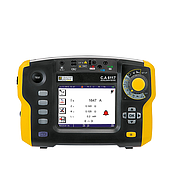
If a panel shows abnormal characteristics, power analyzers can also be used to assess its operating condition. Comparing electrical measurements between individual panels or rows can help determine whether a temperature difference is accompanied by an electrical abnormality.
Thermal imaging therefore serves as a rapid screening and localization method, while identifying the actual cause requires additional information.

When Does a Hot Spot Require Action?
If a hot area is caused by dirt, leaves, or shading, the source of the problem can be removed and the panel inspected again.
If heat is concentrated around a connector or electrical connection point, the contact condition and related components should be inspected. For hot areas appearing on photovoltaic cells or inside a panel, the panel's condition should be assessed further before deciding whether to repair or replace it.
For large rooftop solar arrays with many panels, thermal imaging can quickly identify areas that require further inspection, reducing manual inspection time and allowing personnel to focus on locations showing abnormal thermal patterns.
Inspection Equipment and Methods
A thermal imaging camera used for solar panel inspection should have suitable thermal sensitivity and image resolution. Image storage, thermal analysis functions, and the ability to clearly observe small areas also affect inspection effectiveness.
For large solar arrays, an infrared thermal imaging camera can be combined with an unmanned aerial vehicle equipped with a thermal camera. The drone enables rapid inspection over a large area, after which abnormal locations can be examined directly from the ground.
Hot Spot Inspection Procedure for Solar Panels
A systematic inspection can be carried out in the following sequence:
Check irradiance conditions → scan the entire solar array → compare temperatures → identify abnormal areas → analyze the shape and location → rule out shading, dirt, and reflections → compare with visual images → perform electrical tests when necessary → identify the cause → take corrective action and reinspect.
Detecting a hot spot helps identify where further inspection is needed. Determining the actual cause is what enables effective corrective action for the solar array.
Frequently Asked Questions
Does a Hot Spot on a Solar Panel Mean the Panel Is Damaged?
Not necessarily. A hot spot may be associated with a photovoltaic cell, bypass diode, or connector, but it can also result from shading, dirt, or uneven irradiance conditions.
When Should Solar Panels Be Thermally Inspected?
Thermal inspection should be performed while the system is operating and under sufficient irradiance to produce measurable temperature differences between areas. The specific timing should be selected according to the inspection objective and actual site conditions.
Should a Solar Panel with a Hot Spot Be Replaced Immediately?
A replacement decision should not be based on thermal images alone. The cause and severity of the abnormality should be determined before deciding whether to repair, replace, or continue monitoring the panel.
Can a Thermal Imaging Camera Accurately Identify a Solar Panel Fault?
No. A handheld infrared thermal camera helps detect and localize abnormal thermal patterns. When a hot area is identified, visual inspection and appropriate electrical measurements should be combined to determine the underlying cause.