Thermal imaging for PCB research provides a contactless way to examine heat across an entire circuit board rather than taking readings at only a few physical points. This approach can help engineers locate localized overheating and review how thermal conditions change during operation.
Why is whole-board thermal measurement useful in PCB research?
Whole-board measurement is useful because heat on a PCB is distributed across components, traces, and surrounding areas rather than occurring at a single point. Engineers working with high-power output components need to balance the overall heat load and avoid conditions in which one component overheats and affects board performance.
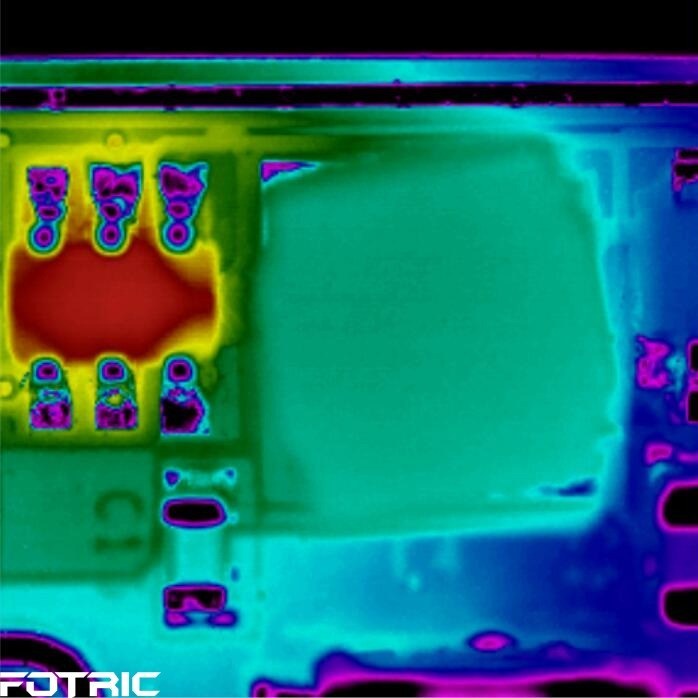
A thermal image can provide temperature information over the board in one acquisition. This makes it possible to inspect the relationship between a suspected hot component and the nearby areas that may contribute to, or be affected by, its temperature.
What limitations can thermal imaging address compared with point-based measurements?
Point-based measurements such as ordinary thermocouples may be inefficient for assessing temperature across an entire board. The source also notes that measurements on smaller devices can introduce bias, while many conventional methods do not provide trend analysis for the full PCB.
| Measurement consideration | Point-based measurement | Whole-board thermal imaging approach |
|---|---|---|
| Coverage | Focuses on selected physical measurement points | Captures thermal information across the board in one image |
| Small-device measurement | May introduce measurement bias according to the source | Observes temperature without physical contact |
| Thermal trend review | May not provide a complete board-level trend | Can use saved thermal information and radiometric video for analysis |
This does not mean that every measurement method serves the same purpose. The practical value of thermal imaging in this context is its board-level view and the ability to investigate individual image pixels when a potential thermal issue is observed.
How can radiometric video help investigate PCB thermal behavior?
Radiometric video preserves temperature-related information in the video stream, rather than showing thermal imagery only as a visual reference. For PCB research, this supports review of thermal behavior over time while retaining access to pixel-level information.
The stated adjustable frame rate of up to 30 Hz can support observation of changes occurring during operation. Engineers can use the saved data to examine a location of interest at different moments, helping distinguish a persistent hot area from a temperature change associated with a specific operating condition.
When should engineers focus on macro lenses and sensitivity for PCB inspection?
Macro lenses and sensitivity are relevant when the inspection target includes small PCB features or localized thermal differences. The stated 20 μm and 50 μm macro-lens options and 30 mK sensitivity are presented as features for chip testing and for identifying PCB design defects.
Lens selection should match the size of the area being examined and the required level of detail. The source does not provide selection rules for particular component sizes, so the appropriate choice should be based on the inspection target and measurement requirements.
Note: The stated accuracy is ± 2 °C or ± 2%, whichever is greater. This means the larger of the two accuracy limits applies to a given measurement.
What thermal issues can PCB researchers investigate with this approach?
Thermal camera can be used to investigate whether high-power output components are creating an uneven heat load, whether a component is overheating, and how heat is distributed across the rest of the board.
A thermal image alone identifies temperature patterns; the observed pattern still needs to be assessed in the context of the board's operating condition and design. Reviewing full-board data together with pixel-level information can give researchers a more complete basis for investigating a suspected thermal issue.