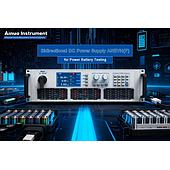
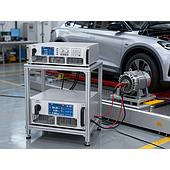
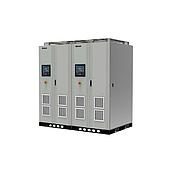
A bidirectional power supply for battery emulation can replace a physical battery during many development-stage tests by reproducing selected electrical behavior in a controlled laboratory setup. Unlike a conventional one-way source, it can deliver power to the device under test and absorb energy that the device sends back.
This capability is relevant where battery voltage, current limits, internal resistance, state-of-charge behavior, and changing load conditions need to be represented without repeatedly charging and discharging physical battery packs.
Summary: Battery emulation reproduces battery electrical behavior with programmable equipment. A bidirectional supply can source and sink energy in one instrument. It supports transient testing, repeatable conditions, and may reduce heat dissipation when absorbed energy is regenerated to the AC grid.
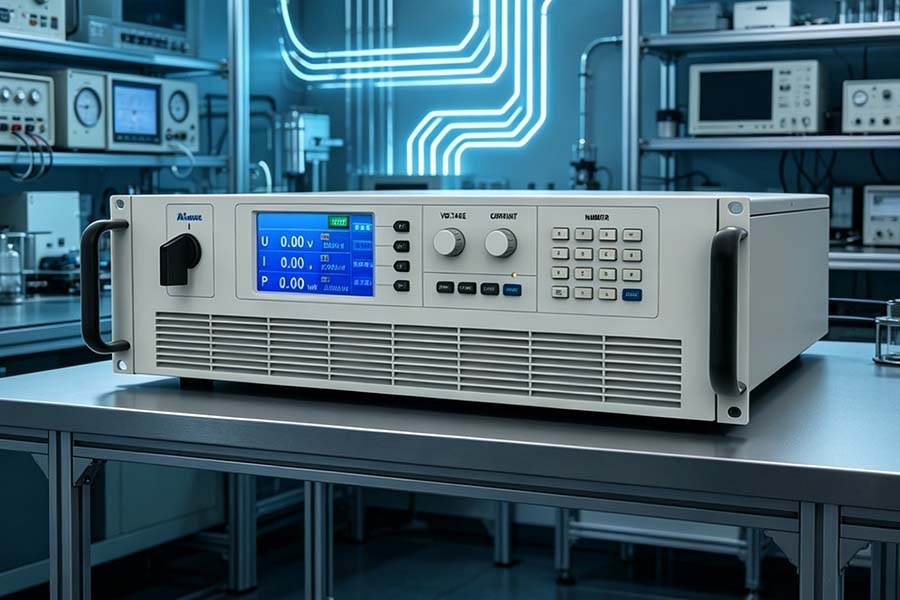
What is battery emulation?
Battery emulation is the use of programmable power equipment to replicate the electrical characteristics and behavior of a real battery. Instead of connecting a battery pack, engineers use a controllable source that can represent operating parameters such as voltage profiles, current limits, internal resistance, and state of charge.
This approach is used for applications including EV powertrain testing, battery management system validation, automotive electronics, renewable energy storage development, consumer electronics design, and aerospace or defense testing. It can help teams run controlled tests without relying on physical batteries for every development task.
Why can physical batteries make development testing difficult?
Physical batteries can require lengthy charge-discharge cycles, safety precautions, and management of performance variation between units. Their behavior can also change with state of charge, temperature, load conditions, and aging.
For lithium-ion batteries, development teams also need to account for risks associated with thermal runaway, overcharging, short circuits, and fire. Physical battery testing may still be necessary at some stages, but emulation provides an alternative for early design validation and functional testing.
Why is bidirectional energy flow important in battery emulation?
Bidirectional energy flow matters because some devices both consume power and return it to the source. A bidirectional power supply combines a programmable DC power source and an electronic load function, so it can source power to a device under test and absorb returned power.
This source-and-sink operation is useful for regenerative braking systems, motor drives, inverters, and energy storage systems. A unidirectional supply cannot absorb reverse power by itself, which may otherwise require separate equipment such as an electronic load.
| Test requirement | How bidirectional operation helps |
|---|---|
| Device consumes energy | The supply delivers power to the device under test. |
| Device returns energy | The supply absorbs returned power during sink operation. |
| Frequent direction changes | The instrument can transition between sourcing and sinking current. |
How does a bidirectional supply reproduce changing battery behavior?
Real batteries are not ideal voltage sources: their output voltage can vary as conditions change, and rapid load transitions can produce voltage fluctuations. Battery emulation therefore needs a supply that can follow defined battery models and respond to changing demand.
Modern bidirectional supplies can be configured to emulate battery voltage profiles, internal resistance, and state-of-charge behavior. Custom models allow engineers to create test conditions that more closely represent the intended operating environment without connecting a physical battery pack.
Why does transient response affect battery emulation results?
Fast transient response is important because battery-powered devices can demand current suddenly. Examples include motor startup, power-tool operation, wireless communication bursts, and peak computing loads.
If the power source responds too slowly, the test condition can be distorted and potential design issues may be masked. Bidirectional supplies designed for rapid response to changing load conditions can help reproduce transient battery behavior more faithfully.
Can bidirectional battery emulation reduce energy waste during testing?
It can reduce energy dissipated as heat when the bidirectional supply regenerates absorbed energy back to the facility AC grid. In contrast, traditional resistive loads and electronic loads commonly dissipate discharged energy as heat.
For high-power EV or energy-storage testing, lower heat dissipation can also reduce cooling requirements. The actual benefit depends on the test setup and whether the selected supply provides energy regeneration.
Note: Energy regeneration is a capability described for regenerative bidirectional power supplies; it should be confirmed for the specific instrument and facility installation.
How does software-defined battery behavior improve repeatability?
Software-defined battery behavior enables engineers to repeat the same defined conditions across tests. This is valuable because real batteries age over time and can vary from one unit to another, making identical physical-battery tests harder to reproduce.
Repeatable conditions can support design validation, automated testing workflows, compliance testing, certification processes, and troubleshooting. Teams can also evaluate a range of operating and fault scenarios without handling live, high-capacity battery packs in every test.
Which applications can benefit from bidirectional battery emulation?
Bidirectional battery emulation is applicable where equipment needs controlled battery-like power and may return energy during operation. It is particularly relevant to electrified systems and power electronics with changing load behavior.
- Electric vehicles: traction inverters, on-board chargers, DC-DC converters, and battery management systems.
- Renewable energy systems: solar inverters, energy storage systems, and microgrid controllers.
- Aerospace and defense: mission-critical systems requiring highly controlled power-test environments.
- Consumer electronics: devices tested under different simulated battery conditions without repeated physical battery cycling.
When should engineers consider a bidirectional power supply for battery emulation?
Engineers should consider this approach when a test requires both battery-like output and controlled absorption of returned energy, especially for regenerative or rapidly changing loads. It is also useful when repeatability, laboratory safety, and reduced dependence on physical battery packs are priorities.
The appropriate battery model, transient performance, and regeneration capability should be matched to the actual device and test objective. A bidirectional supply does not remove the need for all physical-battery testing, but it can provide a controlled platform for many validation activities.