A multi-channel power analyzer supports EV drive testing by synchronizing measurements across the DC bus, motor AC output, and mechanical parameters such as torque and speed. This common timing is important when evaluating efficiency and power flow during changing operating conditions.
For systems with more than one motor, synchronized channels can measure front- and rear-axle power together instead of combining results from separate instruments after the test.
Summary: EV drive tests need synchronized DC, AC, and mechanical data. Multi-channel measurement helps evaluate efficiency and transient power flow. Six channels can address a DC bus and two three-phase motors. Software analysis can generate efficiency maps and identify loss components.
What does a multi-channel power analyzer measure in an EV drive test?
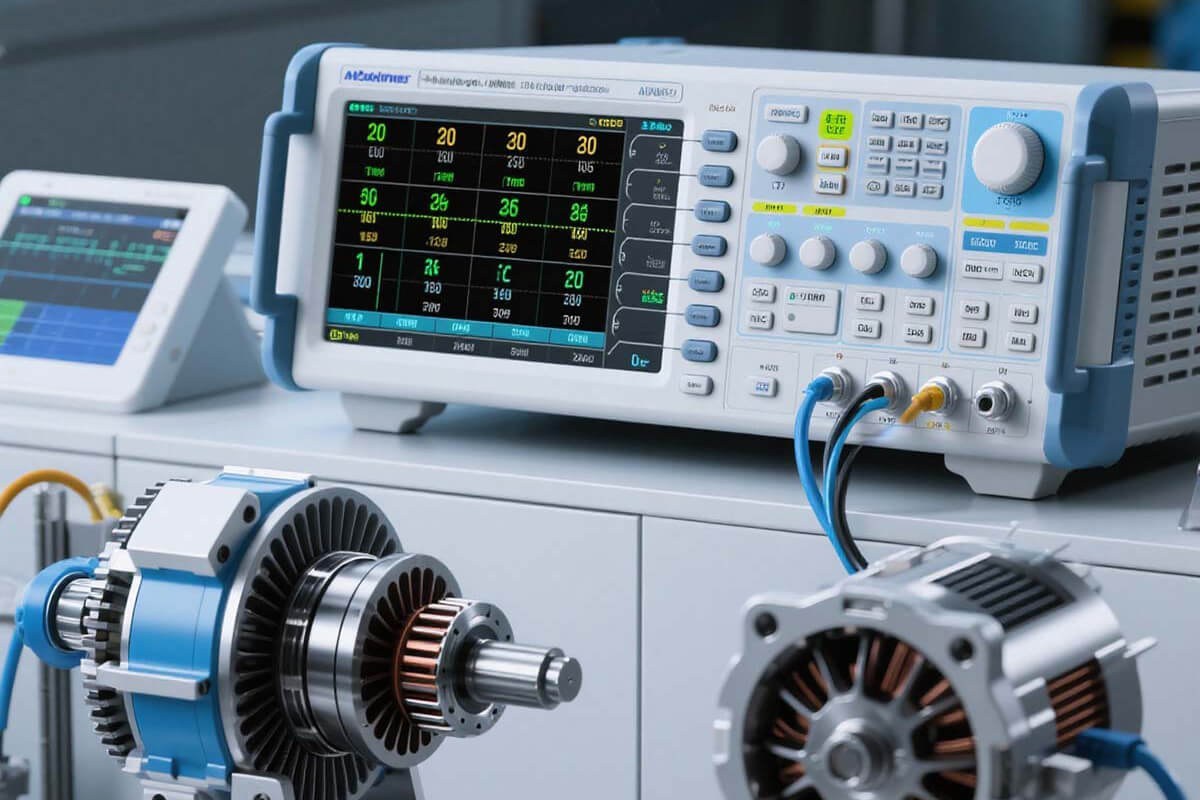
It measures electrical power at multiple points and can correlate that data with torque and speed to assess the drive system as a whole. A typical arrangement captures the motor controller input on the DC side and motor output on the AC side, while mechanical power is derived from torque and speed data.
This arrangement supports system-level efficiency analysis, where inverter efficiency and motor efficiency are considered together. It also provides a basis for examining power-flow changes during acceleration and energy recovery.
| Measurement area | Relevant data | Purpose in the test |
|---|---|---|
| DC bus | DC input power | Evaluates power entering the motor controller |
| Motor output | AC power and phase-current harmonics | Assesses motor-side electrical behavior |
| Mechanical output | Torque and speed | Relates electrical input and output to mechanical power |
Why is synchronous sampling important for electric drive efficiency testing?
Synchronous sampling is important because EV drive power changes rapidly, and phase differences must be captured accurately across all channels. The source describes a unified time base and a sampling rate of at least 1 MS/s as a hardware approach for multi-channel capture.
Fast operating changes can include motor-speed transitions from 0 to 15,000 rpm, acceleration, and energy recovery. When channels do not share the same time reference, combining measurements can introduce errors into transient efficiency or power-allocation analysis.
Which specifications are relevant when selecting channels for a dual-motor EV system?
A dual-motor four-wheel-drive layout may require at least six power channels: one for the DC bus and three-phase measurement for each motor. This enables real-time linkage of front- and rear-motor measurements.
The source also identifies requirements that may be considered for demanding test setups, including power above 250 kW, 500 A current sensors, basic voltage/current accuracy of 0.05% or better, and frequency bandwidth of at least 500 kHz. Actual requirements should be matched to the system under test.
| Test scenario | Key measurements | Multi-channel role |
|---|---|---|
| Traction inverter | Switching loss, efficiency, harmonic distortion | Measures three-phase signals and bidirectional DC/DC behavior |
| Dual-motor four-wheel drive | Front/rear power allocation and combined efficiency | Links six channels in real time |
| Vehicle energy management | Charge/discharge cycle efficiency and energy-consumption simulation | Records voltage and current transient responses simultaneously |
How can analyzer software help interpret EV drive test data?
Software can turn synchronized measurements into an efficiency map based on the motor torque-speed curve. This helps identify the operating range associated with higher efficiency rather than reviewing individual readings alone.
It can also quantify loss components, including iron and copper losses, to help locate efficiency bottlenecks. For durability-related work, continuous recording of charge and discharge cycle data can support semi-automatic long-term verification.
What should be checked when comparing DC bus and harmonic measurements?
Measurement requirements differ by test item, so the relevant accuracy or bandwidth should be read in context. The source lists DC bus power accuracy of 0.03% of reading + 0.05% of full scale for the cited example and a DC to 0.5–1 MHz bandwidth range for motor phase-current harmonics.
It associates DC bus power testing with GB/T 18488-2023 and phase-current harmonic measurement with IEC 61000-3-12. These references describe the test context cited in the source; the applicable requirements depend on the project and market.