What are Leeb and Rockwell Hardness Tests?
The Leeb hardness testing principle: Simple and Fast
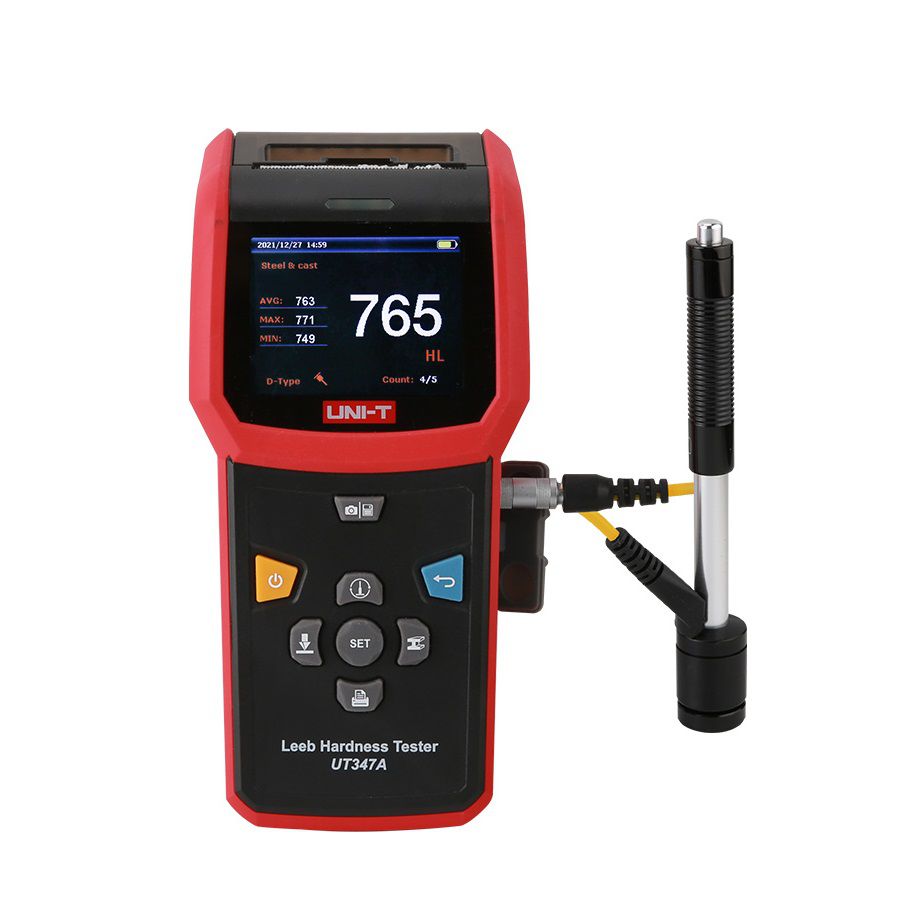
Leeb hardness testing is based on the rebound method. The ratio of the rebound velocity to the impact velocity determines the hardness value. You obtain an HL (Leeb) value, which can be easily converted to HRC, HB, or HV. This is a non-destructive method, ideal for rapid testing using devices like the Equotip Live Leeb D, which features wireless app connectivity, a measuring range of 150-950 HL, and an accuracy of just ±4 HL. You can measure hundreds of points in minutes, with data syncing to the cloud instantly.
The Rockwell hardness testing principle: Static and Highly Accurate
In contrast, Rockwell hardness testing is a static method. A diamond cone or steel ball indenter is pressed into the material with a minor (pre-load) and then a major load. After holding the load and releasing it, the depth of the indentation is measured to calculate the HRC or HRB hardness. This method requires stationary equipment and is suitable for specialized laboratory environments. In practice, Rockwell provides stable results for large cast steel components, but you must prepare a flat, thoroughly cleaned surface.
Why are Leeb and Rockwell Hardness Tests Different?
Differences in testing type and equipment
Leeb testing is dynamic and uses ultra-compact handheld devices. You can easily carry them and measure on-site without dismantling components. Rockwell testing is static and requires heavy benchtop machines. While Rockwell is more accurate for large samples, it is less flexible.
Conversion between scales: HL 800 ≈ HRC 64, but this is not always 100% accurate due to material differences. The ASTM E140 conversion table is recommended for reference.
Pros and cons affecting measurement
Leeb testing is fast (1 second/point) and minimally destructive to the surface, but it is sensitive to rough surfaces or thin components. You need at least 5mm of thickness to avoid vibration. Rockwell testing offers high accuracy (±1 HRC) but leaves a deeper indentation (0.15mm), causing localized damage. Rockwell is ideal for uniform, non-portable materials. Research shows Leeb is suitable for concrete and rock with an error of less than 10%, while Rockwell is reserved for precision metals.
Learn more:
Which handheld metal hardness tester is good?
Surface Hardness Testing With Technology From Novotest
How are these hardness measurement methods applied?
Flexible Leeb hardness testing in the field:
Leeb hardness testing is highly effective in mobile environments. You can inspect oil and gas pipelines or wind turbines without stopping machinery using devices like the NOVOTEST T-D2, which measures steel and aluminum with a bright screen, stores 1,000 results, and connects to an Android app. It offers a wide HL range, multi-material calibration, and 20 hours of continuous battery life. In welding, Leeb quickly checks the Heat Affected Zone (HAZ) without the need for dismantling. The PROCEQ Equotip Live Leeb D syncs data in real-time and emails reports instantly, saving significant time compared to lab testing.
Rigorous Rockwell hardness testing in the lab:
Rockwell is used for strict QA in applications such as the production of cutting tools and automotive shafts. Precise hardness measurement helps ensure product longevity. You can measure tool steel at HRC 60-65 to ensure uniformity across large batches. This method complies with ASTM E18 and is highly reliable for certification. However, Rockwell is less effective in the field as it requires a stable power source and lengthy surface preparation.
Leeb is suitable for oil & gas and aerospace (on-site turbine blade inspection).
Rockwell is excellent for automotive and cutting tool industries (batch production inspection).