For full functionality of this site it is necessary to enable JavaScript.
EMIN.COM.MM
0

How is the measuring tape used correctly?

03/05/2025 11:13:39

Have you ever wondered how to accurately measure the slope, inclination and angle of a building while still ensuring aesthetics? With the water level widely used in architecture and interior design, it has become an indispensable tool in every measurement stage. Based on practical experience and a deep understanding of customer needs, the following article will share how to use the water level correctly, helping to overcome common difficulties when measuring.

Overview of spirit level

The level is known by other names such as level, livo or balance, which can be seen a lot in the mechanical field. This tool helps to check the inclination, slope and deviation angles on many types of works, from construction to interior and exterior design. 

In the activities of measuring and checking deviation angles at works or during interior construction, people often prefer to use level bars (or straight level) and electronic level (also known as electronic angle measuring ruler). In particular, the line of electronic level rulers integrated with laser is always chosen by many technicians and acceptance teams thanks to its outstanding accuracy and convenience.

How to use a spirit level correctly

Since the level rod is the most commonly used type, in this guide, EMIN will focus on how to use a straight level. For other types of levels such as frame levels or electronic levels, the principles of use are similar. 
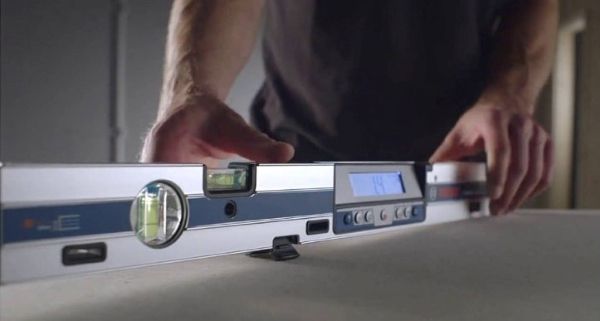
Step 1: Place the level rod on the surface to be measured. If the surface is not flat, the glass tube on the ruler will have one end higher, causing the air bubble to move towards the high end. 

Step 2: Observe the graduations on the ruler body to determine the difference between the two ends. 

Step 3: Read the incline measurement result based on the position of the air bubble relative to the graduations.

How to read a water level correctly

When measuring flatness with a spirit level, people usually gradually adjust by inserting the feeler into the gap, continuing to adjust until the air bubble is almost balanced in the middle of the spirit level tube. Then, the deviation result will be determined based on the thickness of the feeler used. 

If you want to calculate more accurately, you can apply the following method: 

1. Calculate the relative tilt: Assuming the level ruler is 500mm long and has a sensitivity of 0.02mm/m, we calculate as follows: 

- 0.02 x 2 = 0.04mm, meaning that in 1 meter, the difference between the two edges will be 0.04mm. 

2. Calculate the absolute tilt: 

- 0.04 x 0.5 = 0.02mm, meaning that the actual difference on a 500mm long ruler will be 0.02mm.

Refer to the products of the Water ruler at: https://emin.vn/thiet-bi-do-co-khi-nivo-level-do-goc-va-do-thang-nivo-level-thuoc-thuy-155/pc.html?srsltid=AfmBOoqR-zDnFyDicCJ-Pp0urdu9KKsE10LJ7KFa21ZsoR0NBHA6_t8u 

Notes when using a spirit level to ensure durability and accuracy

- Each type of level has a different design, so always read the accompanying instructions carefully to ensure correct operation, avoiding errors that affect the accuracy of the device.

- Avoid dropping the level on a hard surface, as strong impact can damage the water tube or affect the accuracy of the measurement.

- Although some models are water-resistant, you should still limit water contact with the level, especially the electronic components inside.

- If using an electronic level, turn it off when not in use to save battery. If not used for a long time, remove the battery to avoid leakage and damage.


- After each use, clean the level, store in a dry, cool place, avoid areas with high temperature and humidity to prolong the life of the device.


Hopefully with the above notes, you will use the level correctly and achieve the desired accurate measurement results.


Related News

Which Vacuum Pump Should You Choose for a Microbiology Lab to Avoid Affecting Samples?
07/15/2026 14:45:07

Vacuum pumps are utilized in a wide range of microbiology laboratory procedures, from membrane filtration and the aspiration of supernatants following centrifugation to sample concentration and the support of negative-pressure systems. Selecting the appropriate pump not only ensures more stable operational processes but also minimizes the risk of sample contamination, reduces maintenance costs, and extends the equipment's lifespan

QCVN 25:2025/BKHCN Takes Effect: Do Businesses Need to Prepare Electrical Safety Testing Equipment?
07/15/2026 09:15:04

Electrical safety is consistently one of the primary criteria evaluated before electrical or electronic equipment—or industrial components—are released to the market. A product may operate reliably yet still fail to meet requirements if its insulation lacks sufficient durability, its grounding resistance exceeds permissible limits, or leakage current occurs during operation.

Why Is Associated Research Considered an Icon of Hipot Technology?
07/14/2026 09:05:30

When it comes to electrical safety testing equipment specifically Hipot testers—many QA/QC and testing engineers are familiar with the globally renowned brand Associated Research. A subsidiary of the parent company IKONIX, Associated Research (ARI) invented the world's first commercial Hipot tester.

What Is the Standard 3-Phase Voltage? How to Read Cabinet-Mounted Meters Without Errors
07/13/2026 15:09:18

Voltmeters are almost invariably found on the panels of electrical cabinets in factories, power stations, or generator systems. A glance lasting just a few seconds allows an operator to determine whether the power supply is stable or showing signs of abnormality. However, not everyone understands the significance of the displayed readings, particularly regarding three-phase electrical systems.

Distinguishing between ARI’s Hypot, HypotUltra, and HypotMax: Which device is right for your factory?
07/13/2026 09:48:30

Few people realize that the concept of the "Hipot Test"—or electrical safety testing—has long existed within the electrical equipment manufacturing industry. Driven by the growing need to verify the voltage withstand capabilities of conductors, motors, and electrical devices, the industry required a robust and virtually fail-safe method to detect insulation weaknesses before products reached the market.

Stay Updated with Offers

Get exclusive volume discounts, bulk pricing updates, and new product alerts delivered directly to your inbox.

By subscribing, you agree to our Terms of Service and Privacy Policy.

Quick Support

Direct access to our certified experts